Published Updated
Related symptoms: engine light on · engine light flashing · engine warning light · engine warning light at the inspection · engine management light
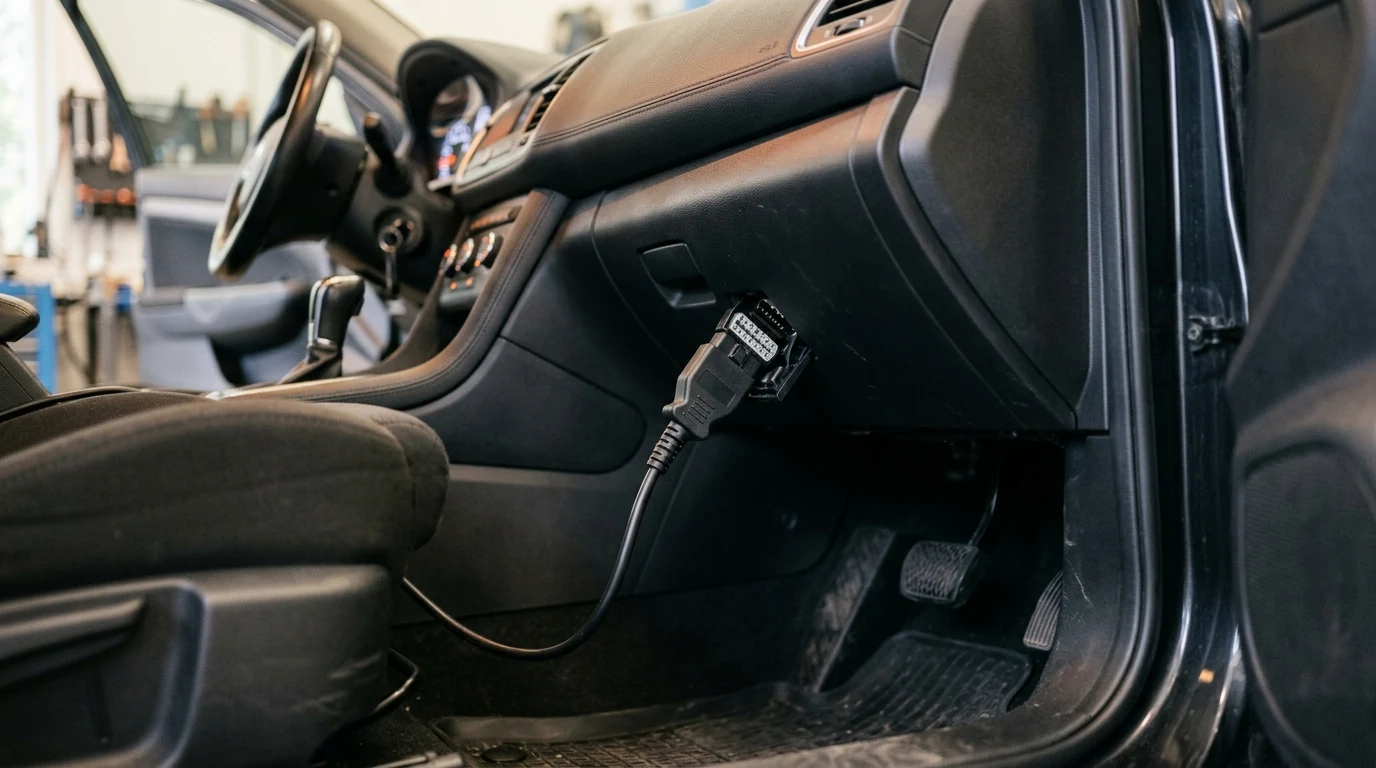
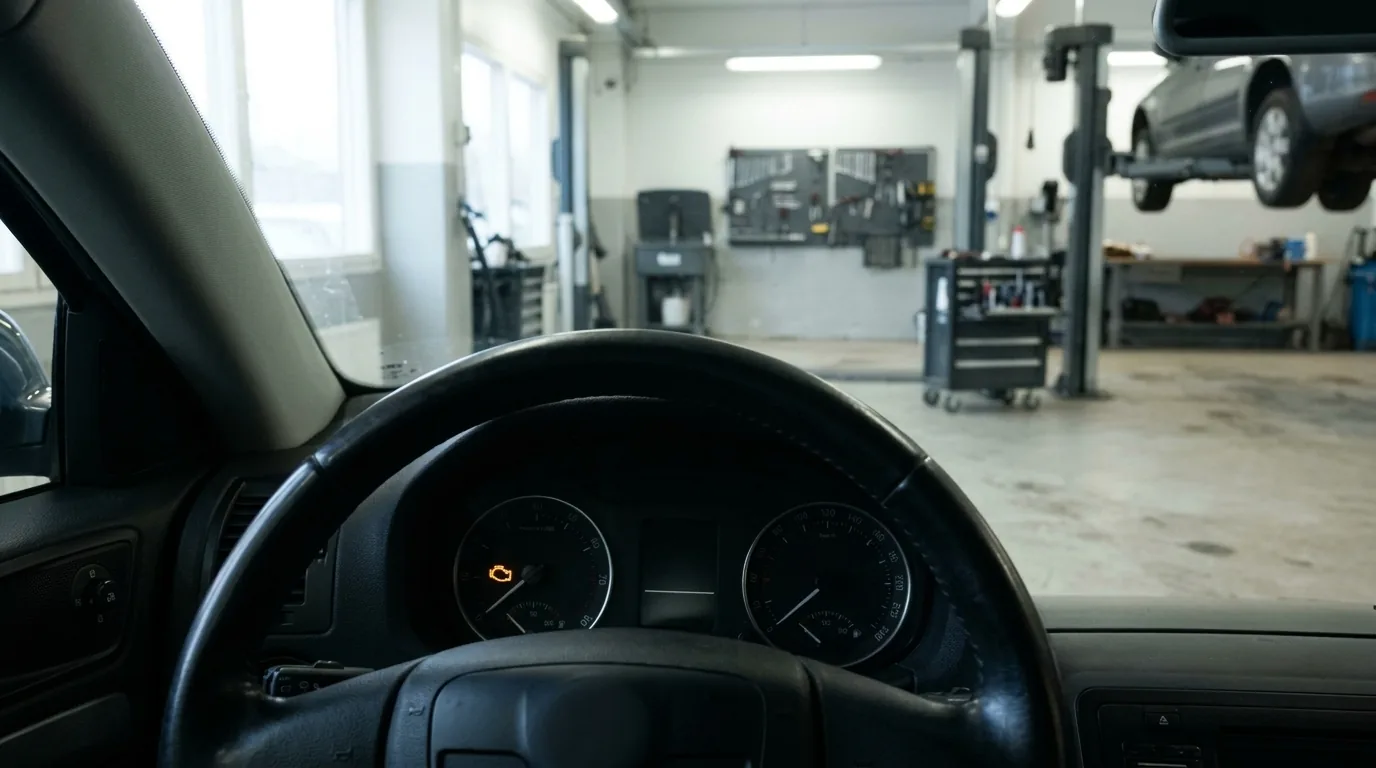
The engine warning light is a yellow or orange light in the shape of an engine. The inspection regulation calls it the MI light, and it is part of the car's on-board diagnostics system, OBD. The system monitors the parts involved in managing the engine and its emissions. When it detects a fault, it stores a fault code and turns the light on.
On most cars the light comes on briefly when you switch on the ignition and goes out when the engine starts. This is the light's self-test. If the light does not come on at all when the ignition is switched on, that is a fault too. At the periodic inspection (katsastus), an MI light that does not work fails the car.
Can you drive with the engine warning light on?
A steady light means that a fault code has been stored. You can usually drive the car a short distance, but you should not put off dealing with the fault. Renault's Finnish-language owner's manual, for example, says that if the emissions control light stays on steadily, you must contact a service centre without delay. The owner's manual for your own car has the instructions for that particular model.
Until the cause is known, avoid high revs and heavy loads, such as towing a trailer or driving uphill fully laden. Act more quickly if the car starts to behave differently at the same time. A drop in power, uneven running and a clear rise in fuel consumption show that the fault is already affecting the way the car drives. On many cars the engine management also limits the power for as long as the fault lasts. If a red warning light is on at the same time, follow the advice for that light: see the table below.
The engine warning light is different from the service reminder light. The service light tells you that a scheduled service is coming up, and it says nothing about a fault.
What does a flashing engine warning light mean?
A flashing warning light usually means that the engine is misfiring. The mixture does not ignite properly in one of the cylinders, and unburnt fuel ends up in the exhaust system. According to Renault's owner's manual, a malfunction in the ignition system, running out of fuel or a spark plug lead that has come loose can overheat the catalytic converter. That impairs the way the converter works and can break it, and the overheating can damage other parts of the car as well.
When the light flashes, do this:
- Ease off the accelerator and drive at low revs. Renault's instructions say to bring the revs down until the light stops flashing.
- Avoid accelerating, driving uphill and putting the engine under load.
- If the light stops flashing and stays on steadily, drive gently to a workshop or home and book the car in.
- If the light keeps flashing or the engine jerks badly, stop the car in a safe place. A tow costs less than a catalytic converter ruined by driving on.
- Do not park a hot car over dry grass or leaves, because the hot exhaust system can set them alight.
The most common causes
You cannot tell from the light itself what the fault is. The fault code and the measurements tell you that. At the workshop, the warning light most often turns out to have one of these causes:
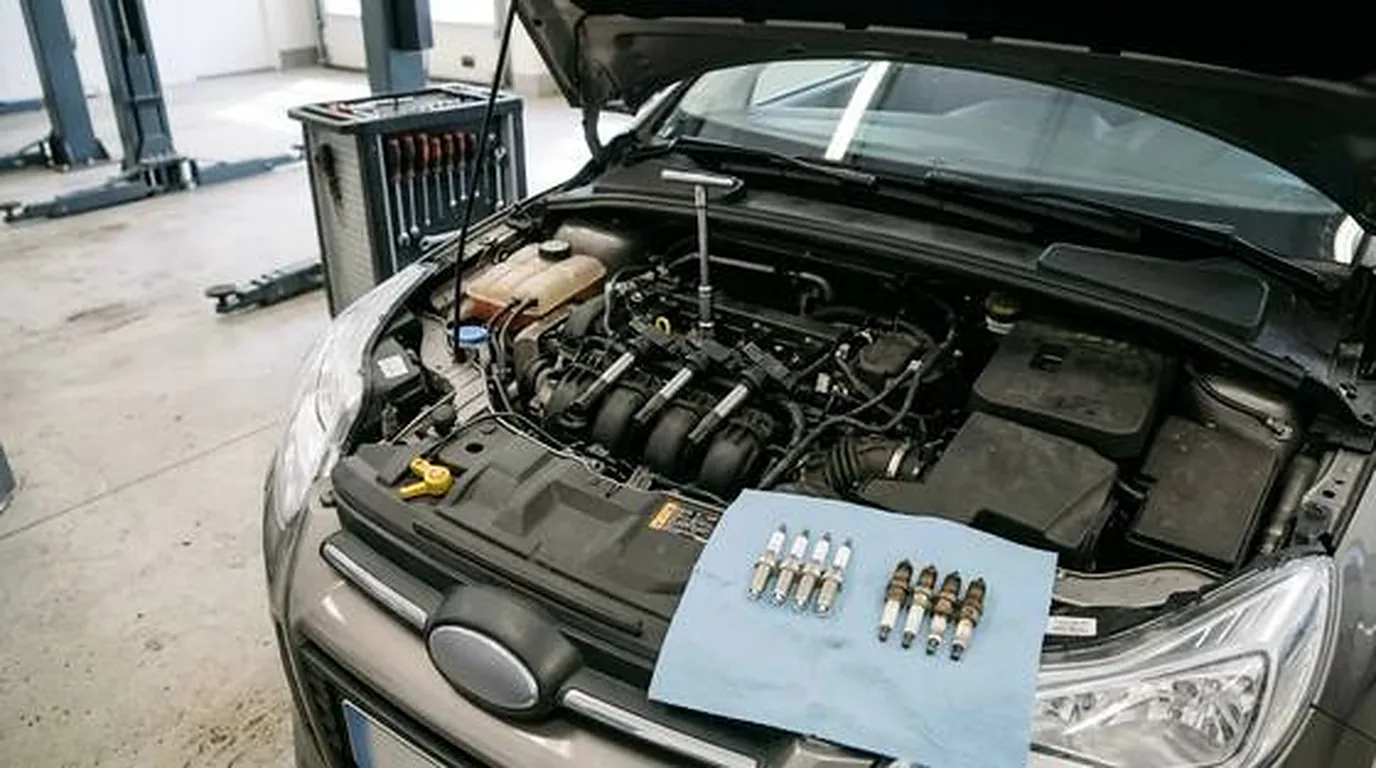
- Ignition. Worn spark plugs or a faulty ignition coil cause misfires. The light then often flashes.
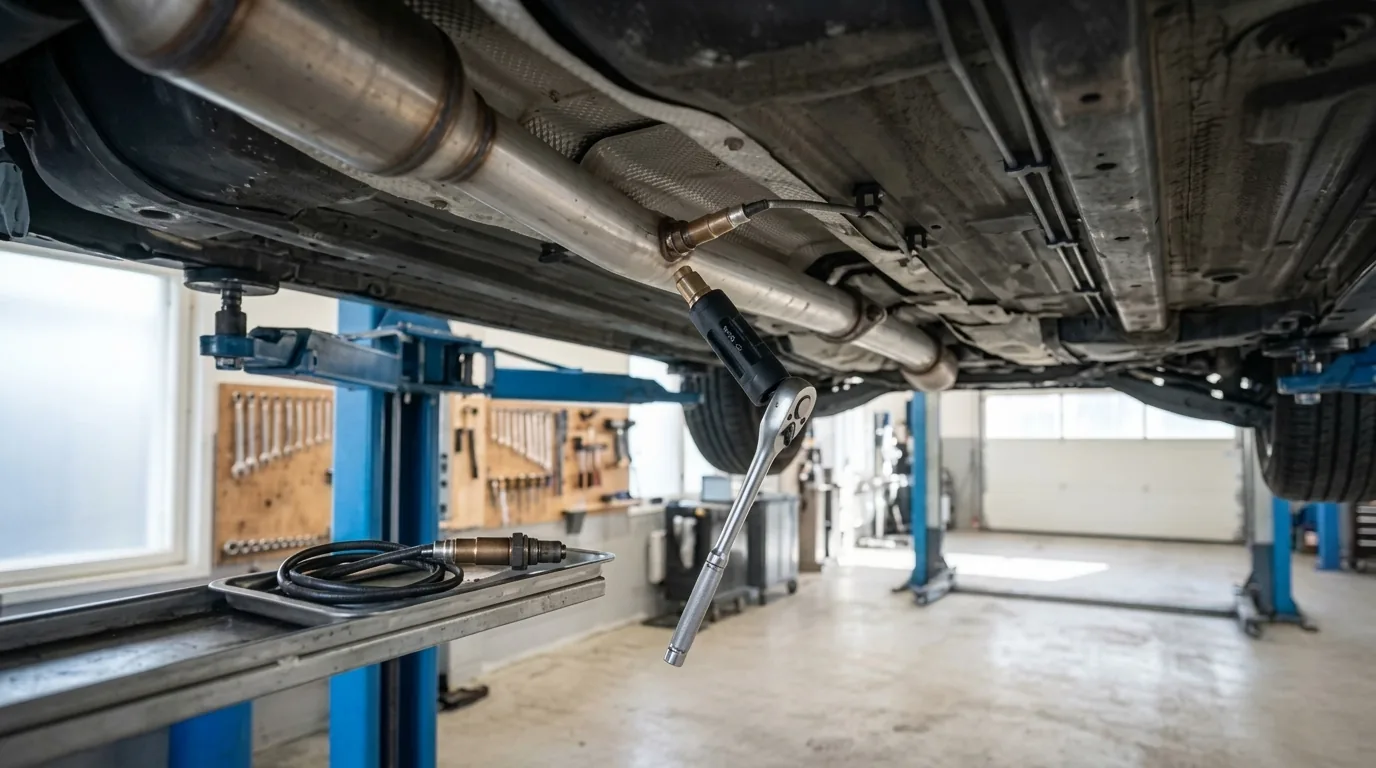
- Lambda sensor and catalytic converter. The sensor measures the oxygen content of the exhaust gas, and the control unit uses its reading to adjust the mixture. A faulty sensor or a catalytic converter that has lost efficiency turns the light on.
- Exhaust gas recirculation and the particulate filter. The EGR valve can become clogged with carbon, and a diesel's particulate filter can block up if the car is only used for short trips. On many cars the particulate filter also has a warning light of its own.
- Intake air and sensors. An intake air leak, the mass air flow sensor or a pressure sensor can give the control unit false information.
- Fuel. Faults in the injectors or the fuel pressure show up in the mixture and the ignition.
- Fuel vapour. On a petrol car, a fuel cap left loose or a leaking vapour hose can turn the light on.
- Wiring and connectors. An oxidised connector or a broken wire can make a working sensor look faulty.
Will the car pass the inspection if the warning light is on?
Usually not. These days the inspection checks emissions largely through the OBD system, and the inspection regulation issued by Traficom, the Finnish Transport and Communications Agency, sets out exactly what counts as a rejection fault. The rules depend on the fuel type and the age of the car:
| Car | What the inspection checks | What fails the car |
|---|---|---|
| Petrol car, up to 10 years since first registration | The MI light's operation, the fault memory and the readiness tests | MI light malfunction, a fault reported by the MI light, fault code P0001–P0499 or P0650, inoperative lambda control |
| Petrol car, over 10 years since first registration, first registered in 2001 or later | Exhaust gas measurement at a raised engine speed, the MI light, the fault memory and the readiness tests | The same as above, plus an idle lambda value outside the range 0.97–1.03, measured in the substitute test |
| Diesel car, first registered 1 January 2007 to 31 August 2016 | Smoke test and a visual check of the MI light's operation | MI light malfunction or a fault reported by the MI light |
| Diesel car, first registered on 1 September 2016 or later | The OBD system's fault codes | MI light malfunction, a fault reported by the MI light, or any fault code in the fault memory |
For passenger cars over 2 500 kg, the rule for cars over ten years old applies to those first registered in 2002 or later. A diesel car first registered before 2007 gets only a smoke test. If the readiness tests have not all been completed, the inspector carries out substitute tests by reading the lambda control values.
The warning light went out by itself
An intermittent fault can turn the light on and then off again after a few journeys, once the system no longer detects the fault. Even so, the fault code often stays in the fault memory. That matters at the inspection: on a petrol car under ten years old, a code P0001–P0499 or P0650 in the fault memory fails the car even if the light is not on. On a diesel car first registered in September 2016 or later, any code in the fault memory is a rejection fault. So if the light has been on, it is worth having the fault memory read before the inspection.
If the warning light is on and the inspection is coming up, take these steps in this order:
- Book the car in for diagnostics right away, not in the week of the inspection.
- Have the fault repaired once a measurement has confirmed it.
- After the repair, drive as usual for a few days, including on the open road, so that the readiness tests have time to complete.
- Only go to the inspection once the light stays off.
In 2025, 30 779 rejection faults were recorded for the OBD system on cars first registered in 2005–2021. That made it the tenth most common rejection item in the inspection statistics. Only 11 repair notices (korjauskehotus) were issued for OBD, so in practice an OBD fault always fails the car.
| Year first registered | OBD rejection faults | Faults / 100 inspections |
|---|---|---|
| 2005 | 4 964 | 4.9 |
| 2008 | 2 590 | 2.2 |
| 2011 | 1 764 | 1.4 |
| 2014 | 1 062 | 0.9 |
| 2016 | 1 504 | 1.4 |
| 2019 | 1 263 | 1.2 |
| 2021 | 678 | 0.6 |
On younger cars, OBD is the main part of the emissions check. On a petrol car under ten years old, the exhaust is not measured with an analyser: the emissions are checked through the MI light, the fault memory and the readiness tests instead. That is why cars first registered in 2016–2021 had only 16 rejection faults in all from the petrol engine emissions test, but thousands from OBD. The figures for the whole country are in the article inspection statistics 2025.
What does the fault code tell you?
Emissions-related fault codes are standardised. Under the EU emissions type-approval regulation (EU) 2017/1151, their definitions follow the ISO 15031-6 or SAE J2012 standard. That is why a generic code reader can read the basic fault codes no matter what make the car is.
The code has five characters. The first letter shows the system: P stands for the engine and drivetrain, B for the body, C for the chassis and U for communication between the control units. The second character tells you whether the code is a generic one defined by the standard (0) or the manufacturer's own (1). The remaining digits identify the subsystem and the fault. For example, codes in the P0300 series mean misfires, and P0420 means that the catalytic converter's efficiency is below the limit value. The range P0001–P0499 named in the inspection regulation covers the codes for fuel and air metering, ignition and auxiliary emission controls, and P0650 is a fault in the MI light's control circuit.
Even so, a code is not a diagnosis. It tells you which measured value was outside the expected range, but not which part is broken. P0420, for example, can be caused by the catalytic converter, a lambda sensor or a leaking exhaust pipe. Replacing the wrong part will not keep the light off for long. So the part name that the code reader shows does not by itself tell you what needs replacing on the car.
In a diagnostic check, we work in this order:
- We read the fault codes and the stored freeze frame data, which show the conditions in which the fault occurred.
- We check the readiness tests.
- We confirm the cause by measuring before anything is replaced.
- We tell you what we found and give you a price for the repair before the work starts.
- After the repair we clear the codes and road-test the car so that the readiness tests have time to complete.
Should you clear the fault codes yourself?
Reading the code yourself does no harm, and you can tell us the code over the phone. It is wise to hold off on clearing it, though, until the cause is known.
Clearing the code turns the light off for a while, but the fault does not go away. At the same time it wipes the stored freeze frame data, which would have helped to track down the fault. Clearing also resets the readiness tests, and they only complete once the car has been driven enough in a range of conditions.
So clearing the codes just before the inspection does not help. Under the inspection regulation, the inspector checks the readiness tests, and if they are incomplete, carries out substitute tests based on the lambda control values. If the fault is still there, the light comes back on.
Other yellow and red warning lights
The look of the warning lights and the instructions for them vary from make to make, so the exact advice is always in your own car's owner's manual. As a rule of thumb, a red light means stop and a yellow one means a visit to the workshop soon. The advice in the table comes from Renault's Finnish-language owner's manual.
| Warning light | What to do |
|---|---|
| Oil pressure warning light | Stop the car immediately and switch off the ignition. Check the oil level. |
| Coolant overheating warning light | Stop and let the engine idle for a couple of minutes. If the temperature does not drop, switch off the engine and let it cool down before you check the coolant. |
| Brake system fault light | Stop the car as soon as traffic allows. The brake fluid level may be too low, or there is a fault in the system. |
| Battery charging warning light | Stop the car as soon as traffic allows and contact a workshop. |
| ABS light | The brakes work as they would on a car without ABS. Take the car in for repair. |
| Glow plug light (diesel) | Comes on when the ignition is switched on and goes out once the glow plugs have heated up enough. Start the engine only then. |
The charging light is often caused by the alternator or the belt that drives it: see auxiliary belt replacement. The brake system light often comes on when the brake fluid level has dropped. The cause is worn brake pads or a leak. The job is then a brake pad replacement, or repairing the leak and a brake fluid change. If a diesel starts poorly in freezing weather, the cause may lie in the glow plugs.
Oil warning light on
If the red oil pressure warning light comes on while you are driving, stop the car as soon as traffic allows, switch off the ignition and check the oil level.
According to Renault's owner's manual, the light can come on in bends or under braking when the engine oil level is too low. Then top up the engine with the right oil: see topping up the oil. If the light goes out late or stays on when you accelerate, there is no oil pressure and the car must be stopped. If the level is correct and the light still comes on, the cause lies elsewhere. Do not drive on in that case: contact a workshop.
ABS light on: can you still drive?
A yellow ABS light means there is a fault in the anti-lock braking system. According to Renault's owner's manual, the brakes then work as they would on a car without ABS. So you can drive carefully to a workshop, but the wheels may lock under hard braking. Keep a longer gap than usual, especially on slippery roads, and take the car in for repair soon.
If the red brake system light is on together with the ABS light, follow the advice for the red light: stop the car as soon as traffic allows.
ABS fault codes are stored in the ABS control unit, not in the engine's fault memory. They are usually chassis codes starting with C, so a reader that only reads the engine codes may not show them. In a diagnostic check we read the codes from the other control units as well as the engine. Common causes are a wheel speed sensor and its wiring.
At the inspection, ABS is checked from the warning lights, with a tester or on a road test. Under Traficom's inspection regulation, the car fails if the anti-lock braking system's warning light does not work, or if the light stays on because the system does not work. The car also fails if the system is missing, a wheel speed sensor is missing or damaged, or the wiring is damaged. The same applies to the electronic stability control system (ESC): a warning light that does not work, or one that stays on, is a rejection fault.
Airbag light on: airbags and the inspection
The airbag warning light comes on when you switch on the ignition and goes out after a few seconds. According to Renault's owner's manual, if the light does not come on at all, or comes on while the engine is running, there is a fault in the airbag system, and you must contact a workshop without delay.
Airbag faults are read from the system's own control unit. Do not remove the airbags, their control unit or their wiring yourself, because an airbag can go off unexpectedly.
At the inspection, the airbags are assessed from the warning light's operation, visually and from the car's documents. Under Traficom's inspection regulation, the car fails if the warning light shows that the system is not in working order, if the warning light does not work, or if an airbag has been removed or is damaged.
When should the car go to the workshop?
Book the car in for fault code reading and diagnostics within the next few days when the warning light stays on, and right away when it flashes. We read the codes and confirm the cause by measuring. You get a written account of what is wrong and what the repair costs, and we tell you the price before the work starts.
The most common repairs include spark plug replacement, lambda sensor replacement, particulate filter cleaning and exhaust repair. If the inspection is coming up, bring the car to us in good time: after the repair, the readiness tests need some driving before they are complete. Other tips on getting ready for the inspection are in the article preparing for the inspection.