
Brake fluid change and brake bleeding
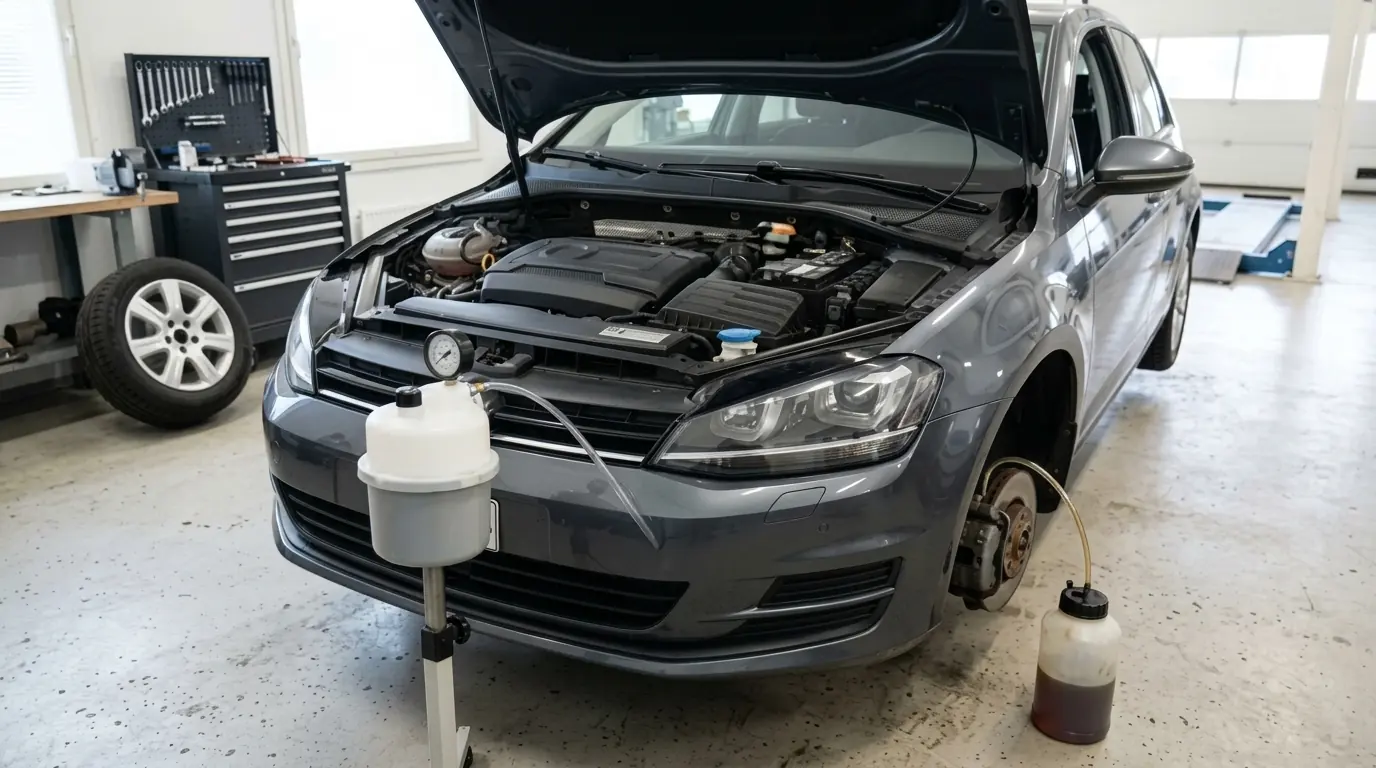
Brake fluid absorbs moisture, and most manufacturers require it to be changed every two or three years. We change the fluid and bleed the brakes on cars of every make, usually in under an hour, and tell you the price before the work starts.
estimate
approx. 65 €
- Takes about
- 45 min
- Prices include VAT
- 25,5 %
- The fluid level and the reservoir checked before the work
- Old brake fluid removed from the reservoir and the brake lines
- New brake fluid of the type the manufacturer requires, for example DOT 4, low-viscosity DOT 4 or DOT 5.1
How it works
Call us or drop in
Give us the registration. We confirm the price and agree a time in the same call.
We do the work
You get the car back at the time we agreed.
Takes about 45 min
You pay the agreed price
No surprises on the invoice. If we find anything else, we call before we touch it.
If a long summer trip with a caravan or trailer is ahead, for example to the mountain roads of Norway, have the brake fluid changed in the spring before you leave.
Call 045 262 5950What the price includes
What the price includes
- The fluid level and the reservoir checked before the work
- Old brake fluid removed from the reservoir and the brake lines
- New brake fluid of the type the manufacturer requires, for example DOT 4, low-viscosity DOT 4 or DOT 5.1
- Brakes bled one wheel at a time, in the order the manufacturer specifies
- ABS unit bled with a diagnostic tool on cars where the manufacturer requires it
- Hoses and connections checked for leaks, pedal feel checked, and a road test
- The old fluid recycled and the change recorded in the service book
What the price does not include
- Flushing the clutch hydraulics. On many manual cars the clutch draws its fluid from the same reservoir as the brakes. We tell you before the work whether the clutch circuit is worth flushing at the same time.
- Repairing a bleed screw that is seized or has snapped. If a screw will not open or snaps, the caliper often has to be replaced, and that is a different job.
- Replacing leaking brake pipes, brake hoses, calipers or the master cylinder.
- Replacing brake pads and discs. That is a job of its own, and we tell you if we notice they are worn out.
About this work in detail
What brake fluid does
When you press the brake pedal, the force reaches the wheels through the brake fluid. The master cylinder pushes fluid into the pipes and hoses, and the fluid pushes the caliper pistons, which press the pads against the disc. The system works because fluid does not compress. Air and vapour do, which is why air in the system is felt at once as a soft pedal.
Ordinary brake fluid is glycol-based and absorbs moisture. Water gets into the system slowly but constantly, through the reservoir vent, the seals and the rubber hoses, even while the car stands still. The water lowers the fluid's boiling point and corrodes the calipers and the ABS unit from the inside.
The standard requires new DOT 4 fluid to have a boiling point of at least 230 °C. The minimum for the wet boiling point, measured on fluid that has absorbed moisture, is 155 °C in the same standard. Under hard braking the calipers get hot and the heat passes into the fluid. If the fluid boils, vapour bubbles form in the calipers, and the pedal can go to the floor without warning.
Read the full guide
Symptoms worth having checked
Old fluid usually goes unnoticed in everyday driving. The boiling point falls gradually, and the difference is felt only when the brakes are needed most. Book a time if you notice any of these:
- the pedal feels soft or goes down further than it used to
- the brakes fade on a long downhill, with a trailer, or after several hard stops in a row
- the pedal has to be pumped before the brake bites
- the brake warning light comes on in the instrument cluster
- the fluid in the reservoir is dark, or the level has dropped below the MIN mark
The same symptoms can also come from a leak, the master cylinder or worn pads. So we check the brakes before we replace anything.
When the change is due
The interval is set by the car's manufacturer and written in the service book or the service schedule. For most manufacturers it is two years. For some it is three, and for some the first change comes at three years and every two years after that.
The interval is tied to time because the fluid absorbs moisture as time passes, whether the car is driven a lot or a little. If the schedule also gives a kilometre limit, the change is made at whichever comes first.
The same applies to electric cars and hybrids. In them the electric motor does much of the braking, but the brake fluid absorbs moisture just as in any other car. If the car's service history is unknown, for example on a used car you have just bought, the fluid is worth changing straight away. The change can be done with a scheduled service when the two fall due close together.
How the change is done
- We check which fluid the manufacturer requires. The type is usually printed on the reservoir cap and in the service instructions. Many cars with electronic stability control require a low-viscosity DOT 4, which stays more fluid than ordinary fluid in freezing weather.
- We look at the fluid level and colour, and at the reservoir, the hoses and the connections.
- We draw the old fluid out of the reservoir and fill it with new.
- We bleed the brakes one wheel at a time, in the order the manufacturer specifies. Usually the work starts at the wheel furthest from the master cylinder. Fluid is run out of the bleed screw until new, clear fluid with no bubbles comes through.
- Where the manufacturer requires it, we bleed the ABS unit with a diagnostic tool. This is the case, for example, on many hybrids and on cars with an electro-hydraulic brake system.
- Finally we set the fluid level, check the connections and the pedal feel, and road-test the car.
Bleeding the brakes and changing the fluid are in practice the same job. Bleeding removes air from the system; a change replaces all the old fluid with new. In both, fluid is run out through the bleed screws at the wheels, and the difference is mostly how much fluid is used. Bleeding is needed whenever the system has been opened, for example after a hose or a caliper has been replaced.
How long it takes
The work itself usually takes under an hour. Bleeding with a diagnostic tool and bleed screws seized by rust make it longer. We tell you the expected time when we agree the booking.
What affects the price
Unlike an oil change, the engine hardly affects the price of a brake fluid change. The price varies with these:
- The fluid. Low-viscosity DOT 4 and DOT 5.1 cost more than ordinary DOT 4, and a large system takes more fluid.
- The bleeding method. Some systems are bled under the control of a diagnostic tool, and that takes longer.
- The clutch. If the clutch draws its fluid from the same reservoir, the clutch circuit is often worth flushing at the same time.
- The bleed screws. On a car driven on salted roads a screw can be rusted solid. If it snaps, the caliper has to be repaired or replaced before the job can be finished.
We check the car and tell you the price before the work starts. If something turns up during the work that changes the price, we call you before we go on.
Brake fluid and the inspection
In Traficom's inspection statistics for 2025, 217 030 rejecting faults were recorded for brake systems. That is 27.7 % of all rejecting faults, and only axles, wheels and suspension had more. The service brake alone accounted for 81 704 rejecting faults and 18 128 repair notices.
The condition of the brake fluid is not an item of its own in the statistics. At the inspection the braking force is measured on a brake dynamometer, the rollers, and the measurement lasts only a moment. The brakes do not get hot enough in it for weak, old fluid to show. So a passed brake test does not tell you whether the fluid will hold up under hard braking on a long downhill.
If the car fails because of a leaking hose or a rusted brake pipe, the system has to be bled after the repair in any case. The fluid change is then worth doing at the same time. Read more about inspection repairs.
What you can check yourself
- The fluid level. The reservoir is under the bonnet, usually on the driver's side near the windscreen. The level should be between the MIN and MAX marks.
- Changes in the level. The level drops slightly as the brake pads wear. A quick drop points to a leak, and adding fluid does not fix it.
- The last change. The service book or the service history shows when the fluid was last changed.
- The colour. New fluid is clear or pale yellow and darkens with age. The colour is only a hint, though, because water content cannot be seen.
Top up the reservoir only with the brake fluid the manufacturer requires. The wrong fluid can ruin the system's seals. Brake fluid also eats into paintwork, so wipe up any spill at once.
When not to drive the car
Do not set off if any of these is true:
- the pedal goes to the floor, or the brake only bites after pumping
- the red brake warning light is on although the parking brake is released
- the inside of a rim is wet with fluid, or the level in the reservoir drops quickly
In that case the car has to come to the workshop on a tow truck. Call us and we will agree a time.
If the brakes fade on a long downhill, stop somewhere safe and let them cool. The pedal usually comes back once the vapour condenses into fluid again, but the fluid must still be changed as soon as possible. On long downhills a lower gear helps, because the engine then does part of the braking and the brakes heat up less.
If something else needs fixing
We do not start work you do not know about. If the car needs something else fixed, we call and tell you what the extra work costs and what happens if it is left undone. You decide.
The final price may exceed the estimate by at most 15 per cent, additional work included.
We work to the motor vehicle service and repair terms approved by the consumer advisory board of the Finnish motor trade.
Related work

Front brake pads and discs
Front axle pads and discs, labour and parts, fixed price. Passenger cars with standard brakes; large or sport brakes priced on request.
299 €
Scheduled service
The scope varies from car to car, so we tell you the price before the work starts.
approx. 189 €
Inspection repairs
We repair the faults on the rejection list, item by item. The price comes from the list, before any work starts.
Ask the price
Shall we agree a time?
Leave a booking request online or call. We confirm the time and tell you the price before any work starts.
estimate
approx. 65 €
- Address
- Lampputie 12 C 67
00750 HelsinkiShow on the map - Opening hours
- Mon–Fri8.00–18.00Sat9.00–15.00Sunclosed
- Phone
- 045 262 5950
- huolto@caron.fi