
Diesel particulate filter (DPF) cleaning or replacement
We clean or replace a diesel car's particulate filter, depending on its condition, when it no longer clears itself as you drive. We first find out why the filter clogged and whether cleaning is enough, and we tell you the price before the work starts.
typical price range
260–
We tell you the exact price for your car before the work starts.
- Prices include VAT
- 25,5 %
- Fault codes and the filter's measured data read: estimated soot load, pressure difference and regeneration history
- Differential pressure sensor, temperature sensors and sensor hoses checked
- The cause of the clogging traced: EGR valve, injection, turbocharger oil leaks and engine warm-up
How it works
Call us or drop in
Give us the registration. We confirm the price and agree a time in the same call.
We do the work
You get the car back at the time we agreed.
You pay the agreed price
No surprises on the invoice. If we find anything else, we call before we touch it.
If the particulate filter light stays on after the open-road drive the owner's manual describes, bring the car in for a check soon. The earlier the filter is checked, the more likely it is to come clean without removing it.
Call 045 262 5950What the price includes
What the price includes
- Fault codes and the filter's measured data read: estimated soot load, pressure difference and regeneration history
- Differential pressure sensor, temperature sensors and sensor hoses checked
- The cause of the clogging traced: EGR valve, injection, turbocharger oil leaks and engine warm-up
- Service regeneration with a diagnostic tool, when the filter holds mostly soot
- The filter removed, cleaned of soot and ash and refitted with new gaskets, when regeneration is not enough
- The control unit's learned values reset as the manufacturer specifies
- A new particulate filter, if the old one is cracked, melted or so full of ash that it no longer cleans. We tell you the price of the replacement before we order the part.
- Engine oil level checked, and a road test during which we watch the pressure difference
What the price does not include
- Repairing the fault that caused the clogging, such as replacing an EGR valve, an injector or a sensor. Those are priced separately before anything is replaced.
- An engine oil change, if fuel has mixed into the oil.
- AdBlue system faults. That is a different system and a different job.
- Removing the particulate filter or bypassing it in software. We do not do it: without a working filter the car no longer meets the emission requirements of its type approval.
About this work in detail
What the particulate filter does
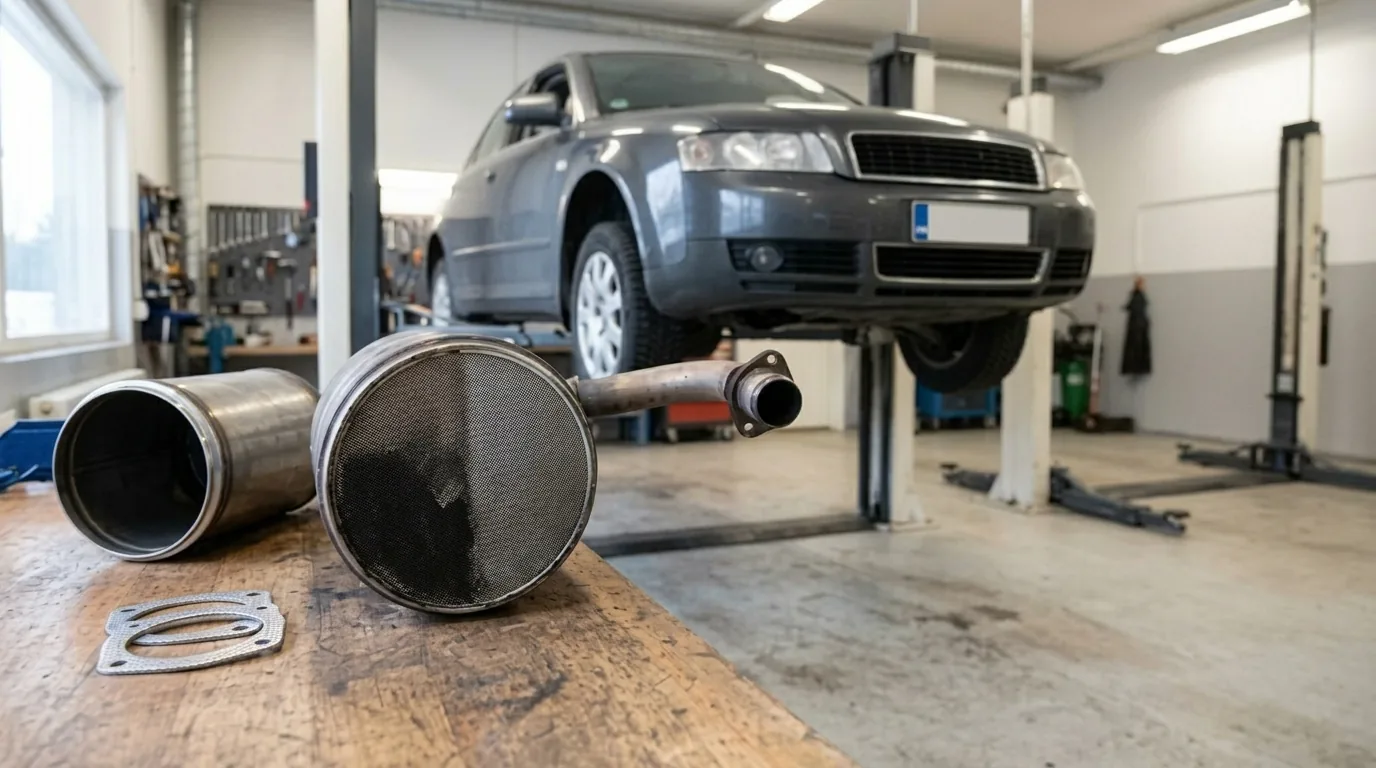
The particulate filter separates the soot from a diesel engine's exhaust. It is a ceramic honeycomb at the front of the exhaust system, often in the same housing as the catalytic converter. Its channels are plugged alternately at opposite ends, so the exhaust has to pass through the porous walls. The soot stays in the walls.
The filter empties itself by burning the soot it has collected. This is called regeneration. On the open road the exhaust is hot enough for some of the soot to burn off as you drive. When enough soot has built up, the engine management raises the exhaust temperature with extra injection and burns the filter clean. Some cars, for example many Peugeot and Citroën diesels, dose an additive into the fuel from a separate tank, which lets the soot burn at a lower temperature.
Almost every diesel passenger car first registered from 2011 onwards has a particulate filter, because the Euro 5 emission standard in practice required one. Many older diesels have one too.
Read the full guide
Soot burns, ash does not
Regeneration removes soot but not ash. Ash comes from the additives in engine oil, as a small amount of oil burns in the cylinders. In cars with an additive system, the fuel additive leaves ash as well. Ash cannot be burned off, so it builds up in the filter over the whole life of the car. Once a car has covered a lot of kilometres, the filter can clog with ash even if regeneration works perfectly. Then the only remedy is removing and cleaning the filter, or a new filter.
That is why a diesel with a particulate filter runs on a low-ash engine oil. The right grade is given in the service schedule, and it is usually an ACEA C class oil. The wrong oil fills the filter with ash faster.
How you notice a clogged filter
The most common sign is the particulate filter warning light on the dashboard. If the filter cannot clear itself, the engine warning light often comes on too, and the engine management may limit power to protect the engine. Other signs:
- the idle speed is higher than usual, or the cooling fan keeps running after the engine is switched off, which means a regeneration was running
- fuel consumption rises for no obvious reason
- an acrid smell around the car after stopping
- the oil level rises between services
A single interrupted regeneration is not a fault. Repeated interruptions show that the filter no longer has time to clear itself.
When cleaning is due
On many cars the particulate filter has no fixed cleaning or replacement interval: the control unit keeps track of how full the filter is. The filter fills according to how the car is driven, the engine's condition and the oil, and the difference between cars is large. A car driven mostly on short trips in town rarely gets to finish a regeneration. In winter the engine warms up slowly, and on a short trip a regeneration may not even start. A car driven on the open road every day, on the other hand, can go a long time without a cleaning.
If the manufacturer has set an interval for the filter, it is in the service schedule. In cars with an additive system, refilling the additive tank is part of the service schedule as well, and its interval varies by model.
Cleaning is due when the measured data show the filter is full and a service regeneration started with a diagnostic tool no longer brings the pressure difference down. That can only be seen by measuring, not from the warning light.
What happens at the workshop
- We read the fault codes and the filter's measured data: the estimated soot load, the pressure difference and the regeneration history.
- We check the sensors and hoses. A faulty differential pressure sensor can look like a clogged filter to the control unit even when the filter is fine, and a cracked or blocked sensor hose gives a false reading.
- We look for the cause. A sticking EGR valve, a leaking injector, a turbocharger oil leak or a thermostat stuck open can make more soot than the filter can burn, or stop regeneration altogether.
- If the filter holds mostly soot and not too much of it, we run a service regeneration with a diagnostic tool. The engine management then burns the filter clean under control, and the filter does not need to come off.
- If there is too much ash, too much soot for a safe regeneration, or a service regeneration does not bring the pressure difference down, the filter is removed, cleaned and refitted with new gaskets.
- We reset the control unit's learned values where the manufacturer requires it, and road test the car. On the road test we make sure the pressure difference stays normal and no fault codes return.
If a fault is behind the clogging, it has to be repaired. Otherwise the cleaned filter is soon full again.
How long it takes
Removing and refitting the filter takes anything from a few hours to a full working day, depending on the car. On some cars the filter can be reached from below, on others it sits behind the engine, and pipes, brackets and heat shields have to come off first. The cleaning takes time on top of that, so the car may stay at the workshop until the next day. If a service regeneration clears the filter, it does not have to come off and the car is usually ready the same day. We tell you the schedule once we have seen the car.
What affects the price
- Where the filter sits. That decides how much of the car has to come apart.
- Seized bolts. Exhaust bolts are often seized after years of heat and road salt, and removing a broken bolt adds work.
- The cause of the clogging. A faulty EGR valve, injector or sensor is a repair of its own.
- The filter's condition. A cracked or melted core cannot be cleaned. Then a new filter is needed, and its price depends on whether you choose an original part or an aftermarket one.
- The additive system. If the car has an additive tank, the additive level is checked and the tank refilled if needed at the same time.
We check the car and tell you the price before the work starts. If the check turns up anything else, we tell you that first as well, and you decide whether it is done.
The particulate filter and the inspection
A particulate filter fault can show up at the inspection in two ways. A cracked filter lets soot through and raises the exhaust measurement result, while a clogged one shows up as a fault code and a lit warning light. In Traficom's inspection statistics for 2025, the diesel exhaust measurement accounted for 5 778 rejecting faults and the on-board diagnostics (OBD) for 30 779, all fuel types included.
Simply clearing the fault code before the inspection fixes nothing. The code comes back the next time the filter fails to clear. If the inspection is close and the particulate filter light is on, bring the car to us first.
What you can check yourself
- The oil level. Read the dipstick on level ground after the engine has been off for a while. If the car has no dipstick, the level is usually shown in a menu on the instrument cluster or the centre screen. If the level rises between services, fuel from interrupted regenerations has most likely mixed into the oil.
- The owner's manual. When the particulate filter light comes on, see what the manufacturer advises. Many manuals advise driving at a steady speed on the open road for about a quarter of an hour so the filter can clear. The speed and the time vary by make.
- Interruptions. If you notice a regeneration is running, do not switch the engine off straight away: drive on for a while so the regeneration can finish.
- The oil grade. Make sure the service uses the oil the service schedule specifies.
When not to drive
Stop and call if the engine warning light flashes, the car drops into limp mode mid-journey and loses power, the exhaust pours smoke, or a burning smell comes into the car while you drive. A clogged filter raises the pressure on the exhaust side, and regenerating a very full filter can heat the core until it cracks or melts. At that point cleaning is no longer enough.
If the oil level is clearly above the maximum mark, do not drive until the oil has been changed and the cause found. Oil diluted with fuel does not lubricate properly.
If something else needs fixing
We do not start work you do not know about. If the car needs something else fixed, we call and tell you what the extra work costs and what happens if it is left undone. You decide.
Once we have seen the car, we tell you the price and whether it is a fixed price, a maximum price or an estimate. The work starts only once you have accepted the price.
We work to the motor vehicle service and repair terms approved by the consumer advisory board of the Finnish motor trade.
Related work

Scheduled service
The scope varies from car to car, so we tell you the price before the work starts.
approx. 189 €
Diagnostics
The first hour. We credit it against the repair if you have the work done here.
69 €
Inspection repairs
We repair the faults on the rejection list, item by item. The price comes from the list, before any work starts.
Ask the price
Shall we agree a time?
Leave a booking request online or call. We confirm the time and tell you the price before any work starts.
typical price range
260–
We tell you the exact price for your car before the work starts.
- Address
- Lampputie 12 C 67
00750 HelsinkiShow on the map - Opening hours
- Mon–Fri8.00–18.00Sat9.00–15.00Sunclosed
- Phone
- 045 262 5950
- huolto@caron.fi