
Auxiliary belt (alternator belt) replacement
The auxiliary belt drives the alternator and the engine's other ancillaries, and a worn belt usually starts by squealing. We replace it on cars of every make, check the tensioner and the pulleys at the same time, and tell you the price before the work starts.
typical price range
85–
We tell you the exact price for your car before the work starts.
- Prices include VAT
- 25,5 %
- A new auxiliary belt of the size and type the car requires
- Old belt removed and the new one fitted, with the wheel and the inner wheel-arch liner removed where needed
- Tensioner, idler pulleys and drive pulleys checked: bearing noise and play, and the belt's line
How it works
Call us or drop in
Give us the registration. We confirm the price and agree a time in the same call.
We do the work
You get the car back at the time we agreed.
You pay the agreed price
No surprises on the invoice. If we find anything else, we call before we touch it.
If the belt squeals, book a time before it breaks. A broken belt stops the alternator and, on many cars, the water pump too, and the car often has to be towed to the workshop.
Call 045 262 5950What the price includes
What the price includes
- A new auxiliary belt of the size and type the car requires
- Old belt removed and the new one fitted, with the wheel and the inner wheel-arch liner removed where needed
- Tensioner, idler pulleys and drive pulleys checked: bearing noise and play, and the belt's line
- Visual check of the alternator's overrunning pulley and the crankshaft pulley
- An elastic belt fitted with the tool made for it, where the car has an elastic belt
- Road test and a check under load: air conditioning on and the steering turned
What the price does not include
- Tensioner and idler pulleys, if they are worn. We call you and tell you the price before we replace them.
- The alternator's overrunning pulley and the crankshaft pulley, if their bearing or rubber is worn.
- Replacing the alternator, the water pump, the power-steering pump or the air-conditioning compressor, if the fault is in them.
- Repairing an oil or coolant leak. If the leak has soiled the belt, the leak has to be fixed before a new belt goes on.
- Timing belt replacement. The timing belt is a second belt under its own cover, and a separate job.
About this work in detail
What the auxiliary belt does
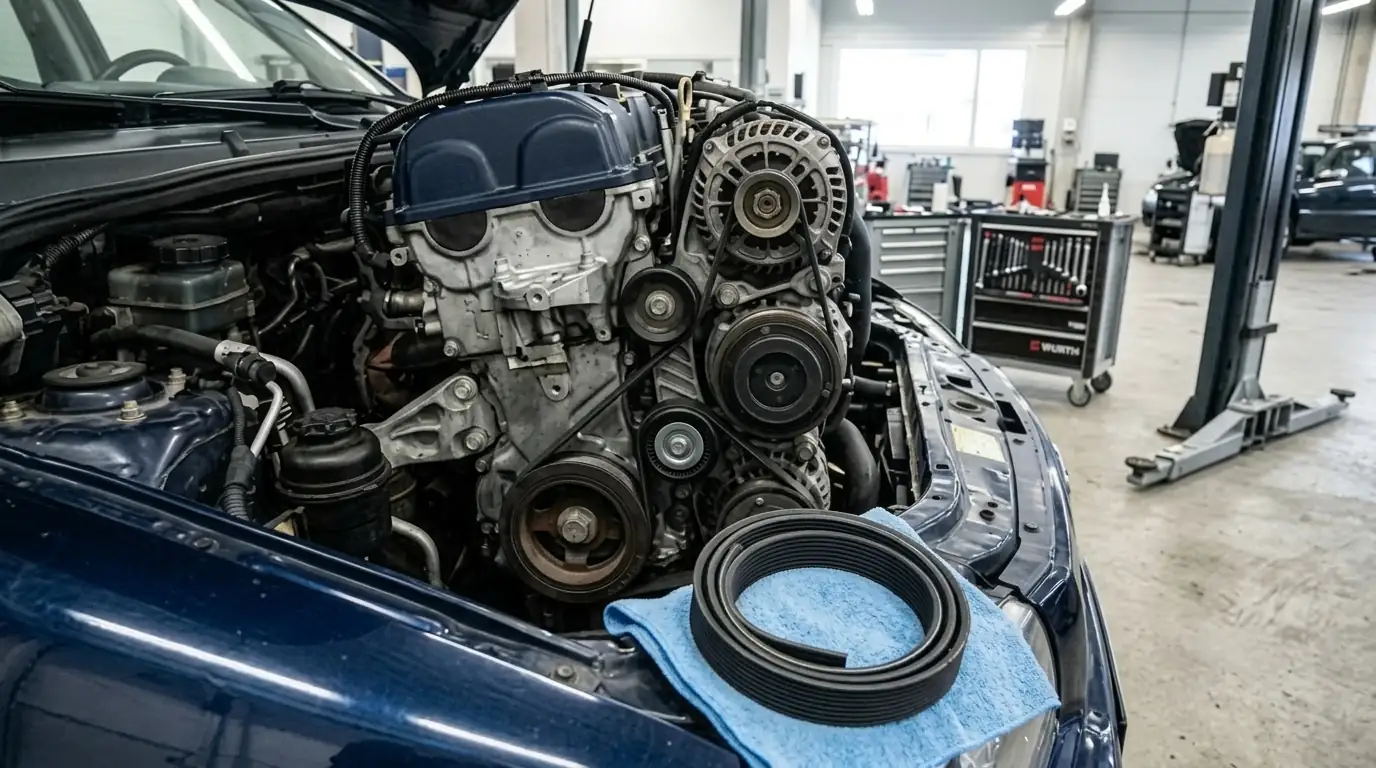
The auxiliary belt is a flat rubber belt running at the end of the engine, with lengthwise ribs on its inner face. The crankshaft pulley drives it, and the belt in turn drives the alternator. Depending on the engine, the same belt also drives the water pump, the air-conditioning compressor and the pump of a hydraulic power steering. It is also called the poly-V belt, the multi-rib belt, the alternator belt and the drive belt.
On most cars a spring-loaded tensioner keeps the belt tight, and idler pulleys keep it on its path. Some cars have two separate belts. An elastic, or stretch-fit, belt keeps itself tight by its own stretch and has no tensioner at all. The belt's size is marked on its back, for example 6PK1060. The marking means six ribs and a length of 1 060 millimetres.
The auxiliary belt is not the same thing as the timing belt. The timing belt runs under its own cover and keeps the camshafts in step with the crankshaft. Its replacement has a page of its own: timing belt replacement.
Read the full guide
How to recognise a worn belt
The most common symptom is a squeal. A worn or slack belt slips on its pulley and screeches. The noise is usually clearest
- on a cold start and during the first few seconds
- in damp weather and in frost
- when the air conditioning is switched on or the steering wheel is turned at a standstill
- when the clutch is let up and the engine revs change quickly.
Other signs of wear:
- The ribs have cracks across them, pieces are missing from the ribs, or the edge is frayed.
- The belt's surface is glazed and hard. A glazed belt slips even if it looks intact.
- The belt wobbles or jumps sideways with the engine running.
- At idle there is a chirping, rumbling or creaking noise. The noise often comes from a tensioner or pulley bearing rather than from the belt itself.
- The charging warning light comes on, or the battery runs down faster than usual.
Newer belts often wear without cracking. The rubber wears from the sides of the ribs, and the belt starts to slip even though its surface looks clean. The squeal can just as well come from the tensioner or an idler as from the belt, so we do not replace a belt on the strength of a noise alone, but first check where the noise comes from.
When the belt is replaced
The interval is set by the car's manufacturer. In many service schedules the belt is checked at the scheduled service and replaced according to its condition, and some manufacturers give it a kilometre limit. The intervals vary a great deal from make to make and engine to engine. If the manufacturer's interval is not known, the belt maker's advice is to replace the belt every 120 000 km.
Rubber ages even while the car stands still. We recommend replacing a belt more than ten years old even if it has covered few kilometres. You can have the belt's condition checked at the scheduled service.
In a timing belt replacement the auxiliary belt usually has to come off to reach the timing belt. It is then worth replacing at the same time, because the work is already done and the extra cost is mostly the new belt.
How the work is done
- We listen with the engine running to find where the noise comes from, and check the belt, the tensioner, the idlers and the pulleys. We also look for oil or coolant that has run onto the belt. We tell you what we found and what the work costs.
- We check the belt's routing in the manufacturer's instructions. On some cars the routing is drawn on a sticker under the bonnet.
- We release the tensioner and remove the old belt. If the belt can only be reached through the wheel arch, we remove the wheel and the inner wheel-arch liner. An old elastic belt is cut off.
- We turn the tensioner and the idlers by hand and check the bearings for noise and play, and the pulleys for alignment. If any part needs replacing, we ask you first.
- We fit the new belt and make sure it sits correctly in the grooves of every pulley. An elastic belt is fitted with the tool made for it, and it must not be replaced by an ordinary belt.
- We start the engine, switch on the air conditioning and turn the steering so that the belt is under load. Finally we road test the car.
How long it takes
On most cars the replacement itself takes less than an hour. A cramped engine bay, work from below and an elastic belt make it longer. If the tensioner or idlers are replaced at the same time, there is more work. We tell you the expected duration when we agree the time.
What the price depends on
Replacing an auxiliary belt is a short job, but the price varies from car to car. It depends on:
- Where the belt sits. When the belt is in view under the bonnet, the replacement is quick. When it can only be reached through the wheel arch or from under the car, there is more work.
- The type of belt. An elastic belt is fitted with a special tool. On some start-stop cars and many mild hybrids the alternator starts the engine through the belt. There the belt and the tensioner are heavier-duty than usual and cost more.
- The number of belts. If the car has a separate belt, for example for the air-conditioning compressor, replacing it is a job of its own.
- Tensioner and pulleys. If the tensioner, an idler, the alternator's overrunning pulley or the crankshaft pulley is worn, the total rises considerably.
- Leaks. A belt soiled by oil or coolant wears quickly, so the leak has to be fixed before the new belt is fitted.
- The parts. Original and aftermarket parts differ in price. We tell you which parts we use.
So we check the car and tell you the price before the work starts. If we find something during the work that changes the price, we call you before we carry on.
The auxiliary belt and the inspection
The belt is not an inspection item of its own, but its failure can show in the steering. Under Traficom's inspection criteria, power steering that does not work is grounds for rejection, and the inspector can impose a driving ban. If the belt drives a hydraulic power-steering pump, a broken belt stops the power steering too. On newer cars the power steering is usually electric, and the belt does not drive it.
A diesel car first registered before 1.9.2016 gets a smoke test at the inspection. In it the engine is revved from idle to the limiter several times. Under the regulation, the inspector checks before the test that the engine's servicing and belt replacements have been done properly. Hard revving strains the belts, so a worn auxiliary belt is worth replacing before the inspection, and it is worth checking at the same time that the timing belt is not overdue.
What you can check yourself
- Look at the belt with the engine off. Look for cracks, pieces missing from the ribs, frayed edges and a glazed surface. A torch helps. The radiator fan can start even with the engine off, so keep your hands away from it.
- Listen to a cold start. Note whether the squeal comes only when cold, on a damp day or with the air conditioning on. Record the squeal on your phone. The recording helps the diagnosis.
- Watch the tensioner with the engine running. The tensioner arm may move a little. If it jumps clearly, the tensioner has probably weakened. Keep hands, sleeves and scarves well away from the running belt.
- Do not spray anything on the belt. Belt sprays and lubricants quieten the squeal for a while but hide the fault, and oil softens the rubber.
- Watch the instruments. The charging warning light and a rising engine temperature can mean a broken or slipping belt.
When not to drive the car
A car with a squealing belt can usually be driven to the workshop, but book a time soon. Stop the car in a safe place and switch off the engine if
- there is a slap from under the bonnet and the charging warning light comes on
- the engine temperature gauge rises or the coolant warning light comes on
- the steering suddenly becomes heavy
- there is loud knocking or flapping from under the bonnet.
A broken belt stops the alternator, and the car then runs on the battery alone until the battery is flat. If the water pump is on the same belt, the engine overheats quickly, and driving on can warp the cylinder head or blow the head gasket. On some engines a broken belt can be drawn into the timing belt cover and damage the timing belt. In these situations it is safest to have the car towed to the workshop. Call us and we will agree a time.
If something else needs fixing
We do not start work you do not know about. If the car needs something else fixed, we call and tell you what the extra work costs and what happens if it is left undone. You decide.
Once we have seen the car, we tell you the price and whether it is a fixed price, a maximum price or an estimate. The work starts only once you have accepted the price.
We work to the motor vehicle service and repair terms approved by the consumer advisory board of the Finnish motor trade.
Related work

Timing belt replacement
The price depends on the engine. We check the car and tell you the price before the work starts.
580–890 € 
Scheduled service
The scope varies from car to car, so we tell you the price before the work starts.
approx. 189 €
Diagnostics
The first hour. We credit it against the repair if you have the work done here.
69 €
Shall we agree a time?
Leave a booking request online or call. We confirm the time and tell you the price before any work starts.
typical price range
85–
We tell you the exact price for your car before the work starts.
- Address
- Lampputie 12 C 67
00750 HelsinkiShow on the map - Opening hours
- Mon–Fri8.00–18.00Sat9.00–15.00Sunclosed
- Phone
- 045 262 5950
- huolto@caron.fi