Published
How often should the engine oil be changed?
The car's manufacturer decides the oil change interval. The interval is set out in the service schedule, which you will find in the owner's manual or the service book. There are two limits, kilometres and time. Kia's owner's manual states the rule plainly: when both a distance and a time are given, the service interval is set by whichever is reached first.
The time limit is needed because oil ages even when the car covers few kilometres. If you drive 8 000 kilometres a year, you reach the 12-month limit before 15 000 kilometres. If you drive 30 000 kilometres a year, a 15 000-kilometre interval means about two oil changes a year.
A car's service interval and its oil change interval are not always the same thing. In Kia's Finnish table of service intervals, many petrol models have their scheduled service every two years or 30 000 kilometres. Between services, an oil change or annual service is done every year or 15 000 kilometres. Check both rows in the service schedule.
The table gives examples from manufacturers' Finnish-language instructions:
| Make and situation | Oil change interval | Source |
|---|---|---|
| Kia, petrol engine | 15 000 km or 12 months | owner's manual |
| Kia, petrol engine, severe conditions | 7 500 km or 6 months | owner's manual |
| Kia, diesel engine, severe conditions | 10 000 km or 12 months | owner's manual |
| SEAT | 15 000 km or 12 months | frequently asked questions |
| Škoda, plug-in hybrid, fixed interval | 15 000 km or 1 year | frequently asked questions |
| Škoda, plug-in hybrid, flexible interval | 30 000 km or 2 years | frequently asked questions |
| Nissan X-Trail e-POWER | the car calculates the interval, at most 15 000 km or 1 year | owner's manual |
The interval depends on the model and the engine, so check your own car's interval in its service schedule.
Fixed and flexible service intervals
Some cars have two alternative service schedules. With a fixed interval, the oil is always changed at the same intervals. With a flexible, or longlife, interval, the car works out the time of the change itself, and the interval can be twice as long. The Škoda rows in the table show the difference.
A flexible interval does not mean the change can be done whenever you like. According to Nissan's manual, the distance left until the oil change is calculated from the driving conditions, and the interval cannot be adjusted by hand. A reminder appears on the display as the interval nears its end. Even the calculation has an upper limit: the X-Trail e-POWER's manual says never to go beyond a year or 15 000 kilometres. When zero kilometres remain, Nissan advises having the car serviced within two weeks or 800 kilometres.
A flexible interval works only with the right oil. According to Škoda, longlife service intervals require a longlife oil meeting the standard VW 504 00 / 507 00 or VW 508 00 / 509 00. For petrol engines on a fixed interval, it recommends a VW 502 00 oil. Kia makes the same point the other way round: if the engine does not have the recommended oil in it, the oil is changed on the severe-conditions schedule. The article on engine oil viscosity explains the standards and how to read them on the bottle.
According to Moottori magazine, a longlife interval is best suited to a car that covers long distances on the open road. City driving and short trips can wear the oil out faster than the official intervals take into account. The interval in the service schedule is an upper limit, not a target, and you may change the oil sooner.
Short trips and freezing weather shorten the interval
The basic interval in the service schedule is calculated for normal driving. For severe conditions, many manufacturers give a separate, shorter interval. Kia's Finnish-language manual lists these, among others, as severe conditions:
- repeated short trips: under 8 kilometres in normal weather or under 16 kilometres in freezing weather
- a lot of idling, or long distances at low speed
- very cold weather, and roads that have been salted
- heavy traffic and frequent stop-start driving
- towing a trailer and driving with a roof load
- taxi or other professional driving
- an engine oil other than the recommended one
In these conditions, according to the manual, a petrol engine's oil and filter are changed every 7 500 kilometres or six months. On a diesel, the interval is 10 000 kilometres or a year. In a Finnish winter, sub-zero temperatures are part of everyday life, and below zero, a drive of under 16 kilometres already counts as a short trip.
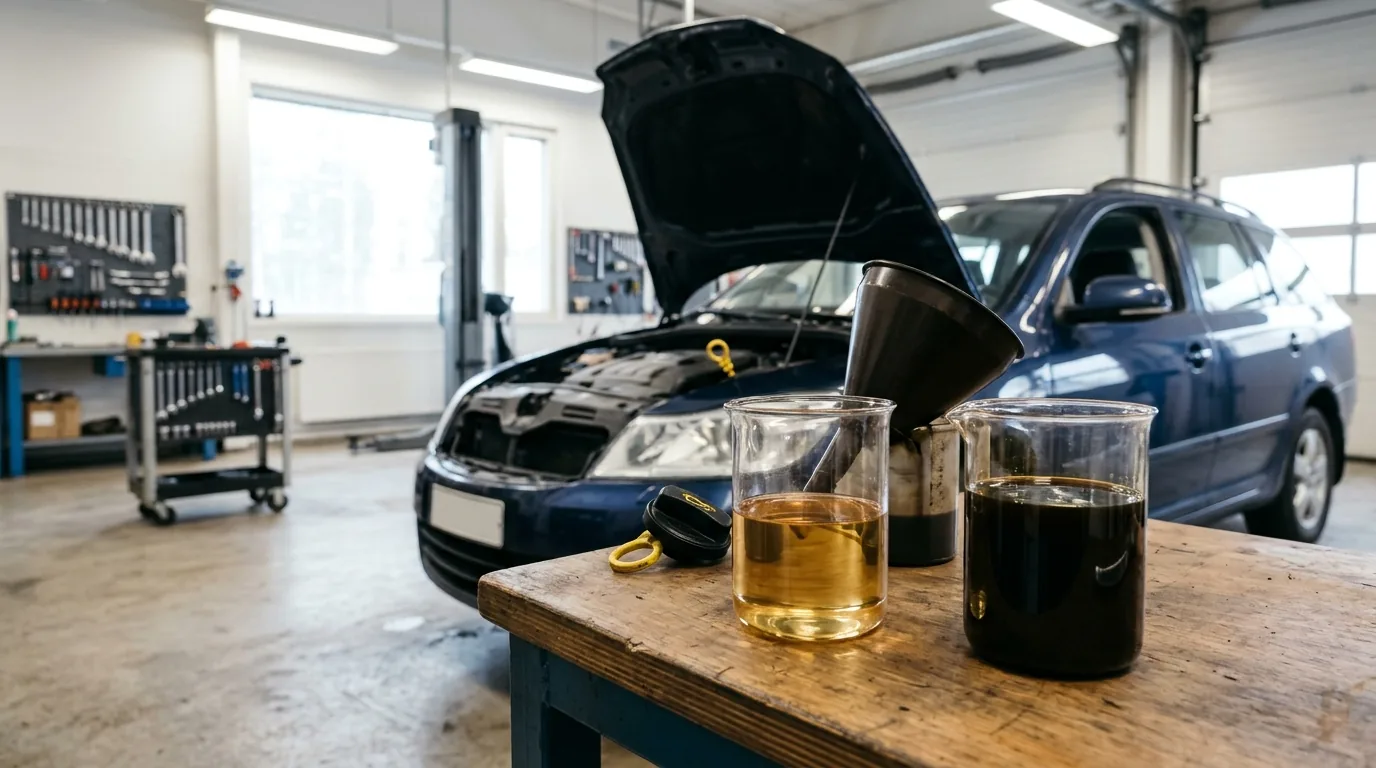
The reason is temperature. Cold oil is thick and lubricates less well until the engine warms up. On a cold start, more fuel than usual is injected into the cylinder, and some of it passes from the cylinder wall into the engine oil. On a short trip, the oil does not get hot enough for the fuel and moisture to evaporate. The oil becomes more diluted with every trip. In freezing weather and on short trips, a pale, mayonnaise-like paste of condensation can build up on the underside of the oil filler cap.
On their Finnish-language websites, some manufacturers advise changing the oil more often than the service schedule's maximum interval would require. In Finnish conditions, Kia recommends an annual service for all models, even in the years when there is no scheduled service. CUPRA's official recommendation is to service petrol and diesel cars on a flexible interval of 30 000 kilometres or two years. On the same page, CUPRA recommends an oil change every 15 000 kilometres or at least once a year.
Preheating helps: according to Motiva, it reduces engine wear. You will find suitable heating times in the article on using a block heater. If you mostly drive short trips, take a longer drive now and then. According to Moottori magazine, even a continuous drive of about twenty kilometres warms the engine up and dries out the moisture.
What happens if the oil change is left too long?
Old oil does not give out all at once. Its protection weakens gradually, and the consequences often show only years later. According to Kia's manual, going past the change interval can reduce the oil's performance and affect the condition of the engine. Nissan warns that an engine run on degraded oil can be damaged.
As the oil is used, fuel, water and combustion residues build up in it. The residues form deposits in the engine that can stop the oil from reaching some lubrication points. In the long run, the result can be wear, a loss of power and higher oil and fuel consumption. The filter fills up too. The engine parts maker MAHLE says that once the service interval has been exceeded, the filter no longer removes enough dirt from the oil. The dirt then gets into the oil circuit through the open bypass valve.
The turbo is particularly sensitive. Its shaft spins at very high speed, and its bearings are lubricated by the engine oil. According to MAHLE, that is why even small particles in the oil can seriously damage the turbo, and lack of lubrication is one of the most common causes of turbo damage.
The timing chain is another sensitive point. The engine oil lubricates the chain, and the chain tensioner works by oil pressure. Long change intervals and short trips wear the chain and the tensioner, and a slack chain can skip a tooth on the sprocket. The symptoms of a stretched chain are listed on the timing chain replacement page.
On a diesel, the condition of the oil also shows in the particulate filter. When oil burns in the cylinders, its additives leave ash that regeneration does not burn off. A regeneration interrupted by a short trip can also add fuel to the oil. When the filter has problems, Moottori magazine advises checking the service history too: whether the service intervals have been stretched and whether the engine has had the right oil. We cover ash and regeneration on the particulate filter cleaning page.
Do you keep the warranty if the oil change is late?
The manufacturer's warranty requires the car to be serviced to the service schedule. Kia, for example, writes that the warranty stays valid when services are done by the time or kilometre limit at the latest. If a service cannot be shown to have been done on time, Kia regards it as neglected. The warranty then does not unconditionally cover a fault that could have been avoided by following the service schedule.
Even so, neglect does not void the warranty automatically. According to the Finnish Competition and Consumer Authority (KKV), the seller, the manufacturer or the importer can refuse liability for a defect caused by neglected servicing. If there is no causal link between the neglect and the defect, they cannot escape liability on the grounds of the neglect alone.
You can have the oil changed somewhere other than a franchised dealer. According to KKV, you may choose where the car is serviced, as long as the services follow the service schedule. Hyundai states the same plainly: the warranty is valid when the car is serviced to the schedule with original or equivalent parts, including at an independent workshop. According to the European Commission's competition guidelines for the motor vehicle sector, a warranty condition that ties servicing outside the warranty to authorised workshops may breach the EU's competition rules. We say more about choosing where to have the car serviced, and about the warranty, in our article on what is done at a scheduled service.
Keep the invoice. For a service done somewhere other than a franchised dealer, Kia requires you to keep the invoices and the completed service forms. If the change is already overdue, have it done straight away and make sure the invoice shows the date and the mileage.
The sticker, the service book and the service reminder
Škoda lists three places where you can see when the oil change is due: the service reminder on the dashboard or the infotainment system, the manufacturer's app, and a separate sticker, the service book or the owner's manual. Here is how to find out when your next change is due:
- Service reminder. The dashboard shows the distance left and tells you when the change is getting close. On a car with a flexible interval, it is the most important source.
- Sticker. The workshop usually writes the mileage and the date of the next change on a sticker. The change is due when either is reached.
- Service book. It shows the date and mileage of the previous change. If the car has only a digital service book, see digital service book.
- Latest invoice. The invoice shows the date, the mileage and the oil used.
- Work it out yourself. Add the kilometres and months in the service schedule to the previous change. Whichever limit comes first decides.
The reminder is reset at the oil change, so that the count starts again from the beginning. If it is not reset, the dashboard shows the wrong time until the next change.
Oil, filter and topping up
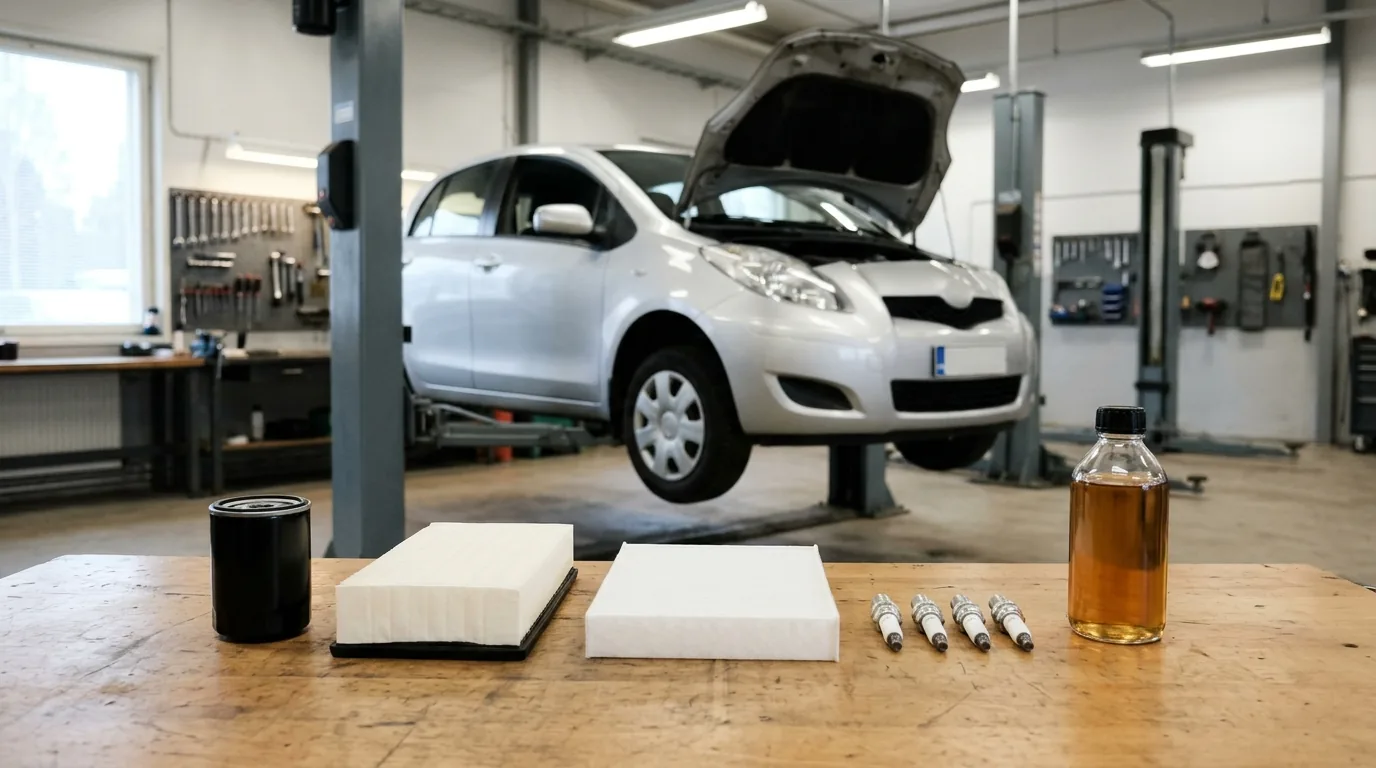
The oil and the oil filter are changed together, because the filter removes dirt from the oil throughout the change interval. In Toyota's service schedule, for example, they are on the same row, and SEAT recommends changing them at the same interval.
An engine always uses a little oil as you drive, and the change interval is no substitute for checking it. According to Kia's manual, the purpose of the change interval is to stop the oil from deteriorating, and it has nothing to do with oil consumption. So check the oil level regularly and top up when needed. A low level is dangerous for the turbo in particular, because according to MAHLE, the turbo then gets too little lubrication and cooling. Moottori magazine notes that small turbo engines especially can use a surprising amount of oil.
Topping up does not replace a change. New oil brings the level back up, but the dirt, fuel and water in the old oil stay in the engine.
A rising oil level usually means that fuel has got into the oil, or in a more serious case, coolant. Fuel thins the oil and weakens lubrication. According to Moottori magazine, you should stop driving if the oil is pale and cloudy, coolant is disappearing, the engine overheats or the oil pressure warning light comes on. We cover the red warning lights in our article on the engine warning light.
When should you take the car to a workshop?
Book an oil change when the service reminder comes on, the car reaches the mileage on the sticker or the service schedule's time limit comes round, even if the car has covered few kilometres. If you mostly drive short trips or tow a trailer, use the severe-conditions interval in the service schedule. We use the registration number to look up the oil in the manufacturer's table, change the oil and the filter, and make an entry in the service book. We tell you the price before the work starts.
If the service schedule says a bigger service is due, book a scheduled service: the oil and filter are part of it too. Bring the car in for diagnostics if the oil level is rising or the oil smells of fuel.