
Lambda sensor replacement
A faulty lambda sensor turns on the engine warning light and can raise fuel consumption. At the inspection it can fail the car. We read the fault codes, make sure the fault is in the sensor, and tell you the price before the work starts.
typical price range
170–
We tell you the exact price for your car before the work starts.
- Prices include VAT
- 25,5 %
- Fault codes read and the sensor's live data checked with a diagnostic tool before the work
- The sensor's wire and connector checked, and the exhaust checked for leaks before the sensor
- One new lambda sensor that fits the car
How it works
Call us or drop in
Give us the registration. We confirm the price and agree a time in the same call.
We do the work
You get the car back at the time we agreed.
You pay the agreed price
No surprises on the invoice. If we find anything else, we call before we touch it.
If the engine warning light is on and the inspection is coming up, bring the car to us first. Clearing the fault code alone does not help, because after a reset the car's own tests are incomplete and the inspector checks the sensor separately.
Call 045 262 5950What the price includes
What the price includes
- Fault codes read and the sensor's live data checked with a diagnostic tool before the work
- The sensor's wire and connector checked, and the exhaust checked for leaks before the sensor
- One new lambda sensor that fits the car
- The old sensor removed and the new one fitted to the manufacturer's tightening torque
- The threads cleaned and the wire secured clear of the hot exhaust
- Fault codes cleared, the new sensor's signal checked with the engine warm, and a road test
What the price does not include
- A second lambda sensor. The price covers one sensor. If the fault codes or the measurements show a fault in more than one, we tell you the total price before the work.
- Replacing the catalytic converter. Fault code P0420 usually points to the converter, and replacing the sensor does not help then.
- Repairing exhaust leaks. A leak before the sensor distorts its reading, so we tell you about it before we replace the sensor.
- Repairing a broken or melted wire or connector, or damaged threads. We ask before we go on.
- Wider diagnostics, if the fault turns out not to be in the sensor but, for example, in an air leak on the intake side or in the mass air flow sensor.
About this work in detail
What a lambda sensor does
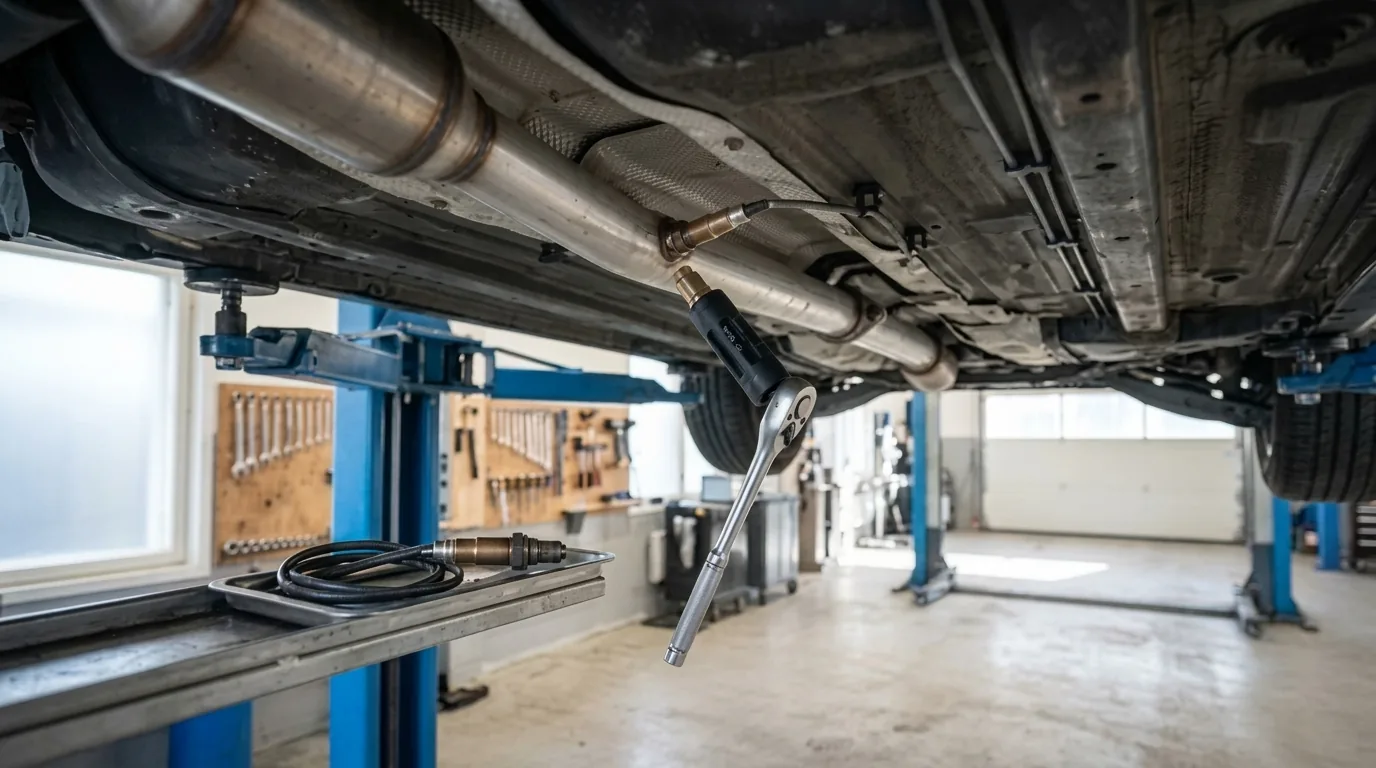
The lambda sensor, or oxygen sensor, is screwed into the exhaust manifold or the exhaust pipe. It measures how much oxygen is left in the exhaust gas, and the engine control unit uses that reading to adjust the amount of fuel all the time you drive.
A petrol engine's exhaust is cleaned best when about 14.7 kilos of air enter the combustion chamber for every kilo of fuel. This mixture ratio corresponds to a lambda value of 1. Only close to it can the catalytic converter reduce carbon monoxide, hydrocarbons and nitrogen oxides at the same time.
Most petrol cars from the 2000s on have at least two sensors. The front sensor sits before the catalytic converter, and the mixture is adjusted by it. The rear one sits after the converter and monitors whether the converter works. On a V engine each bank of cylinders often has its own sensors. The sensor also has a heater, so that it starts measuring soon after a cold start.
Read the full guide
How to tell the sensor is faulty
The most common sign is the yellow engine warning light. Book a time if you notice any of these:
- the warning light is on, and the fault code points to the lambda sensor or its heater
- fuel consumption has risen for no clear reason
- the engine idles unevenly or responds poorly to the throttle
- the car failed the emissions test or the OBD check at the inspection
- the exhaust smells of petrol more than usual
A fault in the heater can hardly be felt while driving. The warning light is then the only sign.
A fault code does not always mean the sensor is broken. If the sensor reports a lean mixture, the cause can be an air leak on the intake side, the mass air flow sensor or fuel pressure that is too low. The sensor is then sound and reading correctly. So we look at the sensor's live data as well as the code before we replace anything. If the fault is elsewhere, we find it through diagnostics.
Which sensor is faulty
The fault code also tells you where the sensor is. The code reader shows it, for example, as «bank 1, sensor 1», in Finnish «lohko 1, anturi 1». Bank 1 is the bank of cylinders that contains cylinder number 1. Sensor 1 is before the catalytic converter and sensor 2 after it. An inline engine has only bank 1.
Code P0420 is a different matter. It means the converter's cleaning efficiency has fallen below the limit value. The rear sensor only detects this, so replacing the sensor does not usually clear the code.
When the sensor is replaced
Most car manufacturers give no replacement interval for the lambda sensor, in kilometres or in years. The sensor is replaced when it is faulty or responds too slowly. The replacement most often comes up when the odometer reads 160 000 to 260 000 kilometres.
A sensor's life is shortened by an engine that burns oil, coolant leaking into the combustion chamber, misfires, and unsuitable silicone sealant used in an engine repair. If the sensor was damaged by a fault in the engine, a new sensor will be damaged for the same reason. The engine fault then has to be fixed first, and we tell you before we replace the sensor.
How the replacement is done
- We read the fault codes and, with the engine warm, look at the sensor's signal and the engine's mixture control.
- We check the sensor's wire and connector, and check the exhaust for leaks before the sensor. A leak before the sensor lets air into the pipe, so even a sound sensor reports a lean mixture.
- We tell you what we found and what the work costs. We order the right sensor for the car once you have accepted the price.
- We remove the old sensor with a special socket. A sensor rusted in place we remove carefully, so that the threads in the exhaust are not damaged.
- We clean the threads and tighten the new sensor to the torque the manufacturer specifies. We secure the wire so that it does not touch the hot exhaust or any moving parts.
- We clear the fault codes, check the new sensor's signal and road-test the car.
The car's own monitoring tests complete only in normal driving, usually over a few trips. If the warning light comes back on, call us.
How long it takes
Replacing the sensor itself usually takes 20–40 minutes. With the fault-code reading, the checks and the road test, the work takes about an hour. A sensor rusted in place and a cramped location, for example in the exhaust manifold behind the engine, make the work longer.
What affects the price
The price of a lambda sensor replacement varies from car to car. It depends on these:
- The sensor type. On many newer cars the front sensor is a wideband sensor, which costs more than the rear one.
- The number of sensors. The price covers one sensor. A V engine often has four, and sometimes more than one needs replacing.
- The part. Original parts and aftermarket parts differ in price. We tell you which part we use.
- The location. Some sensors can be reached directly from below, others only after removing heat shields or other parts.
- Rust. On a car driven on salted roads the sensor can be rusted solid. If the threads are damaged, they have to be repaired before the new sensor can be fitted.
We check the car and tell you the price before the work starts. If something turns up during the work that changes the price, we call you before we go on.
The lambda sensor and the inspection
According to Traficom's statistics, the periodic inspections of passenger cars in 2025 recorded 31 338 failing faults in the petrol engine exhaust measurement. The check of the on-board diagnostics system, OBD, recorded 30 779, and that figure covers every fuel type. The statistics do not say how many of the faults came from a lambda sensor. Environmental hazards as a whole accounted for 79 258 failing faults, 10.1 % of all. Only axles, wheels and suspension, and brake systems had more.
Under Traficom's inspection regulation, on most petrol cars first registered in 2001 or later the fault memory is read, the engine warning light is checked, and the inspector checks that the car's own monitoring tests, the readiness monitors, have completed. The car fails if the warning light shows a fault, if any of the codes P0001–P0499 or P0650 is in the memory, or if the lambda control does not work. The most common lambda sensor fault codes fall in that range. On a car over ten years old the exhaust emissions are also measured at a raised engine speed of at least 2 000 rpm. Carbon monoxide may then be at most 0.2 % and the lambda value must be between 0.97 and 1.03.
Clearing the fault code just before the inspection does not help. The reset also sends the car's own monitoring tests back to the start. While they are incomplete, the inspector reads, as a substitute test, how the mixture control or the front sensor signal varies, and if the lambda control does not work, the car fails. Read more about inspection repairs.
What you can check yourself
- The warning light. See whether the engine warning light stays on or flashes. A flashing light usually means a misfire, which is a more serious fault.
- The fault code. If you have your own OBD reader, write down the code and the sensor position before you clear anything. Tell us both when you book.
- Consumption. The trip computer's average consumption shows whether the car has started using more fuel in recent weeks.
- Noise. If you hear ticking or hissing from under the car after a cold start, the manifold or the front pipe may be leaking before the sensor.
When not to drive the car
With the warning light on steadily you can usually drive to the workshop. Do not put the repair off, though, because the wrong mixture raises consumption and a mixture that is too rich can damage the catalytic converter over time.
Do not keep driving if any of these is true:
- the engine warning light is flashing
- the engine loses a lot of power or goes into limp mode
- black smoke comes from the exhaust or the car smells strongly of fuel
- the sensor wire or another part is hanging under the car
A flashing light warns of a misfire that lets unburnt fuel reach the catalytic converter. The converter overheats and can be damaged even on a short drive. In that case the car should come to the workshop on a tow truck. Call us and we will agree a time.
If something else needs fixing
We do not start work you do not know about. If the car needs something else fixed, we call and tell you what the extra work costs and what happens if it is left undone. You decide.
Once we have seen the car, we tell you the price and whether it is a fixed price, a maximum price or an estimate. The work starts only once you have accepted the price.
We work to the motor vehicle service and repair terms approved by the consumer advisory board of the Finnish motor trade.
Related work

Diagnostics
The first hour. We credit it against the repair if you have the work done here.
69 €
Inspection repairs
We repair the faults on the rejection list, item by item. The price comes from the list, before any work starts.
Ask the price
Exhaust repair
Leaks and loose sections, welded where needed. We check the system and tell you the price before the work starts.
Ask the price
Shall we agree a time?
Leave a booking request online or call. We confirm the time and tell you the price before any work starts.
typical price range
170–
We tell you the exact price for your car before the work starts.
- Address
- Lampputie 12 C 67
00750 HelsinkiShow on the map - Opening hours
- Mon–Fri8.00–18.00Sat9.00–15.00Sunclosed
- Phone
- 045 262 5950
- huolto@caron.fi