
Spark plug replacement
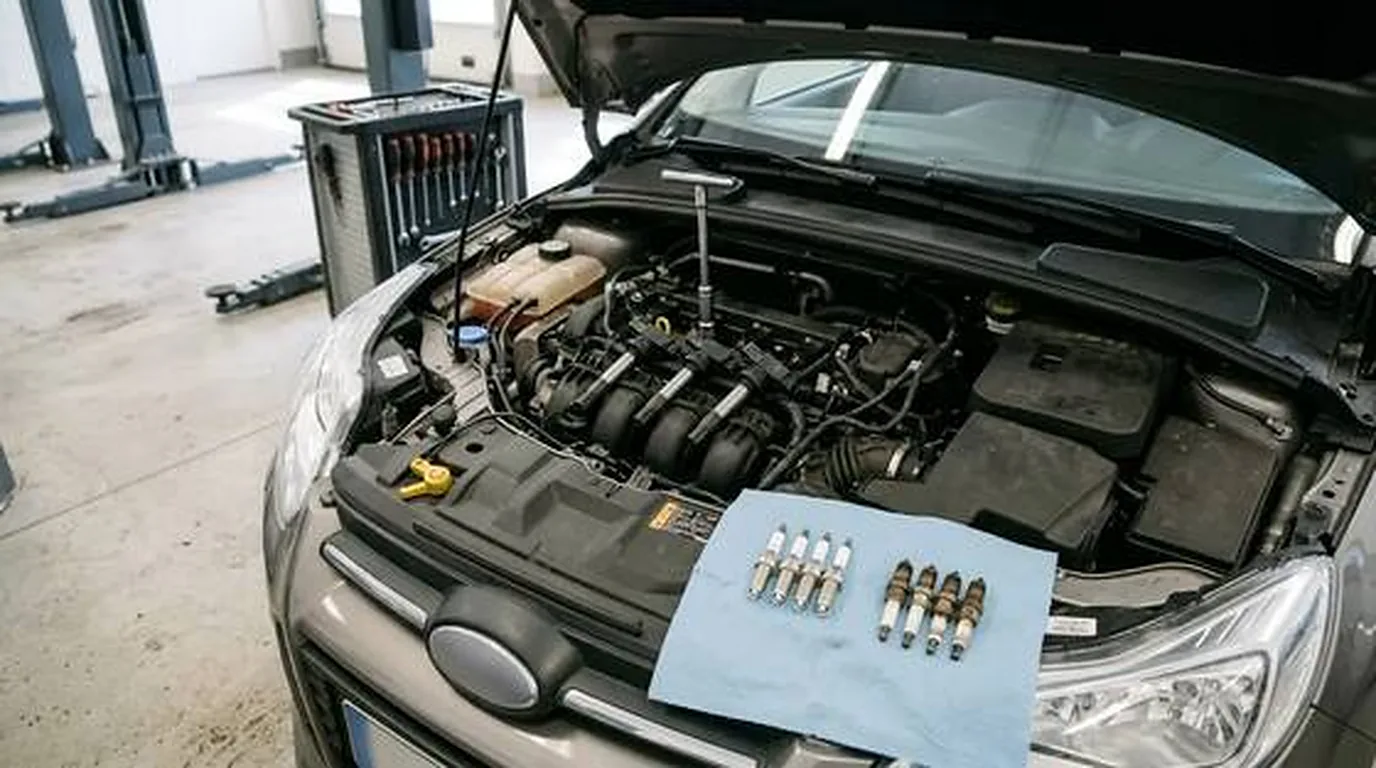
We replace spark plugs on petrol and hybrid cars of every make, using the plug type the manufacturer specifies. On a four-cylinder engine the change usually takes between half an hour and an hour. We tell you the price before the work starts.
typical price range
105–
We tell you the exact price for your car before the work starts.
- Prices include VAT
- 25,5 %
- New spark plugs in every cylinder, of the type the manufacturer specifies
- Fault memory read before the work, if the engine warning light is on
- Ignition coils or plug leads removed and refitted, and the plug wells blown clean with compressed air
How it works
Call us or drop in
Give us the registration. We confirm the price and agree a time in the same call.
We do the work
You get the car back at the time we agreed.
You pay the agreed price
No surprises on the invoice. If we find anything else, we call before we touch it.
If the engine warning light is flashing, stop somewhere safe and call us. A flashing light usually means a heavy misfire, which can ruin the catalytic converter.
Call 045 262 5950What the price includes
What the price includes
- New spark plugs in every cylinder, of the type the manufacturer specifies
- Fault memory read before the work, if the engine warning light is on
- Ignition coils or plug leads removed and refitted, and the plug wells blown clean with compressed air
- Old plugs and plug wells checked: oil, carbon and wear tell us about the engine's condition
- New plugs tightened to the torque the manufacturer specifies
- Fault memory cleared, road test and an entry in the service book
What the price does not include
- Ignition coils and plug leads. If one of them is faulty, we call you and tell you the price before we replace it.
- The valve cover gasket and the plug tube seals, if there is oil in the plug wells.
- Removing the intake manifold, and new manifold gaskets, on engines where the plugs cannot be reached otherwise. We tell you the price of the extra work in advance.
- Repairing the threads in the cylinder head, if an old plug has seized and the thread is damaged. That is a different job.
- Fault finding when the engine runs badly for another reason, and diesel glow plugs. Those are different jobs.
About this work in detail
A spark plug ignites the mixture of fuel and air in the cylinder. The ignition coil raises the voltage to tens of thousands of volts, and the spark jumps across the gap between the electrodes at the plug's tip. Every cylinder has its own plug, and a few engines have two per cylinder. Spark plugs are found in petrol engines, hybrid and gas-powered cars included. In a diesel engine the fuel ignites in air heated by compression, and there are no spark plugs. A diesel's glow plugs help it start from cold, and replacing them is a different job.
The spark wears the electrodes away little by little, and the gap grows. The wider the gap, the more voltage the spark needs. Once the gap has grown far enough, the voltage is no longer enough every time, and the engine starts to misfire: now and then the mixture in a cylinder does not ignite. The electrodes of iridium and platinum plugs wear more slowly than those of ordinary nickel plugs, so their replacement interval is longer.
Read the full guide
How to recognise worn plugs
- The engine idles unevenly.
- The car jerks when accelerating, especially uphill or when overtaking, and does not pull as it used to.
- The engine is hard to start, especially in freezing weather.
- Fuel consumption rises for no other obvious reason.
- The engine warning light comes on, and the fault memory holds a misfire code.
The same symptoms can come from an ignition coil, a plug lead, an injector or an intake air leak. If the plugs were replaced only recently, the fault is probably elsewhere. So we first ask when the plugs were last replaced, and we read the fault codes if the warning light is on. If the cause is not the plugs, we find it with diagnostics.
When the plugs are replaced
The car's manufacturer sets the interval, and it depends on the engine and the type of plug. It is usually 30 000 to 120 000 km. The shortest interval is usually on older cars with nickel plugs. On an engine fitted with iridium or platinum plugs it is often 60 000 km or more. On a turbocharged petrol engine it is often shorter than on a naturally aspirated one, because the pressure in the cylinder is higher and the spark needs more voltage.
Many manufacturers set a time limit as well as the kilometres, usually 3 to 6 years, and the plugs are replaced at whichever comes first. The time limit matters for a car that is driven little. On short trips, especially in winter, the engine never warms up properly, and carbon builds up on the plugs. A plug left in place for a long time can also seize in the cylinder head.
In the service schedule the plug change is usually assigned to a particular scheduled service, and it is done with that service. If the service book has no entry for a plug change and the car has covered more than the manufacturer's interval, the plugs are worth replacing.
How the work is done
- We look up the plug type and the tightening torque for your car's engine in the manufacturer's data. If the warning light is on, we read the fault codes before the work. We tell you the price before we start.
- We let the engine cool. On most engines the cylinder head is aluminium, and a plug removed from a hot head can damage the threads.
- We remove the engine cover and the ignition coils or plug leads. We blow the plug wells clean with compressed air so that dirt does not fall into the cylinder.
- We remove the old plugs and look at their tips. An oily, sooty or pale burnt tip tells us about the state of the engine. At the same time we check whether there is oil in the plug wells.
- We start the new plugs by hand first, so that the thread does not cross, and tighten them to the manufacturer's torque. We check the gap on the plugs where it is adjusted. Iridium and platinum plugs usually come pre-gapped.
- We refit the ignition coils or plug leads and check the rubber boots and connectors. Finally we clear the fault memory, road test the car and record the change in the service book.
How long it takes
On an ordinary four-cylinder engine the change usually takes from half an hour to an hour, and on a three-cylinder it is often quicker. On a transversely mounted V6 the plugs of the rear bank can often be reached only with the intake manifold removed, and then the work takes considerably longer. When we agree the price, we tell you when the car will be ready. The plugs can often be replaced at the same visit as a scheduled service or an oil change.
What the price depends on
The price of a spark plug replacement varies from car to car. It depends on:
- The number of cylinders and plugs. A three-cylinder engine has three plugs and a V8 eight. If each cylinder has two plugs, the number doubles.
- Access to the plugs. If the plugs can be reached only after the intake manifold or other parts come off, there is more work, and the manifold gaskets are replaced with new ones.
- The type of plug. Iridium and platinum plugs cost more than nickel plugs. We use the type the manufacturer specifies for the engine.
- Seized plugs. A plug left in place for a long time can be stuck in an aluminium head. We remove it carefully, but if the thread is damaged, repairing it is a different job.
- Extra findings. A cracked coil boot or oil in a plug well means that another part needs replacing too. We call you and tell you the price before we do it.
So we check the car and tell you the price before the work starts.
Spark plugs and the inspection
The plugs are not examined as such at the inspection, but a misfire shows up in the emissions check. Under Traficom's inspection regulation, a petrol car's emissions are checked by reading the fault memory of the car's OBD system. On a car more than ten years old, the exhaust is also measured at raised revs.
A fault reported by the engine warning light is grounds for rejection, and so is a code between P0001 and P0499 stored in the fault memory. The misfire codes P0300 to P0308 fall within that range. When the mixture in a cylinder does not ignite, unburnt fuel raises the hydrocarbon content of the exhaust, and the measurement can exceed the limit.
In Traficom's inspection statistics for 2025, the petrol engine exhaust measurement accounted for 31 338 rejecting faults and the OBD system for 30 779. The statistics do not say how many of the faults were caused by the ignition, because the same groups also cover lambda sensors, catalytic converters and other faults in the emission system.
Simply clearing the fault codes before the inspection does not fix the fault. If the misfire continues, the engine control unit stores the code again. The inspector also checks that the system's own readiness tests have been completed, and clearing the fault memory resets them. Because we clear the fault memory after replacing the plugs, drive the car normally for a few days before the inspection so that the readiness tests have time to complete.
If the car has already failed on emissions, bring the inspection certificate with you, and we see straight away what the inspector recorded. Read more about inspection repairs.
What you can check yourself
- Look in the service book or the electronic service history to see when the plugs were last replaced and what interval is set for the car.
- Notice when the symptom appears: with the engine cold or warm, at idle or when accelerating, in dry or wet weather. If the engine jerks mainly in damp weather, the cause is often an ignition coil or a plug lead.
- See whether the engine warning light is on steadily or flashing, and tell us when you book a time.
- Keep an eye on fuel consumption. If it has risen noticeably for no other reason, mention that too.
When not to drive the car
An engine that runs only slightly unevenly can usually be driven to the workshop, but a time is worth booking soon. Do not keep driving if
- the engine warning light is flashing
- the engine shakes heavily or the car cannot keep up with traffic
- there is a smell of petrol or burning from the car
- the engine cuts out while driving.
A flashing warning light usually means a misfire so heavy that unburnt fuel burns only in the catalytic converter and overheats it. The converter can be damaged after only a short drive, and replacing it costs several times as much as replacing the plugs. In that case, bring the car to the workshop on a tow truck. Call us and we will agree a time.
If something else needs fixing
We do not start work you do not know about. If the car needs something else fixed, we call and tell you what the extra work costs and what happens if it is left undone. You decide.
Once we have seen the car, we tell you the price and whether it is a fixed price, a maximum price or an estimate. The work starts only once you have accepted the price.
We work to the motor vehicle service and repair terms approved by the consumer advisory board of the Finnish motor trade.
Related work

Scheduled service
The scope varies from car to car, so we tell you the price before the work starts.
approx. 189 €
Diagnostics
The first hour. We credit it against the repair if you have the work done here.
69 €
Inspection repairs
We repair the faults on the rejection list, item by item. The price comes from the list, before any work starts.
Ask the price
Shall we agree a time?
Leave a booking request online or call. We confirm the time and tell you the price before any work starts.
typical price range
105–
We tell you the exact price for your car before the work starts.
- Address
- Lampputie 12 C 67
00750 HelsinkiShow on the map - Opening hours
- Mon–Fri8.00–18.00Sat9.00–15.00Sunclosed
- Phone
- 045 262 5950
- huolto@caron.fi