
Glow plug replacement
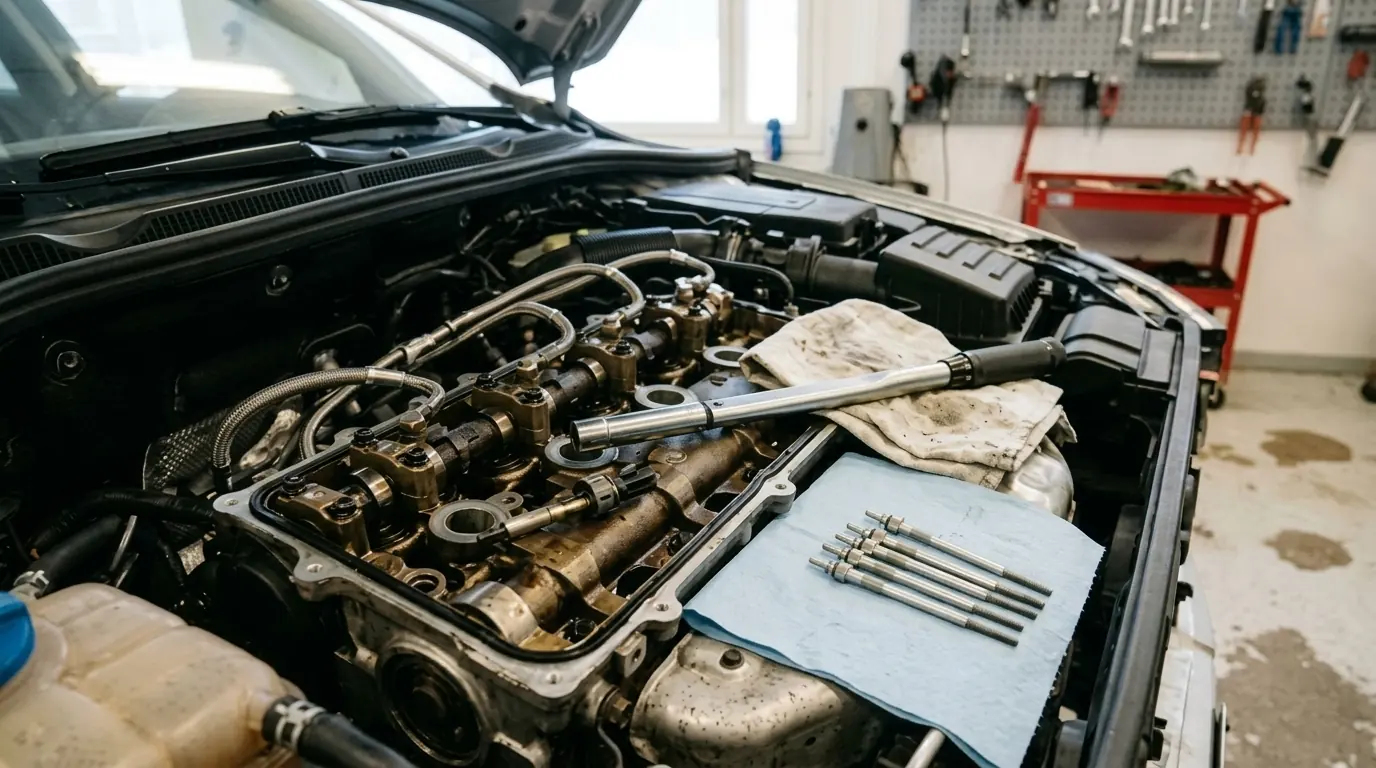
We replace glow plugs on diesel cars of every make, and when the plugs come out normally the work usually takes under an hour. Old plugs can be seized in place, so we check the car and tell you the price before the work starts.
typical price range
195–
We tell you the exact price for your car before the work starts.
- Prices include VAT
- 25,5 %
- A check of the glow system and a fault memory read before the work
- New glow plugs of the type the manufacturer specifies, usually in every cylinder
- Careful removal of the old plugs, from a warm engine and with penetrating oil
How it works
Call us or drop in
Give us the registration. We confirm the price and agree a time in the same call.
We do the work
You get the car back at the time we agreed.
You pay the agreed price
No surprises on the invoice. If we find anything else, we call before we touch it.
A weak glow plug usually shows itself with the first frosts. If the car is hard to start from cold even above freezing, have the plugs checked before winter.
Call 045 262 5950What the price includes
What the price includes
- A check of the glow system and a fault memory read before the work
- New glow plugs of the type the manufacturer specifies, usually in every cylinder
- Careful removal of the old plugs, from a warm engine and with penetrating oil
- Cleaning carbon from the plug bores and threads
- New plugs tightened to the manufacturer's torque, and the wiring checked
- Fault memory cleared, a glow function test and a test start
What the price does not include
- Removing a seized or broken plug with special tools. If a plug will not come out safely, we stop the work, call you and tell you the price before we carry on.
- Repairing or replacing the glow relay, the glow control unit or the wiring harness, if the fault is there.
- Other causes of hard starting, such as the battery, the starter motor, the fuel filter and the injection system. Those are different jobs.
- Faults in the EGR valve, the particulate filter or the injectors, even if their fault codes are in the memory at the same time.
About this work in detail
A diesel engine has no spark plugs. The piston compresses the air until it is so hot that the injected fuel ignites on its own. A cold cylinder head and cold cylinder walls soak heat out of the compressed air, though, and in a cold engine the air does not get hot enough, least of all in a frost. So every cylinder has a glow plug. Its tip heats to about 1 000 °C within a few seconds and warms the combustion chamber so that the engine starts.
On many newer diesels the plugs keep glowing after the engine has started. This after-glow smooths a cold engine's running and reduces smoke and knocking in the first few minutes. The glow is switched by a relay or a separate glow control unit, and the glow time follows the engine's temperature.
Read the full guide
How to recognise a faulty glow plug
- The car is hard to start from cold, and the starter has to turn the engine for a long time. The fault shows first in a frost, and a warm engine starts normally.
- A cold engine runs unevenly, knocks or shakes for the first few minutes, because a cylinder whose plug does not glow works poorly until the engine warms up.
- White or bluish smoke comes from the exhaust after a cold start.
- The glow plug warning light flashes while driving, or the engine warning light is on. The fault memory then often holds a glow circuit fault code, for example P0380 or one between P0670 and P0684.
- The car starts well after the block heater has been on, but badly without it. The block heater hides a weak glow.
Hard cold starting is not always the glow plugs. A weak battery, a tired starter motor, a clogged fuel filter and summer-grade diesel gelling in the frost can cause the same symptom. If the starter turns the engine slowly, the cause is usually the battery or the starter. We do not replace glow plugs on the strength of a symptom alone: we measure them first.
When glow plugs are replaced
Most manufacturers give glow plugs no replacement interval: the plugs are replaced when they stop working. Many glow plugs last 150 000 to 300 000 km, some longer still.
Age still matters to the work. On most engines a steel plug is screwed into an aluminium cylinder head, and years of heating and cooling, carbon and corrosion can make it seize. The longer the plugs have been in, the more likely they are to be tight.
When one plug has failed, the others are just as old. It is usually worth replacing them all at once, so the cover and wiring come off only once. If the working plugs are very tight, it can make more sense to replace only the failed one. We then call you before we carry on.
A seized plug
A glow plug is slender, and a seized plug snaps easily if it is forced. Removing a broken plug is many times the work of the replacement itself, and in the worst case the cylinder head has to come off.
We remove the plugs with care. We let penetrating oil work, warm the engine and undo the plugs slowly and with controlled force. If a plug will not come out safely, we do not force it, but call you and explain the options. A plug that still works can sometimes be left in place. A plug that is both broken and seized is removed with special tools. That is a job of its own, and we tell you its price before we carry on.
How the work is done
- We read the fault memory and measure every plug and the glow relay or control unit. We tell you what is faulty and what the work costs. Parts are ordered only once you have accepted the price.
- We remove whatever is in the plugs' way. On most engines that is only the engine cover and the plug wiring, on some also the injector pipes or the intake manifold.
- We undo the old plugs from a warm engine and check that each one comes out whole.
- We clean carbon from the plug bores and threads, so the new plugs seat tightly.
- We start the new plugs by hand and tighten them to the manufacturer's torque. We refit the wiring and the parts we removed.
- We clear the fault memory, test the glow, start the engine and read the fault memory once more.
How long it takes
When the plugs come out normally, the replacement takes about half an hour on most four-cylinder cars and about an hour on the most awkward ones. It goes fastest when the plugs sit right under the engine cover. A six-cylinder engine, or one where the intake manifold has to come off, takes considerably longer. A seized or broken plug can stretch the work to several hours, and the car may then stay with us until the next day.
What the price depends on
The price of a glow plug replacement varies from car to car. It depends on:
- The number of plugs. Each cylinder has its own plug: four on most cars, five or six on some.
- Where the plugs sit. On some engines the intake manifold, the injector pipes or other parts have to come off before the plugs can be reached. If the manifold comes off, its gaskets are usually renewed at the same time.
- The type of plug. Ceramic plugs cost more than metal ones. On some engines one or more plugs also work as a combustion pressure sensor, and such a plug costs considerably more than a plain one.
- The parts. Original and aftermarket parts differ in price. We tell you which parts we use.
- The condition of the plugs. A seized or broken plug adds the most work.
If the fault is in the relay, the control unit or the wiring, repairing it is a separate job. We check the car and tell you the price before the work starts.
Glow plugs and the inspection
Glow plugs are not checked on their own at the inspection, but their fault can show up in the exhaust emissions check. Under Traficom's inspection regulation, a diesel car first registered on 1 September 2016 or later has its OBD fault codes read. A fault reported by the engine warning light, or a fault code in the memory, is then grounds for rejection. Diesel cars first registered between 1 January 2007 and 31 August 2016 get a smoke test, and the inspector also checks that the engine warning light works normally. For them too, a fault reported by the warning light is grounds for rejection.
A glow circuit fault is usually stored in the engine control unit's fault memory, and on many cars it also lights the engine warning light. So a failed glow plug can lead to a rejection even while the car still starts well. In Traficom's statistics for 2025, the on-board diagnostics (OBD) accounted for 30 779 rejection faults and the diesel exhaust measurement for 5 778. The OBD figure covers all fuel types, and the statistics do not say how many of the faults came from the glow system.
What you can check yourself
- Watch the instrument panel when you switch the ignition on. The glow plug light comes on and goes out after a moment, a little later in a frost. If it flashes while driving or the engine warning light is on, tell us.
- With a cold engine, wait for the glow plug light to go out before you start. On many cars with a start button, the engine waits for the glow by itself.
- Notice whether the car is hard to start only when cold, and whether the block heater helps. That helps tell glow faults from others.
- Listen to the starter. If it turns the engine slowly, the battery is a more likely cause than the glow plugs.
- Do not use starting spray on a diesel engine. It can ignite too early at a glowing plug and damage the engine.
When not to drive the car
Once the engine has started and warmed up, a glow plug fault does not usually stop you driving. The car can be driven to the workshop, but a time is worth booking before the hard frosts. Do not keep driving if
- a sudden loud metallic knocking comes from the engine and does not go away once it is warm
- the engine runs clearly unevenly even when warm and smokes all the time
- there is a smell of burnt electrical wiring from the engine bay.
An overheated plug can split so that its tip drops into the cylinder. Driving on can then damage the piston or the cylinder head, so the car is best towed to the workshop. If the car will not start, do not keep the starter turning for long at a stretch, because the battery runs flat and the starter overheats. Call us, and we will agree how the car gets to the workshop.
If something else needs fixing
We do not start work you do not know about. If the car needs something else fixed, we call and tell you what the extra work costs and what happens if it is left undone. You decide.
Once we have seen the car, we tell you the price and whether it is a fixed price, a maximum price or an estimate. The work starts only once you have accepted the price.
We work to the motor vehicle service and repair terms approved by the consumer advisory board of the Finnish motor trade.


Shall we agree a time?
Leave a booking request online or call. We confirm the time and tell you the price before any work starts.
typical price range
195–
We tell you the exact price for your car before the work starts.
- Address
- Lampputie 12 C 67
00750 HelsinkiShow on the map - Opening hours
- Mon–Fri8.00–18.00Sat9.00–15.00Sunclosed
- Phone
- 045 262 5950
- huolto@caron.fi