
Exhaust repair and replacement
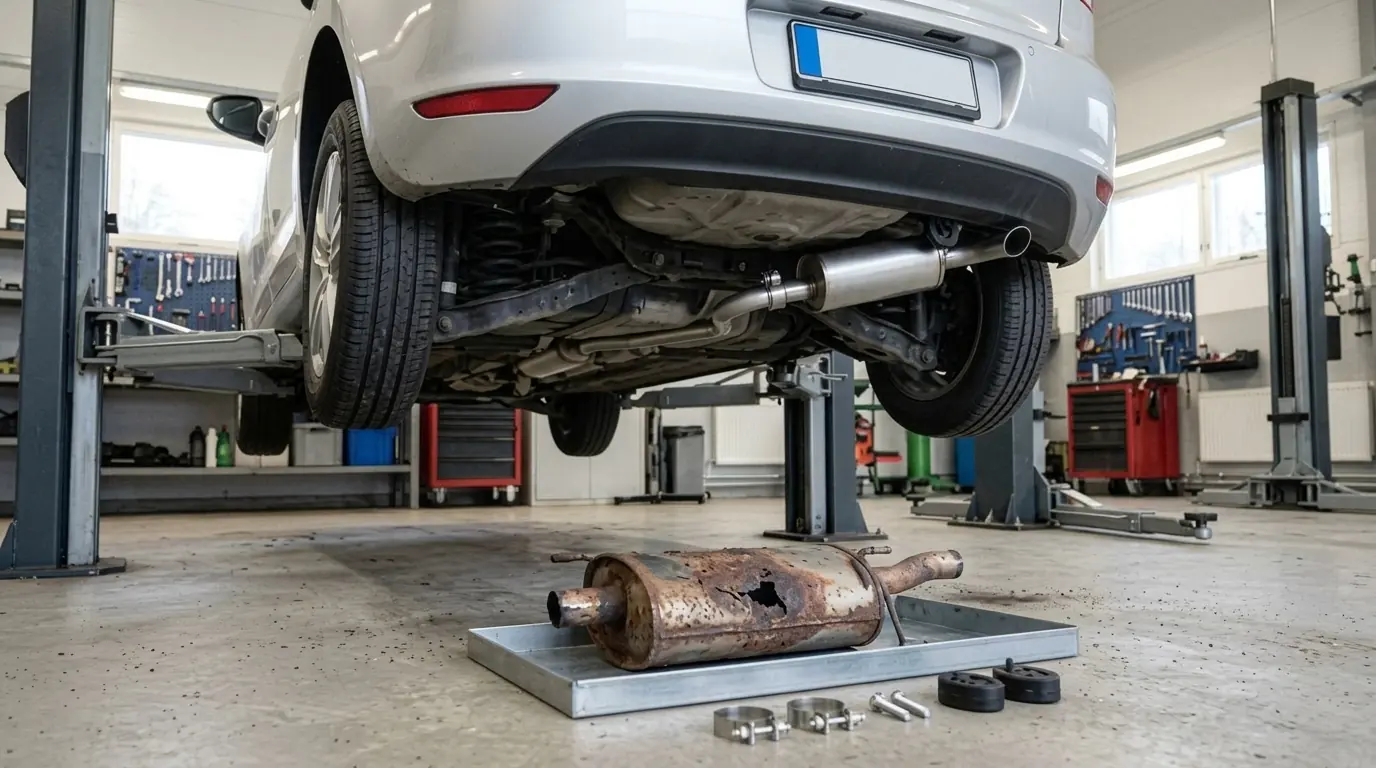
We repair a leaking, rusted or loose exhaust by welding it or by replacing the damaged section, whatever the make. We check the system on the lift and tell you the price before the work starts.
The price before the work starts
This job has no published price. Call or book a time. We check the car and tell you the price before the work starts.
How it works
Call us or drop in
Give us the registration. We confirm the price and agree a time in the same call.
We do the work
You get the car back at the time we agreed.
You pay the agreed price
No surprises on the invoice. If we find anything else, we call before we touch it.
A small leak is easier to repair than a broken pipe, so book a time as soon as the sound changes.
Call 045 262 5950What the price includes
What the price includes
- Exhaust check on the lift from the manifold to the tailpipe: leaks, rust, hangers and heat shields
- A hole, crack or loose joint repaired by welding, where the metal will take a weld
- A damaged section replaced with a new one, where welding is no longer enough
- New gaskets, joining sleeves and clamps on every joint that was opened
- Broken rubber hangers and loose brackets replaced
- A rattling heat shield secured
- A leak check with the engine running, and a road test
What the price does not include
- Replacing the catalytic converter or the diesel particulate filter. They are the most expensive parts of the system, and we tell you their price separately if the fault is there.
- Replacing the exhaust manifold or its gasket. The manifold is bolted to the engine, and we tell you the price of that job separately.
- Replacing lambda sensors. If a sensor has to be replaced, we tell you its price separately.
- Sports exhausts, removing silencers and other modifications. We repair the system to standard condition.
- Rust damage to the floor where the exhaust is mounted. That is body repair, and we say so plainly if we find it.
About this work in detail
The exhaust system carries the engine's exhaust gases under the car to the rear, cleans them and quietens the engine. It starts at the engine's exhaust manifold and runs through the catalytic converter, the middle pipe and the silencers to the tailpipe. Newer diesel cars also have a particulate filter in the system. Lambda sensors in front of and behind the catalytic converter measure the oxygen content of the exhaust gas. From their readings the engine control unit adjusts the amount of fuel and monitors the catalytic converter.
The system hangs under the car on rubber hangers, so that the engine's vibration does not pass into the body. Almost all of its length is exposed to road salt, water and grit. Water also condenses inside the pipe when the engine is started cold. On short trips the system never gets hot enough for the water to evaporate, and the silencers rust from the inside as well. That is why the rear silencer, the coldest part of the system, is usually the first to rust through.
Read the full guide
How to tell the exhaust is faulty
- The sound gets louder, rasps or hisses, especially when starting and accelerating. A small crack may only be heard with a cold engine, before the metal warms up and expands.
- There is a knock or a rattle from under the car over speed bumps or at idle. The cause is often a broken rubber hanger or a loose heat shield.
- The exhaust hangs lower than usual, the tailpipe is crooked or the pipe touches the ground.
- There is a smell of exhaust inside the car, especially at idle or when driving slowly.
- The engine warning light comes on. A leak in front of a lambda sensor can let air into the pipe and distort the sensor's reading.
The warning light has many other causes, so on its own it does not mean the fault is in the exhaust.
When the exhaust is repaired
There is no manufacturer interval for the exhaust. It is repaired when it leaks, has rusted through or its mounting has failed. How long a system lasts varies a lot. It depends on the material, road salt and how much the car is driven on short trips. A stainless steel system usually lasts clearly longer than one made of ordinary steel.
The exhaust is worth a look whenever the car is on the lift anyway, for example at a service. Surface rust does not yet mean a hole, and a silencer that looks sound from the outside can be eaten away inside. So we tap the pipe and move the joints and hangers by hand.
Weld or replace
Not everything is worth welding. A weld holds when the hole or crack is small and the metal around it is still sound. If rust has thinned the pipe over a wide area, the pipe soon gives way right next to the new weld. In that case we replace the damaged section. The usual solutions are:
- Welding, when the damage is small: a hole, a crack, a loose joint or a broken bracket.
- Replacing a section, when the rear silencer, the middle section or the front pipe has rusted through or thinned.
- Replacing hangers and brackets, when the pipe is sound but hangs low or knocks.
On many cars the system leaves the factory as one piece from the catalytic converter to the tailpipe. Then we cut out the damaged section and join the new one with a sleeve and clamp or by welding. The whole system does not have to be replaced just because it was made in one piece.
How the work is done
- We lift the car and go through the system from the manifold to the tailpipe.
- Where needed, we locate the leak with the engine running.
- We tell you what we found: what can be welded, what has to be replaced and what the work costs. We start only once you have accepted the price.
- We remove the damaged section. We undo or cut off any bolts that have seized with rust.
- We weld the damage or fit the new section with new gaskets and clamps.
- We hang the system on its hangers so that it touches neither the body nor the suspension.
- We check the joints for leaks with the engine running and road test the car.
How long it takes
Replacing the rear silencer or the middle section of the system is usually less than an hour of work, when the joints come undone. How long welding takes depends on the size of the damage and how easy the spot is to reach. Replacing a catalytic converter usually takes from half an hour to about three hours, depending on the car. Bolts seized with rust add time to all of these jobs. If a part has to be ordered, we tell you when we agree the time.
What the price depends on
We do not publish a single price for exhaust repair, because the job can be one welded joint or half the system replaced. Replacing the rear silencer is a more bounded job, and it has its own estimate. The price depends on:
- Which part is damaged. The rear silencer is usually among the cheapest parts of the system, the catalytic converter and the particulate filter among the most expensive.
- Weld or replace. Welding is enough for small damage, but a thinned pipe has to be replaced.
- Parts. Original and aftermarket parts differ in price, and so do parts made of ordinary and of stainless steel.
- How the car is built. A twin exhaust has more parts, and on some cars underbody panels have to come off to reach the system.
- Rust. On a car driven on salted roads the flange bolts are often seized, and removing a broken bolt takes time.
We check the car and tell you the price before the work starts. If something else turns up during the repair, we call you before going on.
The exhaust and the inspection
At the inspection the exhaust is checked by eye and by ear. Under Traficom's inspection rules, a small leak and a wrongly directed tailpipe are minor faults, which earn a repair notice. The car fails, for example, for a clear leak, a missing catalytic converter, a non-compliant silencer or catalytic converter, or a mounting so poor that the pipe could come loose. An exhaust that is too loud earns a repair notice or a fail. On a petrol car the size of a leak is also judged in the emissions test, because air leaking into the pipe shows in the oxygen content of the exhaust gas.
According to Traficom's statistics, periodic inspections of passenger cars recorded 36 351 repair notices and 7 267 failing faults for the exhaust system in 2025. So there were five times as many repair notices.
A car with a repair notice passes, and nobody checks the repair afterwards. But rust keeps spreading from the edges of the hole, and the leak grows. By the next inspection it may already fail the car. The earlier a leak is repaired, the more often a weld or a single section is enough.
What you can check yourself
- Listen from behind and beside the car while someone else starts the cold engine. A rasping or hissing sound usually means a leak.
- Look from behind the car to see whether the pipe hangs low or the tailpipe is crooked.
- With the engine off and the pipe cooled down, move the tailpipe gently by hand. The hangers give a little, but a knock or a lot of play means a broken hanger or a loose joint.
- Note when the noise comes, and tell us. It speeds up finding the leak.
Do not touch the pipe while the engine is running or just after a drive, because it is hot. And do not go under the car if it is only on a jack.
When not to drive the car
A small leak at the rear of the system is usually no reason to leave the car standing, but it is a reason to book a time soon. Do not drive, however, if
- there is a smell of exhaust inside the car
- the exhaust has come loose and hangs or drags on the ground
- there is a burning smell from under the car.
Exhaust gas contains carbon monoxide, which cannot be smelled or seen. If you can smell exhaust inside the car, carbon monoxide is getting in too. A loose pipe can drop onto the road while driving, and a pipe dragging on the ground is damaged further. In that case it is safest to have the car towed to the workshop.
If something else needs fixing
We do not start work you do not know about. If the car needs something else fixed, we call and tell you what the extra work costs and what happens if it is left undone. You decide.
Once we have seen the car, we tell you the price and whether it is a fixed price, a maximum price or an estimate. The work starts only once you have accepted the price.
We work to the motor vehicle service and repair terms approved by the consumer advisory board of the Finnish motor trade.
Related work

Diagnostics
The first hour. We credit it against the repair if you have the work done here.
69 €
Inspection repairs
We repair the faults on the rejection list, item by item. The price comes from the list, before any work starts.
Ask the price
Suspension repair
Control arms, joints and shock absorbers. The price is assessed from what the lift shows.
Ask the price
Shall we agree a time?
Leave a booking request online or call. We confirm the time and tell you the price before any work starts.
- Address
- Lampputie 12 C 67
00750 HelsinkiShow on the map - Opening hours
- Mon–Fri8.00–18.00Sat9.00–15.00Sunclosed
- Phone
- 045 262 5950
- huolto@caron.fi