Published Updated
Related symptoms: car clunks when driving · car clunks over bumps · car clunks over potholes · front end clunks when turning · car clunks when driving slowly · rear end clunks · suspension clunks
Why a car clunks when you drive
A clunk usually comes from the suspension: a worn joint, a control arm bush, an anti-roll bar mounting or a shock absorber mounting. A clicking noise when you turn often points to a CV joint. A loose ball joint is not just a noise: at the periodic inspection (katsastus) it is grounds for rejection or a driving ban (ajokielto), so it pays to have a clunk checked on a lift in good time.
A car's suspension has dozens of joints and rubber bushes. Potholed streets, speed bumps and winter road salt wear all of them. When the rubber hardens or a joint wears loose, the parts can move against each other, and every jolt is heard as a clunk. That is why the most useful clue in tracking down the fault is when you hear the noise.
A lot of clunking starts in spring, when potholes and frost damage emerge from under the snow. Sub-zero temperatures, on the other hand, harden the rubber bushes, so in winter you may hear the noise only while the car is cold, and it may disappear as the rubber warms up on the move. That is worth noting too.
What the noise sounds like helps as well. A single clunk usually comes from a part with play hitting the end of its travel. Constant clunking on a rough road points to a loose mounting or a light part that can swing about. Clicking when you turn is typical of a CV joint, and creaking of rubber or a bearing. A steady rumble or hum that grows louder with speed is a different fault. It often comes from a wheel bearing: see wheel bearing replacement.
Clunking over bumps and potholes
The most common source is the anti-roll bar link, called «koiranluu» (dog bone) in everyday Finnish. It connects the anti-roll bar to the wheel's suspension, and when its joints wear loose it clunks over small bumps at low speed. The anti-roll bar's own rubber bushes, which hold it to the body or the subframe, make the same noise.
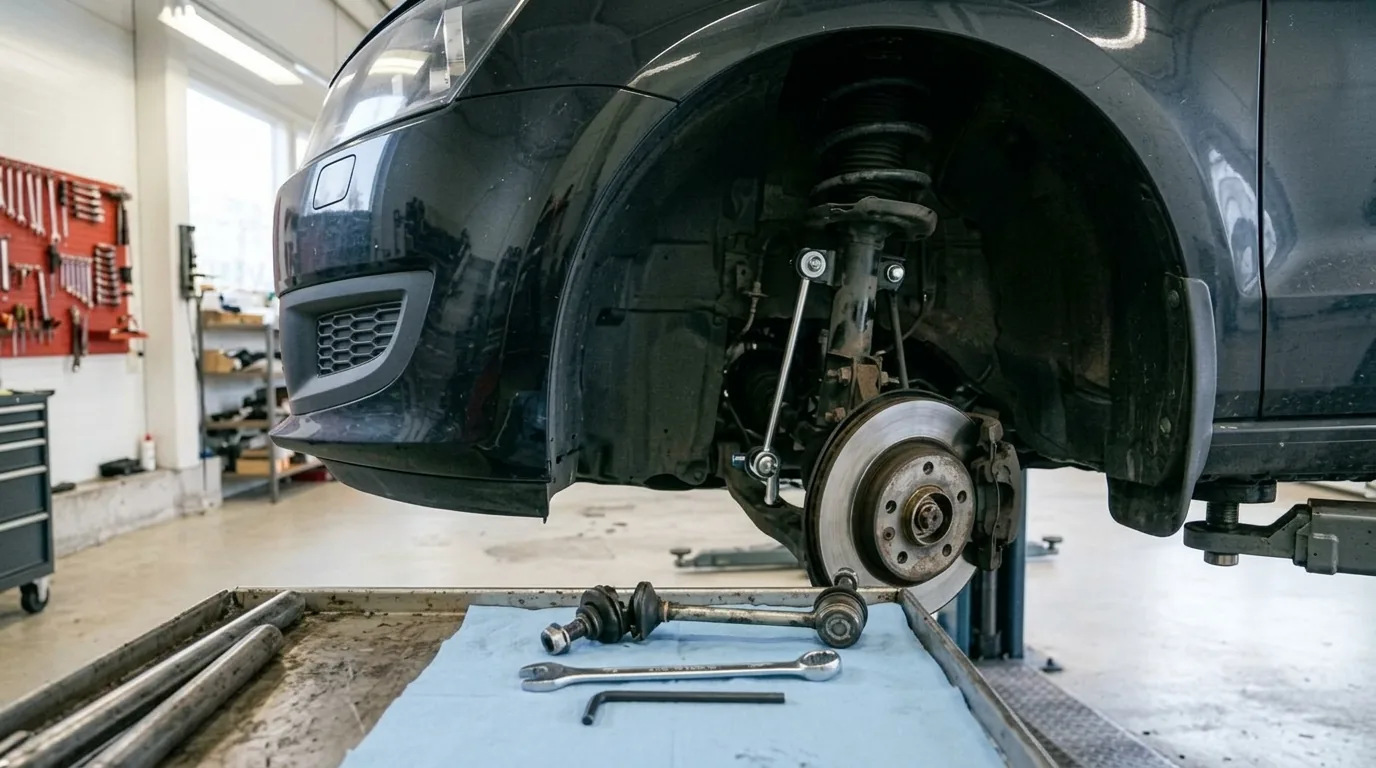
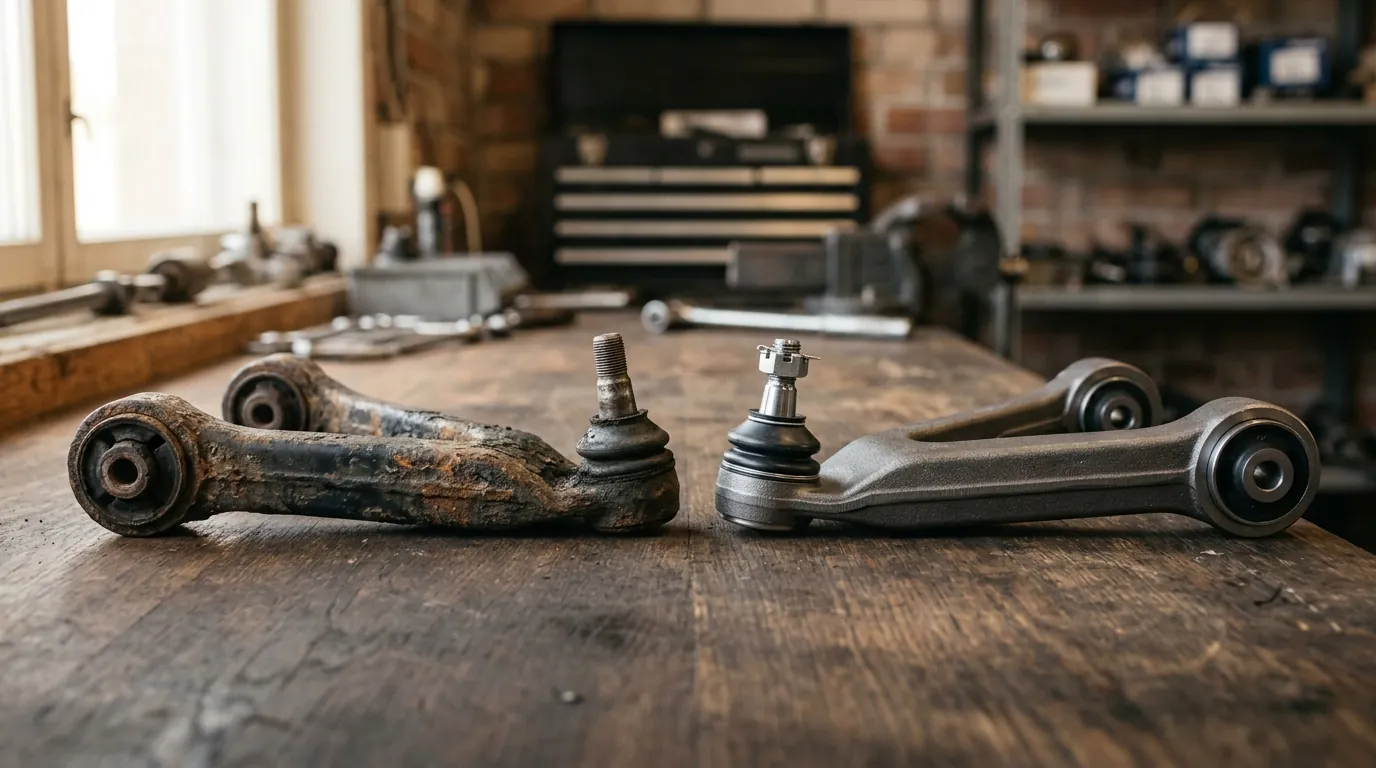
The shock absorber top mount and its rubber usually clunk over bigger potholes or bumps, as the suspension compresses and rebounds. Control arm bushes and the ball joint give a duller clunk, and their play can also be felt in the steering or under braking. If the clunk comes specifically as you start to brake, the control arm's rear bush is one of the first places to check.
You can get a rough idea of a shock absorber's condition yourself. Push one corner of the car down and let go. If the body goes on bouncing several times, the damper is probably weak. The test says nothing about the condition of the top mount or the bushes, but an oily damper body in the wheel arch points to a leak.
Clunking from the front when you turn
A noise when you turn has three common sources, and you can tell them apart by when you hear it.
- Clicking when you turn sharply and accelerate, for example in a car park or at a junction. This is the typical sound of a CV joint on a front-wheel-drive car. The joint often wears because its boot has torn, letting the grease out and grit in.
- Knocking you can feel through the steering wheel on an uneven road. It points to a track rod end or another joint in the steering linkage.
- Creaking or a clunk when you turn the steering wheel with the car at a standstill or moving slowly. It often comes from the bearing at the top of the shock absorber, on which the whole strut turns.
You can confirm a CV joint noise safely in an empty car park:
- Turn the steering wheel almost to full lock.
- Drive slowly in a circle and accelerate a little.
- Do the same in the other direction.
- If the clicking is heard only when turning and gets louder as you accelerate, it is probably the outer CV joint.
At the inspection a torn boot only earns a repair notice (korjauskehotus), but worn CV joints are grounds for rejection or a driving ban. If the boot is replaced in time, the joint is often saved. See CV boot replacement and track rod end replacement.
Clunking at low speed
Clunking at walking pace often comes from an anti-roll bar link or an anti-roll bar bush. They come into play when the left and right wheels move out of step, for example when you drive over a kerb at an angle or into a driveway. The anti-roll bar twists, the play makes itself heard, and at low speed no other noise drowns it out.
Not all clunking comes from the suspension. A loose exhaust heat shield rattles even at idle and under acceleration, and loose items in the boot or a door pocket sound surprisingly like a suspension fault. Empty the boot and the glove box before you book, and one possible cause is already ruled out.
A light rattle on a rough road can also come from the brakes. If the noise stops when you press the brake pedal lightly, the cause may be that the brake pads or their retaining clips have play in the caliper. It is not a suspension fault, but it is worth having it checked at the same visit.
Clunking from the rear
Faults at the rear are recorded at the inspection less often than faults at the front, but clunking at the rear has several sources too:
- Rear axle bushes and control arms. On many front-wheel-drive cars the rear axle is a one-piece beam attached to the body by two large rubber bushes. When the bushes wear loose, the rear end clunks over bumps and can feel as if it is steering itself in corners.
- Rear shock absorbers and their mountings. A loose top mount clunks, and a worn-out damper lets the wheel bounce.
- Rear anti-roll bar links, if the car has them. The sound is the same as at the front.
- Rubber exhaust hangers. A stretched or broken hanger lets the pipe knock against the body.
- The spare wheel, jack or tools in the bottom of the boot, if their fixings have come loose.
- A propshaft or driveshaft joint on a rear-wheel-drive or four-wheel-drive car. It is typically heard as a clunk when you pull away or change gear.
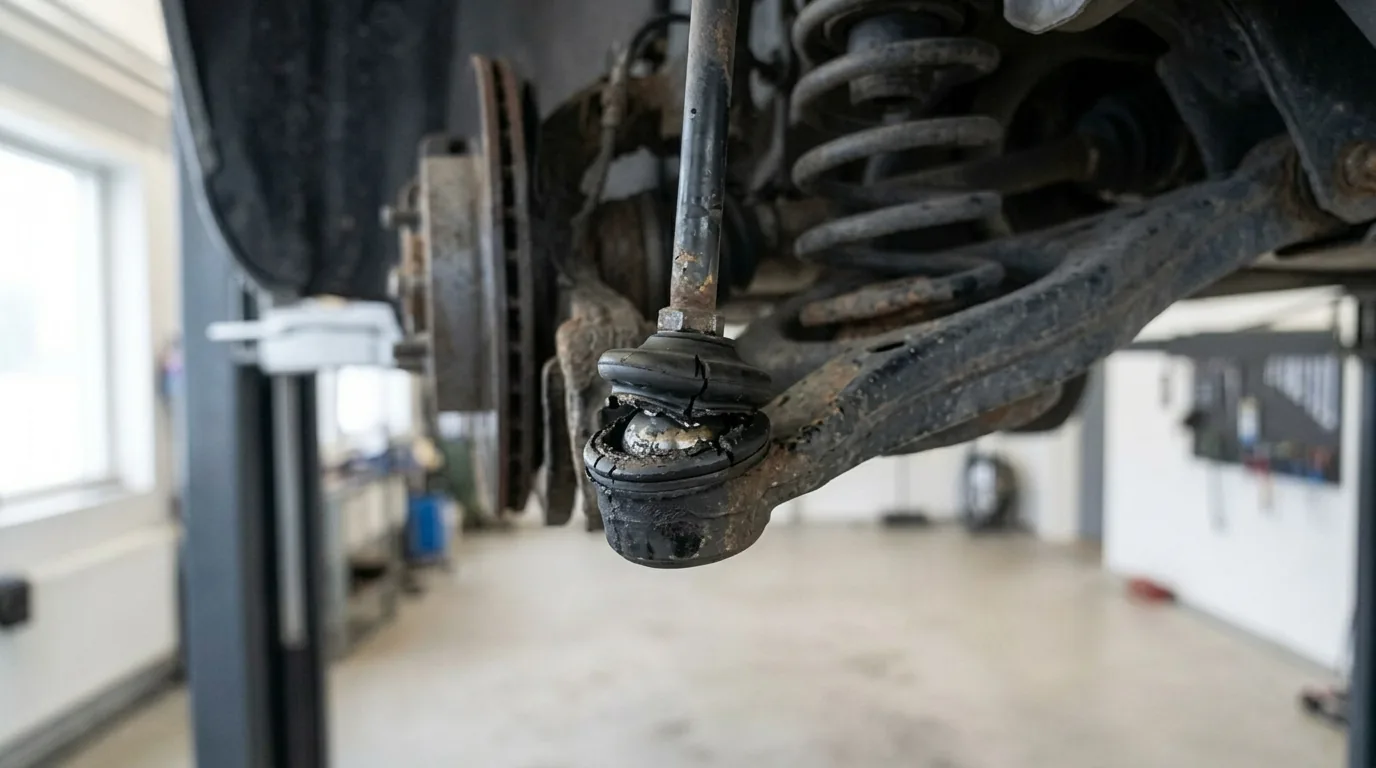
In 2025 the rear axle was the third most common rejection cause among the chassis items, after the front axle and the suspension. The rear anti-roll bar mounting has the same 1 mm play limit as the front one. Worn propshaft joints are grounds for rejection or a driving ban, and under the inspection criteria an exhaust mounting at risk of coming loose fails the car.
Is clunking dangerous?
The clunk itself does not break anything, but it tells you there is play. Play wears a tyre unevenly, often on the inner or outer edge, and the steering becomes imprecise. Turn the steering wheel to full lock and look at the edges of the front tyres: if one edge has clearly worn more than the other, the play or the alignment has already affected how the car drives. At worst a worn joint can come apart, and then the wheel is no longer under control. That is why the inspection judges these same parts strictly. Under the inspection criteria of Traficom (the Finnish Transport and Communications Agency), the inspector tests the joints on a play detector and by rocking them by hand, and assessing them by ear is also part of the check.
| What the inspector records | Result |
|---|---|
| Play in a ball joint caused by wear | Failed or driving ban |
| Play in the control arm bearings caused by wear | Failed or driving ban |
| Play in the steering linkage joints caused by wear | Failed or driving ban |
| Worn CV joints | Failed or driving ban |
| Play caused by wear in a shock absorber that supports the wheel | Failed |
| More than 1 mm of play in an anti-roll bar mounting | Repair notice or failed |
| Damaged ball joint or CV joint boot | Repair notice |
A car that clunks can usually be driven as far as the workshop. If the steering starts to feel loose, the car wanders in its lane or the clunking turns into a constant pounding, do not drive on. A joint may then have serious play, and it is wise to bring the car in for a check immediately, on a tow truck if necessary.
Describe the noise when you book
A good description shortens the search for the fault on the lift. You do not need to know the right name for the noise. It is enough to tell us when you hear it.
- Where? Front or rear, left or right. If you are not sure, say that too.
- When? Over a bump, in a pothole, when turning, braking or accelerating.
- At what speed? At walking pace, in town or on the open road.
- Cold or warm? Do you hear it only in the morning, or all the time?
- Since when? Did the noise start after you hit a pothole, for example, or after a tyre change or a repair?
A description such as «a single clunk from the front left when I drive over a speed bump at walking pace» narrows the fault down to a few parts while we are still on the phone. With these details we can also book the right amount of time for the job.
The causes of clunking at a glance
| When it clunks | Likely part | Service |
|---|---|---|
| Over small bumps at low speed | Anti-roll bar link, anti-roll bar bush | Anti-roll bar link replacement |
| In a big pothole | Shock absorber top mount or the damper | Shock absorber replacement |
| A dull clunk as you start to brake or over a bump | Control arm bush, ball joint | Ball joint replacement, suspension repair |
| Clicking as you accelerate through a sharp turn | CV joint | CV boot replacement |
| Knocking felt through the steering wheel | Track rod end | Track rod end replacement |
| Creaking as you turn the steering wheel at a standstill | Shock absorber top bearing | Suspension repair |
| Rattling at idle or under acceleration | Exhaust heat shield or hanger | Exhaust repair |
The table is based on experience in the workshop. The same noise can sometimes come from a different part, which is why only the lift gives the final answer.
Clunking in the 2025 inspection statistics
The suspension and steering parts that clunk account for the largest group of rejections at the inspection. In 2025, passenger cars first registered in 2005–2021 went through 1 672 937 inspections, which recorded a total of 783 266 rejection faults. The four items below accounted for 327 710 of them, or 41.8 %.
| Inspection item | Rejection faults | Repair notices |
|---|---|---|
| Front axle | 126 260 | 54 334 |
| Suspension and damping | 101 496 | 17 492 |
| Rear axle | 51 338 | 13 731 |
| Steering joints and rods | 48 616 | 1 606 |
Of the individual inspection items, the front axle was the most common rejection cause. It covers the ball joints, the control arms and their bushes, and the anti-roll bar mountings. For steering joints and rods only 1 606 repair notices were issued: when a fault is found there, the result is almost always a rejection. So a clunk is worth investigating before the inspection, not after it.
The front axle also drew 54 334 repair notices. A torn boot or slight play in the anti-roll bar, recorded as a notice, can mean a rejection as early as the next inspection. We explain what to do about a notice in our article on the repair notice.
When should you go to a workshop?
When the clunking has gone on for a week or two and does not go away, or immediately if the steering feels different. You cannot reliably locate a noise with the car standing in the street. On the lift the mechanic tests the joints by hand and with a pry bar, which reveals the play and identifies the worn part. At the same time we check the tyre wear and the condition of the shock absorbers, because they show whether the play has already had time to affect how the car drives.
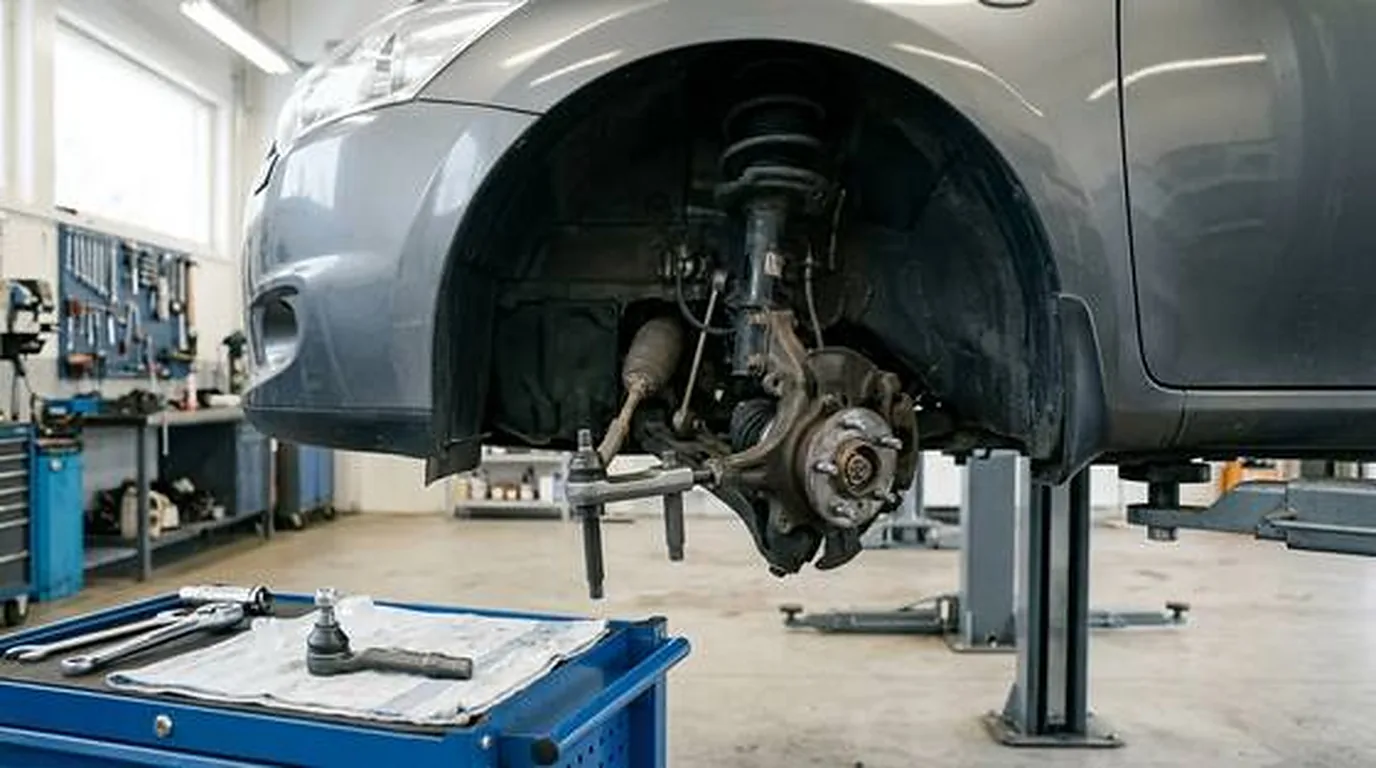
Then we tell you which part needs replacing and what the work costs. Nothing is replaced until you have accepted the price. Many clunk repairs are short jobs: replacing an anti-roll bar link usually takes less than an hour, replacing one lower ball joint from half an hour to two hours, and replacing a track rod end, including the toe setting, usually 1–2 hours. The check and the repair can often be done at the same visit: see suspension repair. When steering or front axle parts are replaced, it is worth checking the wheel alignment at the same time: see four-wheel alignment.
If the noise fits none of the descriptions here, start with diagnostics. If the car vibrates when you brake, the cause is usually in the brakes, and we cover that in our article on vibration when braking.