
Wheel bearing replacement
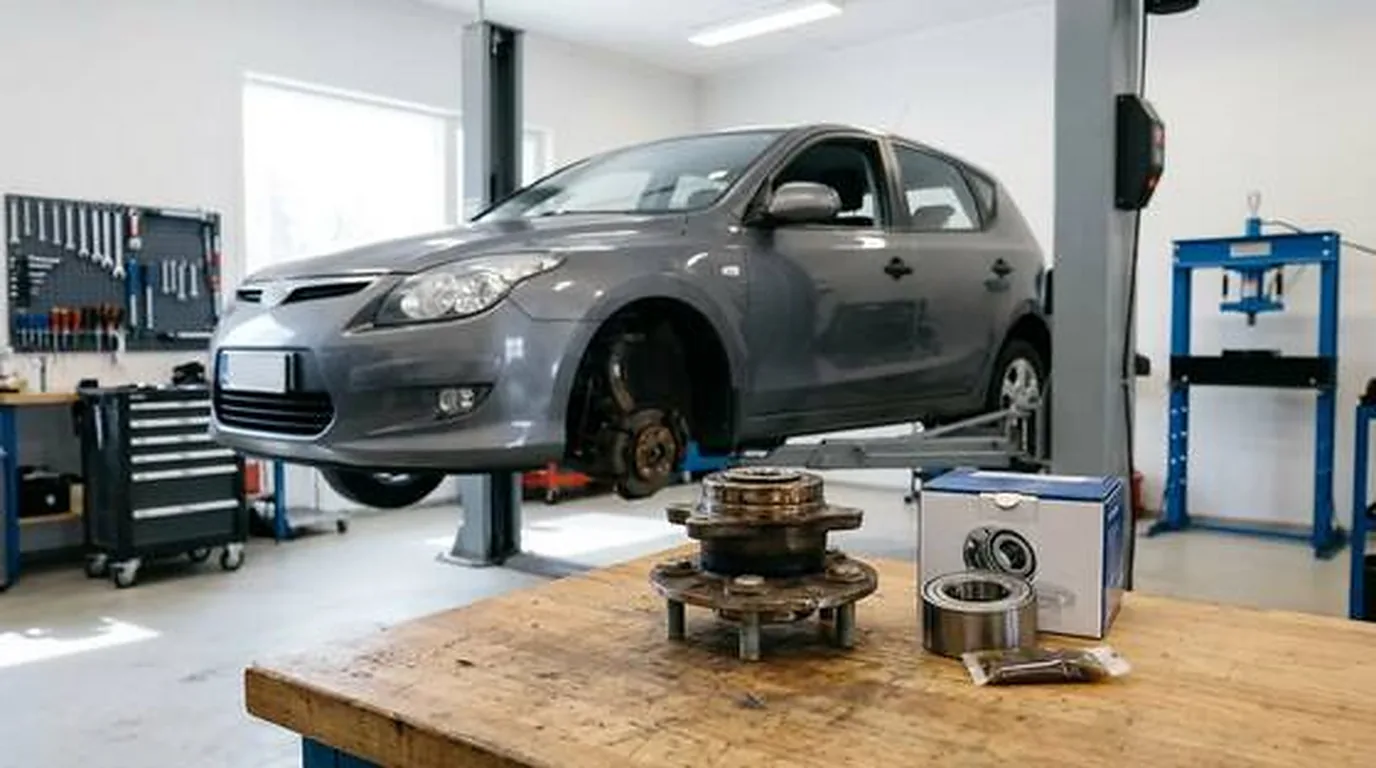
We replace a worn wheel bearing at the front or the rear, whatever the make. Replacing the bearing on one wheel usually takes about an hour, and we tell you the price before the work starts.
estimate
approx. 245 €
- Takes about
- 60 min
- Prices include VAT
- 25,5 %
- Locating the noise on a road test and on the lift, so that the bearing is replaced on the wheel the noise comes from
- A new bearing for one wheel: a bearing kit or a hub with the bearing built in, whichever the car uses
- A pressed-in bearing removed and fitted with a press
How it works
Call us or drop in
Give us the registration. We confirm the price and agree a time in the same call.
We do the work
You get the car back at the time we agreed.
Takes about 60 min
You pay the agreed price
No surprises on the invoice. If we find anything else, we call before we touch it.
A hum that grows louder as the speed rises is worth having checked soon. A worn bearing does not go quiet on its own, and excessive play fails the inspection.
Call 045 262 5950What the price includes
What the price includes
- Locating the noise on a road test and on the lift, so that the bearing is replaced on the wheel the noise comes from
- A new bearing for one wheel: a bearing kit or a hub with the bearing built in, whichever the car uses
- A pressed-in bearing removed and fitted with a press
- The hub nut and fixing bolts tightened to the manufacturer's torque, single-use nuts and bolts renewed
- The ABS sensor checked and the fault memory read after the work
- Road test and a check of the bearing on the other side
What the price does not include
- The bearing on the other side. If it also has play or noise, you get a separate price for replacing it.
- The ABS sensor, if it is already faulty or rusted in so badly that it breaks on removal.
- Brake discs and pads, even though the disc comes off for the job. If they are worn, we tell you.
- Replacing a CV joint, a driveshaft or a CV boot, if they turn out to be worn as well.
- Wheel alignment, if the steering knuckle has to come off and an alignment is needed afterwards.
About this work in detail
The wheel bearing sits in the hub, and the wheel turns on it. It carries the car's weight and takes the side forces that build up in corners. The wheel bearings on current cars are lubricated for life and maintenance-free: they are not greased or adjusted, and a worn bearing is replaced with a new one.
There are two main designs. In one, the bearing is a separate part pressed into its housing, at the front usually the steering knuckle. In the other, the bearing is built into the hub, and the whole hub is replaced as one piece, usually bolted on. Which one a car has depends on the model, and often on whether it is the front or the rear wheel.
On many cars the ABS sensor reads the wheel speed from a magnetic ring in the bearing seal. A bearing fault can therefore also show up as an ABS or stability control (ESP) warning light, and a new bearing has to be fitted the right way round.
Read the full guide
How to tell a bearing is worn
- A hum or a drone that grows louder as the speed rises. It is often clearest at open-road speeds.
- The noise changes in corners. If it grows louder when turning left, the fault is often on the right, because the weight then shifts onto the right-hand wheels. Turning right, it is the other way round.
- A badly worn bearing grinds or rasps, and vibration may be felt in the steering wheel or the floor.
- The ABS or ESP light comes on.
- When the wheel is rocked at the top and bottom on the lift, it has play.
The same hum can also come from the tyres. Studded tyres and unevenly worn tyres drone in a way that is hard to tell from a bearing. So we locate the noise before we replace anything.
When the bearing is replaced
There is no manufacturer interval for a wheel bearing. It is replaced when it has play, makes noise or shows damage. How long one lasts varies a great deal. Knocks from potholes and kerbs, water and road salt getting past the seal, and mistakes in an earlier fitting all shorten its life.
Once a bearing has started to hum, the noise does not go away. It usually grows gradually, but how fast is hard to predict.
Wheel bearings do not have to be replaced in pairs. If the other bearing on the same axle is just as old and also has play, we tell you that and the price of replacing it before we start.
How the work is done
- We road test the car and listen to where the noise comes from and how it changes in corners.
- On the lift we spin the wheels by hand, rock them and look at how the tyres have worn. That is how we tell a bearing noise from tyre, brake and CV joint noises.
- We remove the wheel, the brake caliper, the brake disc and the ABS sensor. On a driven wheel we also undo the hub nut and free the driveshaft from the hub.
- If the bearing is part of the hub, we unbolt the old hub and fit the new one. A pressed-in bearing we replace with a press, and for that we often take the bearing housing off the car. We do not drive a bearing in with a hammer, because the blow damages the new bearing.
- We reassemble and tighten the hub nut and the other fixings to the manufacturer's torque. Nuts and bolts specified as single-use are replaced with new ones.
- We check that the ABS sensor gives a signal and read the fault memory.
- We road test the car and make sure the noise has gone.
How long it takes
Replacing the bearing on one wheel usually takes about an hour, and from just under an hour to a couple of hours depending on the design. A bolt-on hub is quicker to replace than a pressed-in bearing, and parts rusted in place make the job longer. If the part has to be ordered, we tell you when the car will be ready as soon as you book.
What the price depends on
The price depends on:
- Front or rear wheel. The design and the work differ between the front and the rear. On a driven wheel the driveshaft also has to be freed from the hub.
- Design. A bolt-on hub or a pressed-in bearing. A separate bearing kit is often the cheaper part, but fitting it takes more work.
- Parts. Original and aftermarket parts differ in price.
- Rust. On a car driven on salted roads the driveshaft can rust into the hub, the bearing into its housing and the ABS sensor into its seat. Freeing them takes time, and a sensor rusted in place can break.
- Other findings. With the wheel off we also see the condition of the brakes and the CV boot. Repairing them is not part of the bearing price.
We check the car and tell you the price before the work starts. If something else that needs repair turns up once it is apart, we call you before going on.
Wheel bearings and the inspection
The inspection checks the wheel bearings at both the front and the rear. The inspector checks for play with the play detector and by hand, and spins the tyre while feeling at the spring whether the bearing runs smoothly. Under Traficom's inspection rules, excessive play, a bearing that is too tight and a damaged bearing are all grounds for failing the car. If the fault is dangerous, the car also gets a driving ban.
According to Traficom's statistics, inspections in 2025 recorded 126 260 failing faults on front axles and 51 338 on rear axles. Together they are 22.7 % of all failing faults. Front axles also drew 54 334 repair notices and rear axles 13 731. The statistics do not say how many of the faults concerned wheel bearings, because ball joints and control arms, for example, belong to the same groups.
If a bearing is already humming, it is worth replacing before the inspection. After a failure you face a re-inspection on top of the repair.
What you can check yourself
- Drive on a quiet road with the radio off and listen whether the noise changes with road speed. If it changes when you shift gear or lift off the throttle, it usually does not come from a bearing.
- Somewhere safe, weave gently from side to side. If the noise grows when turning one way, tell us which.
- Run a hand over the tyre tread. Saw-tooth or other uneven wear can cause the same hum.
- Note whether the ABS or ESP light is on.
Play in a wheel is hard to check without a lift, so leave that to us.
When not to drive the car
With a mild hum you can usually still drive, but book a time soon. Do not set off on a longer drive if
- the hum has turned into grinding, rasping or knocking
- the steering wheel or the whole car vibrates
- the car pulls to one side or a wheel has play.
A bearing worn right out heats up, and at worst it can seize or break up while driving. The wheel can then start to wobble and the car becomes harder to control. If you suspect this, call us before you set off.
If something else needs fixing
We do not start work you do not know about. If the car needs something else fixed, we call and tell you what the extra work costs and what happens if it is left undone. You decide.
The final price may exceed the estimate by at most 15 per cent, additional work included.
We work to the motor vehicle service and repair terms approved by the consumer advisory board of the Finnish motor trade.
Related work

Seasonal tyre change
Tyres already on rims. We tell you if the tread will not last another winter.
29 €
Inspection repairs
We repair the faults on the rejection list, item by item. The price comes from the list, before any work starts.
Ask the price
Suspension repair
Control arms, joints and shock absorbers. The price is assessed from what the lift shows.
Ask the price
Shall we agree a time?
Leave a booking request online or call. We confirm the time and tell you the price before any work starts.
estimate
approx. 245 €
- Address
- Lampputie 12 C 67
00750 HelsinkiShow on the map - Opening hours
- Mon–Fri8.00–18.00Sat9.00–15.00Sunclosed
- Phone
- 045 262 5950
- huolto@caron.fi