
Shock absorber replacement
We replace worn shock absorbers in pairs, front or rear, on all makes. Replacing the front pair usually takes 2 to 4 hours, and we tell you the price before the work starts.
typical price range
390–
We tell you the exact price for your car before the work starts.
- Prices include VAT
- 25,5 %
- Both front shock absorbers replaced with new ones, parts and labour
- A suspension check on the lift before the work: dampers, springs, top mounts, dust covers and bump stops
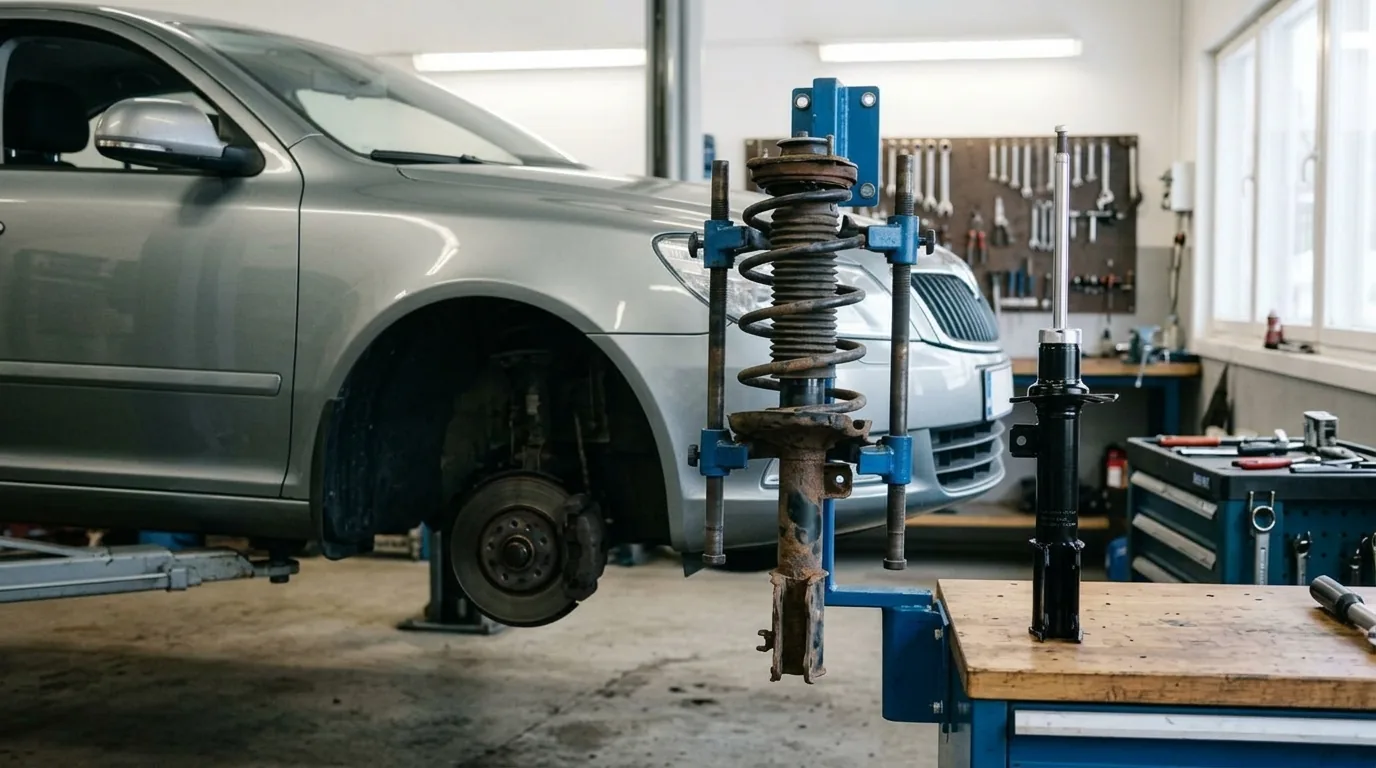
- The spring moved onto the new damper with a spring compressor
How it works
Call us or drop in
Give us the registration. We confirm the price and agree a time in the same call.
We do the work
You get the car back at the time we agreed.
You pay the agreed price
No surprises on the invoice. If we find anything else, we call before we touch it.
Bring the car in for a check well before the inspection. Then worn dampers can be replaced in advance, and the car does not have to go back for a re-inspection after a fail.
Call 045 262 5950What the price includes
What the price includes
- Both front shock absorbers replaced with new ones, parts and labour
- A suspension check on the lift before the work: dampers, springs, top mounts, dust covers and bump stops
- The spring moved onto the new damper with a spring compressor
- Fixings tightened to the manufacturer's torque, and single-use nuts and bolts replaced where the manufacturer requires it
- Road test and a check of the work on the lift
- Replaced parts shown on request
What the price does not include
- Rear shock absorbers. Replacing them is a job of its own, with its own price.
- Top mounts, dust covers and bump stops, if they are worn. We tell you their price before replacing them.
- Spring replacement, if a spring has broken or sagged.
- Wheel alignment. We tell you whether it is needed and what it costs.
- Air suspension and electronically adjustable dampers. Their parts cost considerably more, and the price is always given separately.
About this work in detail
The springs carry the car's weight. A shock absorber's job is to slow the spring's movement, so the wheel stays on the road and the body settles straight after a bump. Without a damper the car would keep bouncing after every pothole.
Inside the damper is oil, which flows through small valves in the piston every time the wheel moves up or down. The resistance to that flow turns the energy of the movement into heat. Most current dampers also hold pressurised gas, which keeps the oil from foaming. At the front, on most cars the damper is part of a strut: a coil spring sits around it, and a top mount at the upper end of the strut. At the rear, many cars have the damper and the spring separately.
A damper wears so slowly that the driver gets used to the change. The difference is often only felt once the dampers have been replaced.
Read the full guide
How to tell the shock absorbers are worn
- The car keeps bouncing after a bump or a pothole, and the body feels soft and floaty.
- The nose dives noticeably under braking, and the body leans more than usual in corners.
- The car feels unsteady at motorway speed and is sensitive to crosswinds.
- The tyres show cupping: the tread has worn in patches.
- There is oil on the damper body, or dirt built up from oil and dust.
- There is a knocking or clunking over bumps. The noise can come from the damper, but just as well from a top mount, an anti-roll bar link or another suspension part.
A worn damper also costs grip. When the tyre bounces on an uneven surface it is not firmly on the road all the time, and the braking distance can grow, especially on a wet, bumpy road.
When shock absorbers are replaced
Most carmakers set no replacement interval for shock absorbers, in kilometres or in years. Dampers are replaced on condition, and the condition is checked at services and at the inspection. How fast they wear depends on the roads, the load and the driving. On potholed roads and in a heavily loaded car they tire sooner.
Workshops' rule of thumb is to check the dampers by about 100 000 km at the latest, and at every service after that. The dampers of an old car with low mileage are worth a check as well, because seals and rubber parts perish with age.
Why always in pairs
Dampers are always replaced in pairs on the same axle: both front dampers or both rear dampers. A new and a worn damper damp differently, and the car can pull to one side under braking and behave differently in left and right corners. Replacing only one shock absorber therefore makes no sense, even if only one of them is leaking.
At the inspection, a large difference between the dampers on one axle is grounds for a fail. If the dampers on both axles are worn, all four can be replaced at the same visit.
How the work is done
- We lift the car and check the suspension: damper leaks and fixings, springs, top mounts, dust covers and bump stops.
- We tell you what needs replacing and what it costs. The work starts only once you have accepted the price.
- We remove the wheel and then free the strut at its lower and upper mountings. Where needed we also remove the anti-roll bar link and the brake hose and sensor cable brackets.
- We compress the spring with a spring compressor and move it onto the new damper. If a top mount, dust cover or bump stop is worn and you have accepted its price, we replace it at this stage.
- We reassemble the strut, fit it back and tighten the fixings to the manufacturer's torque. Where the manufacturer says a nut or bolt is single-use, we replace it with a new one.
- We road test the car and check the work once more on the lift.
At the rear the job is simpler on many cars, because the damper is separate from the spring and the spring does not have to be compressed. After the front dampers are replaced the wheel angles are worth checking, because removing the strut can change them. We tell you if an alignment is needed.
How long it takes
Replacing the front shock absorbers, road test included, usually takes 2 to 4 hours. Replacing the rear pair is usually 1 to 2 hours of work. It takes longer if bolts have rusted in, or if the top mounts or springs are replaced at the same time. If all four dampers are replaced in one go, be prepared to leave the car with us for the whole day.
What the price of shock absorber replacement depends on
The price depends on:
- How the suspension is built. Whether the damper is part of a strut or separate from the spring, and how much of the suspension has to come apart before the damper can be reached.
- Parts. Original and aftermarket parts differ in price. A ready-assembled strut, with the damper, spring and top mount, speeds up the work but costs more as a part.
- Rust. On a car driven on salted roads the strut often rusts in place and bolts seize, and freeing them takes time.
- Other worn parts. Top mounts, dust covers, bump stops and springs are worth replacing at the same time if they are worn, because they come off during the job anyway.
- Special suspension. Parts for air suspension and electronically adjustable dampers cost considerably more than ordinary ones.
We check the car and tell you the price before the work starts. If something else turns up during the work, we tell you about it and its price before going on.
Shock absorbers and the inspection
At the inspection the dampers are checked by eye, by rocking the car by hand or on a damper tester, and during the test drive. Under Traficom's inspection rules, the car fails if the damping is insufficient, if a damper is damaged, seized or missing, or if one damper on an axle is considerably weaker than the other. A leaking damper and a faulty mounting lead either to a fail or to a repair notice, depending on how serious the fault is. Slight seepage does not count as a fault at the inspection.
According to Traficom's statistics, in the periodic inspections of passenger cars in 2025 a suspension or damping fault was grounds for a fail 101 496 times and for a repair notice 17 492 times. That is about 13 % of all grounds for a fail. Of the inspection items, only front axle faults were grounds for a fail more often. The statistics do not separate dampers from springs.
If the inspection certificate mentions a damper or the suspension, bring the certificate with you. It shows us straight away what the inspector found.
What you can check yourself
- Push one corner of the car down hard and let go. With a sound damper the body rises back and settles almost at once. If it keeps bouncing, the damper is probably tired. The test is crude, and it does not reveal mild wear.
- Turn the steering wheel to full lock and look behind the front wheel with a torch. An oily, dusty damper body points to a leak.
- Look at the tyre tread. Cupping often points to the dampers.
- Note when the car bounces or knocks, and tell us. It speeds up the diagnosis.
When not to drive the car
A worn damper on its own is no reason to leave the car standing, but it is worth booking a time soon. Until then, drive calmly and keep a longer gap than usual, especially on wet and bumpy roads. Do not drive the car if
- a spring has broken
- a damper has come loose from its mounting or knocks hard
- the car leans clearly to one side or a tyre touches the body.
The sharp end of a broken spring can puncture the tyre, and a loose damper can damage the brake hose or other parts. In that case it is best to have the car towed to the workshop.
If something else needs fixing
We do not start work you do not know about. If the car needs something else fixed, we call and tell you what the extra work costs and what happens if it is left undone. You decide.
Once we have seen the car, we tell you the price and whether it is a fixed price, a maximum price or an estimate. The work starts only once you have accepted the price.
We work to the motor vehicle service and repair terms approved by the consumer advisory board of the Finnish motor trade.
Related work

Inspection repairs
We repair the faults on the rejection list, item by item. The price comes from the list, before any work starts.
Ask the price
Suspension repair
Control arms, joints and shock absorbers. The price is assessed from what the lift shows.
Ask the price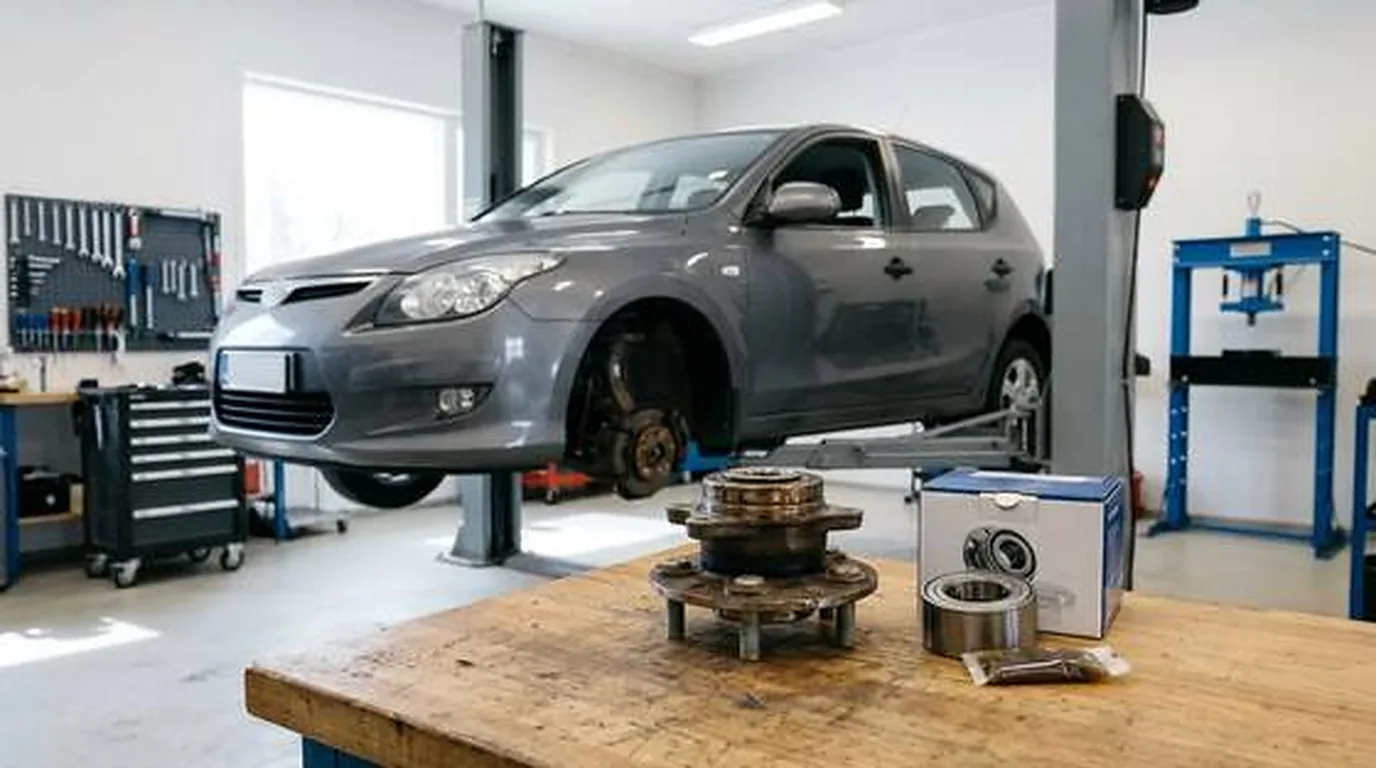
Front wheel bearing, one side
Bearing and fitting for one front wheel.
approx. 245 €
Shall we agree a time?
Leave a booking request online or call. We confirm the time and tell you the price before any work starts.
typical price range
390–
We tell you the exact price for your car before the work starts.
- Address
- Lampputie 12 C 67
00750 HelsinkiShow on the map - Opening hours
- Mon–Fri8.00–18.00Sat9.00–15.00Sunclosed
- Phone
- 045 262 5950
- huolto@caron.fi