
Four-wheel alignment
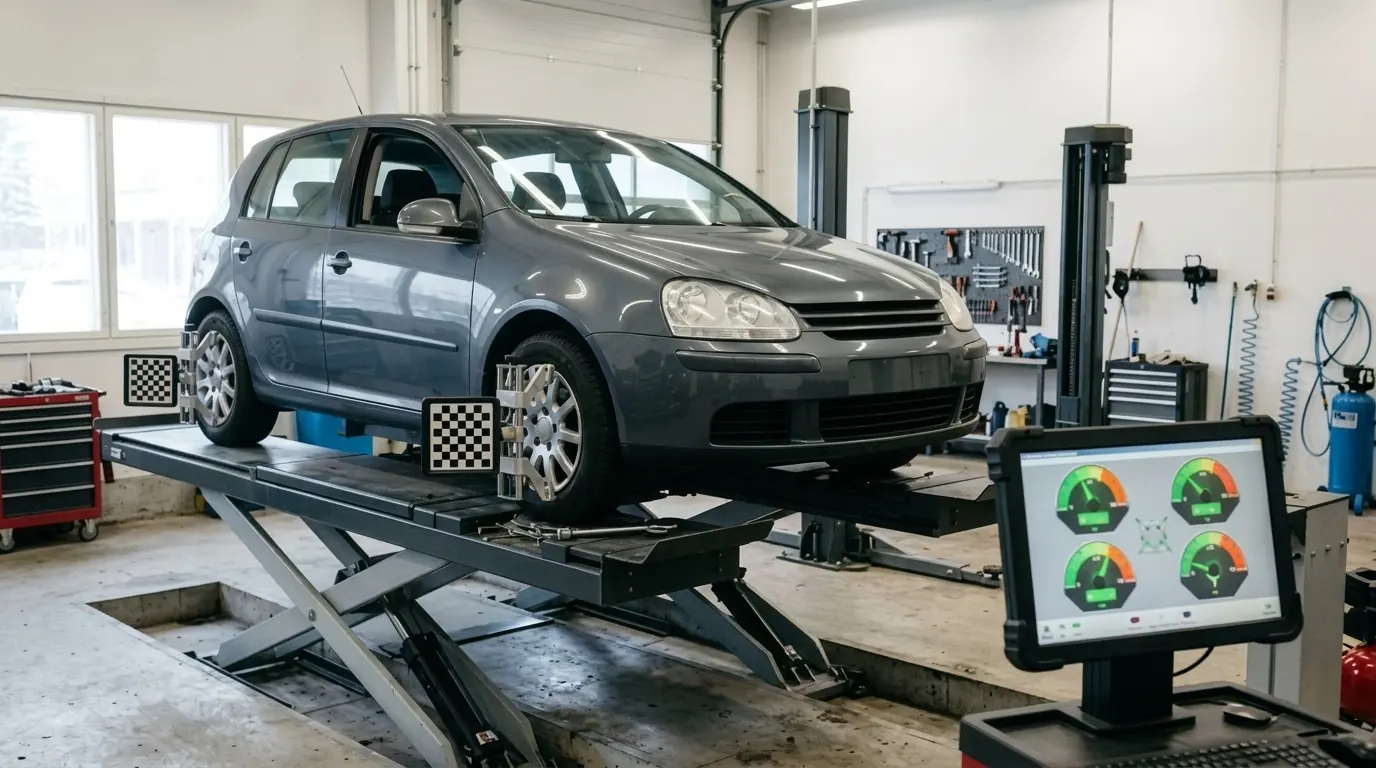
In a four-wheel alignment we measure the angles of all four wheels and set them to the manufacturer's values as far as the car's design allows. We check the steering and suspension joints first and tell you the price before the work starts.
estimate
approx. 95 €
- Takes about
- 105 min
- Prices include VAT
- 25,5 %
- Tyre pressures set and tyre wear checked before measuring
- Steering and suspension joints checked on the lift: track rod ends, ball joints, control arm bushes and wheel bearings
- Angles measured against the manufacturer's values: toe and camber on all four wheels, caster on the front wheels
How it works
Call us or drop in
Give us the registration. We confirm the price and agree a time in the same call.
We do the work
You get the car back at the time we agreed.
Takes about 105 min
You pay the agreed price
No surprises on the invoice. If we find anything else, we call before we touch it.
Winter potholes and frost damage can knock the alignment out. In spring the alignment can be done at the same visit as the seasonal tyre change.
Call 045 262 5950What the price includes
What the price includes
- Tyre pressures set and tyre wear checked before measuring
- Steering and suspension joints checked on the lift: track rod ends, ball joints, control arm bushes and wheel bearings
- Angles measured against the manufacturer's values: toe and camber on all four wheels, caster on the front wheels
- Rear wheels adjusted where the rear axle is adjustable, and front toe set to the direction the rear wheels point
- Steering wheel set straight, and the steering angle sensor reset on cars that need it
- A measurement report showing the values before and after adjustment
- Road test
What the price does not include
- Replacing worn parts. If a track rod end or ball joint has play, or a control arm bush is worn, we tell you what we found and what the repair costs before we go on.
- Correction parts for camber and caster, such as eccentric bolts, where the car has no adjustment of its own for them.
- Wheel balancing. If the steering wheel shakes at a particular speed, the cause is usually balance, and an alignment does not cure it.
- Calibrating the camera and radar of the driver assistance systems. Some manufacturers require it after an alignment. We tell you before the work whether it applies to your car.
- New tyres. We do not sell tyres.
About this work in detail
What an alignment adjusts
An alignment sets the angles of the wheels relative to each other and to the road. There are three main angles. Toe says whether the wheels on one axle point straight ahead or slightly towards each other; when they point away from each other, it is called toe-out. Wrong toe wears tyres fastest of all. Camber says how far the wheel leans when seen from the front, and too much camber wears one edge of the tyre. Caster concerns the steered front wheels. It affects how steadily the car holds a straight line and whether the steering wheel returns to the centre by itself after a bend.
A four-wheel alignment measures all four wheels even when the rear wheels cannot be adjusted. The rear wheels decide which way the car travels, and the front wheels are set to match. If only the front is aligned, the steering wheel can stay crooked even though the front values are within limits.
The manufacturer gives each angle a target value and permitted limits. The values depend on the model and the suspension version, so there is no one correct figure for every car. We always compare the measurements with the values for your model.
Read the full guide
Signs that the alignment may be out
- The steering wheel is off centre while the car goes straight.
- The car pulls to one side on a level road.
- The tyres wear unevenly. One edge wears faster than the middle, or the tread blocks feel saw-toothed when you run a hand across the tread.
- The car hit a kerb or a deep pothole, and the steering wheel has sat at a different angle since.
Not all pulling comes from the alignment. A pressure difference between tyres, a sticking brake caliper or a faulty tyre can cause the same symptom. The road matters too: a carriageway usually slopes towards its edge, so a slight drift to the right is normal. Steering wheel vibration at road speed, on the other hand, usually comes from wheel balance, not from the alignment.
When an alignment is due
An alignment usually has no fixed interval in kilometres or years in the service schedule; it is done when needed. If the car runs straight, the steering wheel is centred and the tyres wear evenly, no alignment is needed. An alignment is needed:
- every time a track rod, a track rod end or the steering rack is replaced
- usually after a control arm or a suspension strut is replaced
- after a hard impact, if the steering wheel's position or the way the car runs changed
- when new tyres go on and the old ones had worn unevenly, so that the new ones do not wear the same way
Frost damage, ruts and potholes load the steering and suspension all winter, and in spring many cars are due for an alignment. It can be done at the same visit as the seasonal tyre change.
How the alignment is done
- Tyres and pressures. We set the tyre pressures to the manufacturer's values and look at how the tyres have worn. The wear pattern often shows in advance which angle is out.
- Joints on the lift. We check the track rod ends, ball joints, control arm bushes and wheel bearings. On loose suspension the angles shift while driving, so the alignment does not hold. If we find a worn part, we tell you the price of the suspension repair before we go on.
- Measuring. The alignment rig's measuring heads or targets are fitted to the wheels, and the rig measures the angles of all four. The results are compared with the manufacturer's values.
- Adjusting. If the rear axle is adjustable, we set the rear wheels first. Then we set the front camber and caster, where they can be adjusted. Last, we lock the steering wheel straight and set the front toe to the direction the rear wheels point.
- Steering angle sensor. On many current cars the sensor is reset with a diagnostic tool after the alignment, so the stability control knows where the steering wheel's straight-ahead position is.
- Results and road test. You get a measurement report showing the values before and after the adjustment. On the road test we make sure the car runs straight and the steering wheel is centred.
On many cars only the toe can be adjusted, and camber and caster are fixed. If they are clearly out, the cause is usually a bent or worn part, and we tell you the price of that repair separately. At the rear, many small and mid-size front-wheel-drive cars have a torsion beam axle with no adjustment at all. On a multi-link rear suspension the rear toe, and often the camber too, can be adjusted.
How long an alignment takes
A four-wheel alignment usually takes 1.5 to 2 hours. It takes longer if the adjusters have rusted solid or if a joint has to be replaced before the alignment. Once we have checked the car, we tell you when it will be ready.
What affects the price
Measuring and adjusting are a similar job on most cars. The price varies between cars mainly for these reasons:
- An adjustable rear axle. A multi-link rear suspension has more adjustment points than a torsion beam axle, and the work takes longer.
- Rusted adjusters. Road salt makes track rod lock nuts and adjusting bolts rust solid easily. Freeing them takes time, and sometimes a seized track rod end has to be replaced.
- Worn or bent parts. A joint with play is repaired and a control arm bent in an impact is replaced before the alignment. They are priced separately.
- Driver assistance systems. Some manufacturers require the camera or radar to be calibrated after an alignment.
We check the car and tell you the price before the work starts. If we find anything else during the work, we call and ask first.
Alignment and the vehicle inspection
Wheel angles are not an item of their own in Traficom's inspection statistics, but alignment is tied to the repairs that fail the most cars. In the 2025 statistics the front axle was the most common single item behind a failure: 126 260 rejecting faults were recorded for it, about one in six of all rejecting faults. On top of that, 54 334 repair notices were issued for the front axle. Steering joints and rods accounted for 48 616 rejecting faults.
When these faults are repaired, an alignment is often the next job. After a track rod end is replaced the toe must always be set again, and usually after a control arm is replaced. If your car failed the inspection, we can do the inspection repair and the alignment at the same visit.
Tyres and wheels accounted for 29 545 rejecting faults. A wrong alignment wears one edge of the tyre, and a tyre badly worn at the edge can fail the inspection even though the middle still has tread.
What you can check yourself
- Tyre pressures. Check them first. A pressure difference between the left and right side can make the car pull.
- The edges of the front tyres. Turn the steering wheel to full lock and you can see the inner edge of the front tyre. If one edge has worn clearly more than the rest of the tread, the cause is often in the wheel angles.
- The steering wheel's position. Drive on a level, straight road and see whether the steering wheel is centred. Allow for the slope of the road.
- A change after an impact. If the steering wheel was straight and went crooked when the car hit a kerb, something has moved or bent.
When not to drive the car
An alignment error on its own does not usually make a car dangerous. It wears the tyres and tires the driver, who has to keep correcting the steering, but the car stays under control. It is different if the fault came from an impact. Do not drive at main road speeds if:
- the steering wheel went clearly crooked after a hard impact
- a wheel visibly sits at a different angle from the one on the other side
- the steering has new play, knocking or stiffness
- the tyre sidewall has a bulge or a cut
In that case the fault may be a bent track rod or control arm, and a bent part can fail. A bulge in the sidewall means the tyre's structure is damaged and the tyre can burst. Call us before you set off, and we will work out together whether the car can be driven to the workshop or whether a tow is safer.
If something else needs fixing
We do not start work you do not know about. If the car needs something else fixed, we call and tell you what the extra work costs and what happens if it is left undone. You decide.
The final price may exceed the estimate by at most 15 per cent, additional work included.
We work to the motor vehicle service and repair terms approved by the consumer advisory board of the Finnish motor trade.
Related work

Seasonal tyre change
Tyres already on rims. We tell you if the tread will not last another winter.
29 €
Inspection repairs
We repair the faults on the rejection list, item by item. The price comes from the list, before any work starts.
Ask the price
Suspension repair
Control arms, joints and shock absorbers. The price is assessed from what the lift shows.
Ask the price
Shall we agree a time?
Leave a booking request online or call. We confirm the time and tell you the price before any work starts.
estimate
approx. 95 €
- Address
- Lampputie 12 C 67
00750 HelsinkiShow on the map - Opening hours
- Mon–Fri8.00–18.00Sat9.00–15.00Sunclosed
- Phone
- 045 262 5950
- huolto@caron.fi