
Track rod end replacement
We replace a worn track rod end on all makes. With the toe setting, the job usually takes 1 to 2 hours. We first check the steering on the lift and tell you the price before the work starts.
typical price range
120–
We tell you the exact price for your car before the work starts.
- Prices include VAT
- 25,5 %
- A steering check on the lift before the work: outer and inner track rod ends, steering rack boots and ball joints
- One outer track rod end replaced with a new one, part and labour
- The new end screwed onto the track rod at the same point as the old one, so the toe changes as little as possible
How it works
Call us or drop in
Give us the registration. We confirm the price and agree a time in the same call.
We do the work
You get the car back at the time we agreed.
You pay the agreed price
No surprises on the invoice. If we find anything else, we call before we touch it.
If the track rod end is named on your inspection certificate, bring the certificate with you. After a fail, there is a month for the re-inspection.
Call 045 262 5950What the price includes
What the price includes
- A steering check on the lift before the work: outer and inner track rod ends, steering rack boots and ball joints
- One outer track rod end replaced with a new one, part and labour
- The new end screwed onto the track rod at the same point as the old one, so the toe changes as little as possible
- A new self-locking nut or split pin on the taper pin, tightened to the manufacturer's torque
- Road test, checking the steering wheel position and how the steering feels
- Replaced part shown on request
What the price does not include
- The toe setting. It has to be done every time a track rod end is replaced, and we tell you its price before the work starts.
- The inner track rod end, also called the axial joint. It is a job of its own, because the steering rack boot has to come off to replace it.
- The track rod end on the other side. If it is worn too, it can be replaced at the same visit.
- Replacing the whole track rod, if the outer end has rusted onto the rod and will not come off. We agree on it before we carry on.
- Repairs to the steering rack, ball joints and control arms, if they are faulty.
About this work in detail
The track rod connects the steering rack to the front wheel. When you turn the steering wheel, the rack moves sideways, and the track rods turn the wheels. Each front wheel has its own track rod.
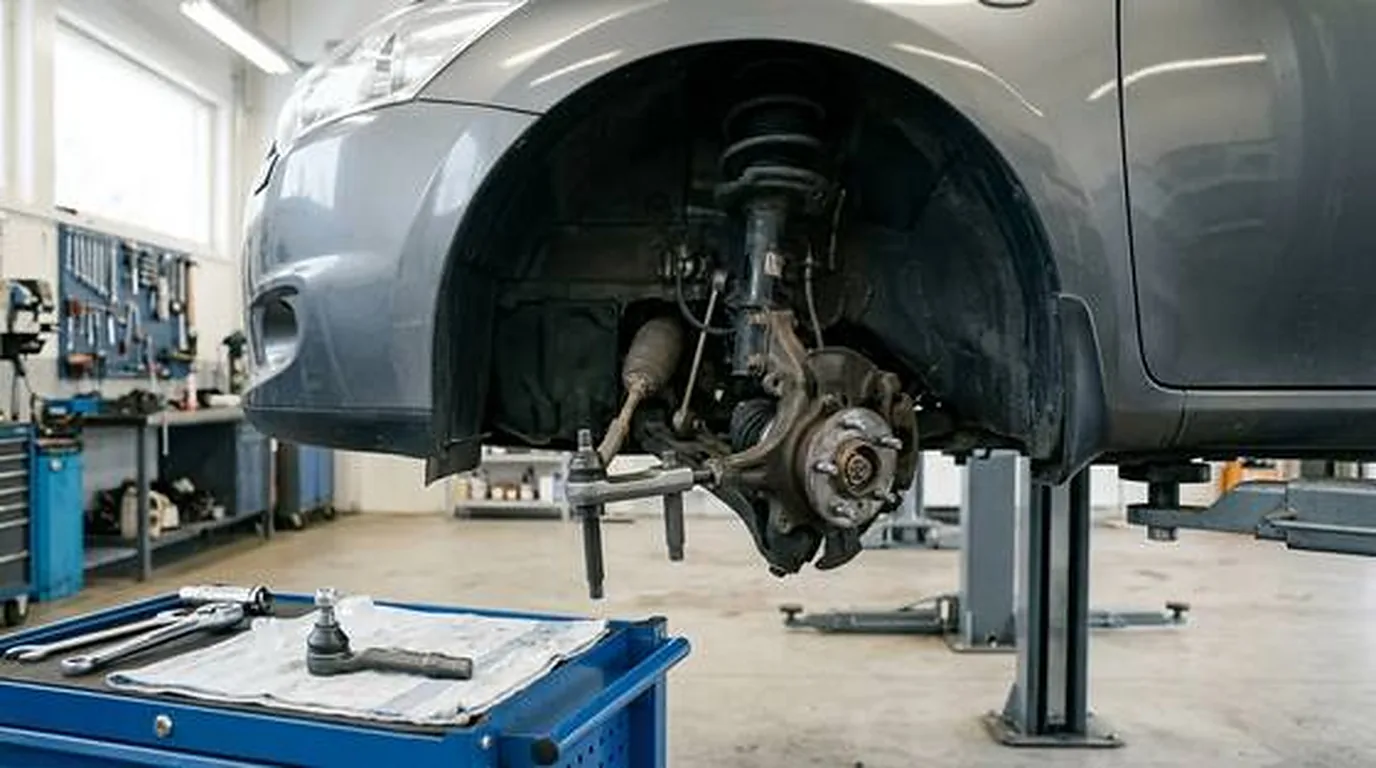
A track rod has two joints. The inner end is screwed onto the end of the rack, under the steering rack boot. The outer end is a ball joint whose taper pin fits into the wheel's steering knuckle. A track rod end replacement usually means this outer joint.
The outer end's thread is also where the toe is set. Loosening the locknut and turning the rod makes the track rod longer or shorter, and the direction of the wheel changes. A new end never sits on the thread at exactly the same point as the old one, so the toe has to be set every time the end is replaced.
The joint's ball moves in a greased plastic cup, and a rubber boot keeps water and grit out. When the boot cracks, water and road salt get in, the grease washes out and the joint wears loose. Potholes, frost damage and knocks against kerbs add to the strain.
Read the full guide
How to tell a track rod end is worn
- There is a knock or clunk from the front over speed bumps, on uneven roads and when turning at low speed.
- The steering feels loose or vague, and the car wanders in ruts.
- The steering wheel is off centre although the car runs straight.
- The inner or outer edge of a front tyre wears faster than the middle.
- The joint's rubber boot is torn, with grease around it.
Many drivers notice nothing, and the play is only found at a service or at the inspection. The inner track rod end, a ball joint, control arm bushes, anti-roll bar links and a wheel bearing cause the same symptoms. So we look on the lift for where the play is before we replace anything.
When a track rod end is replaced
A track rod end has no replacement interval in kilometres or years. It is replaced when the joint has play or the boot is broken. Many track rod ends last more than 100 000 km, and the replacement often comes between 130 000 and 260 000 km. Salted roads, frost-damaged streets and hard knocks shorten a joint's life considerably.
Track rod ends do not have to be replaced in pairs the way shock absorbers do. The joint on the other side has as many kilometres behind it, though, so we check it at the same time. If it is worn as well, both are worth replacing at the same visit, because the toe is set in any case.
How the work is done
- We lift the car and check the steering. We rock the front wheel side to side and see whether the play is in the outer track rod end, the inner end, the steering rack or elsewhere. We tell you what we found and what the work costs. The work starts only once you have accepted the price.
- We remove the wheel and mark the old end's position on the track rod thread.
- We undo the track rod locknut and the taper pin nut. We free the taper from the steering knuckle with a joint separator.
- We unscrew the old end and screw the new one on at the same point. We tighten the taper pin with a new nut to the manufacturer's torque and tighten the track rod locknut.
- We refit the wheel, and then the front wheels' toe is set. The toe setting is not included in the price of the track rod end.
- Finally we road test the car and check that the steering wheel is straight and the steering feels right.
On a car driven on salted roads, the taper has often rusted into the steering knuckle and the end onto the track rod. Sometimes the taper pin nut will not undo but spins with the pin. Then we hold the pin still with a wrench or split the nut, since the old end is coming out anyway. If the outer end has rusted onto the rod so that it will not come off, the whole track rod has to be replaced. We tell you about it and its price before we carry on.
How long it takes
Replacing one track rod end is less than an hour's work on many cars. With the toe setting included, it usually takes 1 to 2 hours. It takes longer if parts have rusted in place, if the inner end is replaced as well, or if the ends are replaced on both sides. We agree when the car will be ready at the same time as the price.
What the price depends on
The price of a track rod end replacement varies from car to car. It depends on:
- Outer or inner end. Replacing the inner end is a bigger job, because the steering rack boot has to come off and the joint is undone from the rack with a special wrench.
- One side or both. If both ends are worn, they are replaced at the same visit and the toe is set once.
- Rust. A taper or end rusted in place adds work, and sometimes the whole track rod has to be replaced.
- Parts. Original and aftermarket parts differ in price. We tell you which parts we use.
- The toe setting. It is always done after the replacement, and it has its own price.
So we check the car and tell you the price before the work starts.
The track rod end and the inspection
At the inspection the steering joints are checked by eye, on a play detector and by rocking the front wheels by hand with the front axle unloaded. Under Traficom's inspection regulation, play in a steering joint caused by wear is grounds for a fail, and in a dangerous case the inspector also bans the car from the road. The same applies to a damaged rod and to a steering part repaired by welding. A torn joint boot and a missing split pin lead to a repair notice.
According to Traficom's statistics, in the periodic inspections of passenger cars in 2025 a fault in the steering joints and rods was grounds for a fail 48 616 times. That is about 6 % of all grounds for a fail, and among single inspection items it was the seventh most common reason for a fail. Only 1 606 repair notices were given for the same item. So when a fault is found in this item, the result is almost always a fail. The statistics do not say how many of the faults concerned track rod ends.
On the inspection certificate the fault is often written like this: «Ohjausnivelet ja -tangot, raidetangon pää, välyksellinen, oikealla edessä ulompi» (steering joints and rods, track rod end, play, front right outer). Bring the certificate with you, and we see straight away which side and which end it is. If the certificate names other faults too, we carry out inspection repairs to the whole fault list.
What you can check yourself
- Turn the steering wheel to full lock and look behind the front wheel with a torch. If the track rod end's rubber boot has cracked or there is grease around it, the joint will soon wear loose.
- With the engine running and the car standing, turn the steering wheel from side to side and listen for a click or a knock from the front wheels.
- Look at the edges of the front tyres. If the inner or outer edge has worn clearly more than the middle, the toe may be out.
- Leave testing for play to us. Rocking a wheel needs the car lifted, and nobody should go under a car that stands on a jack.
When not to drive the car
A track rod end with slight play can usually be driven to the workshop, but a time is worth booking soon. If the car failed the inspection without a driving ban, the law says the fault must be repaired as soon as possible. Do not keep driving if
- the steering feels clearly loose or the car will not hold its line
- there is a loud knock from the front at every turn
- the steering wheel suddenly went off centre, for example after hitting a kerb
- the inspector banned the car from the road.
A badly worn joint can come apart, and the wheel then no longer steers. A car under a driving ban may not be driven until the fault has been repaired and the car has passed the inspection. In that case the car comes to the workshop on a tow truck, unless the inspection station has issued a certificate that allows moving it to the nearest repair place.
If something else needs fixing
We do not start work you do not know about. If the car needs something else fixed, we call and tell you what the extra work costs and what happens if it is left undone. You decide.
Once we have seen the car, we tell you the price and whether it is a fixed price, a maximum price or an estimate. The work starts only once you have accepted the price.
We work to the motor vehicle service and repair terms approved by the consumer advisory board of the Finnish motor trade.
Related work

Inspection repairs
We repair the faults on the rejection list, item by item. The price comes from the list, before any work starts.
Ask the price
Suspension repair
Control arms, joints and shock absorbers. The price is assessed from what the lift shows.
Ask the price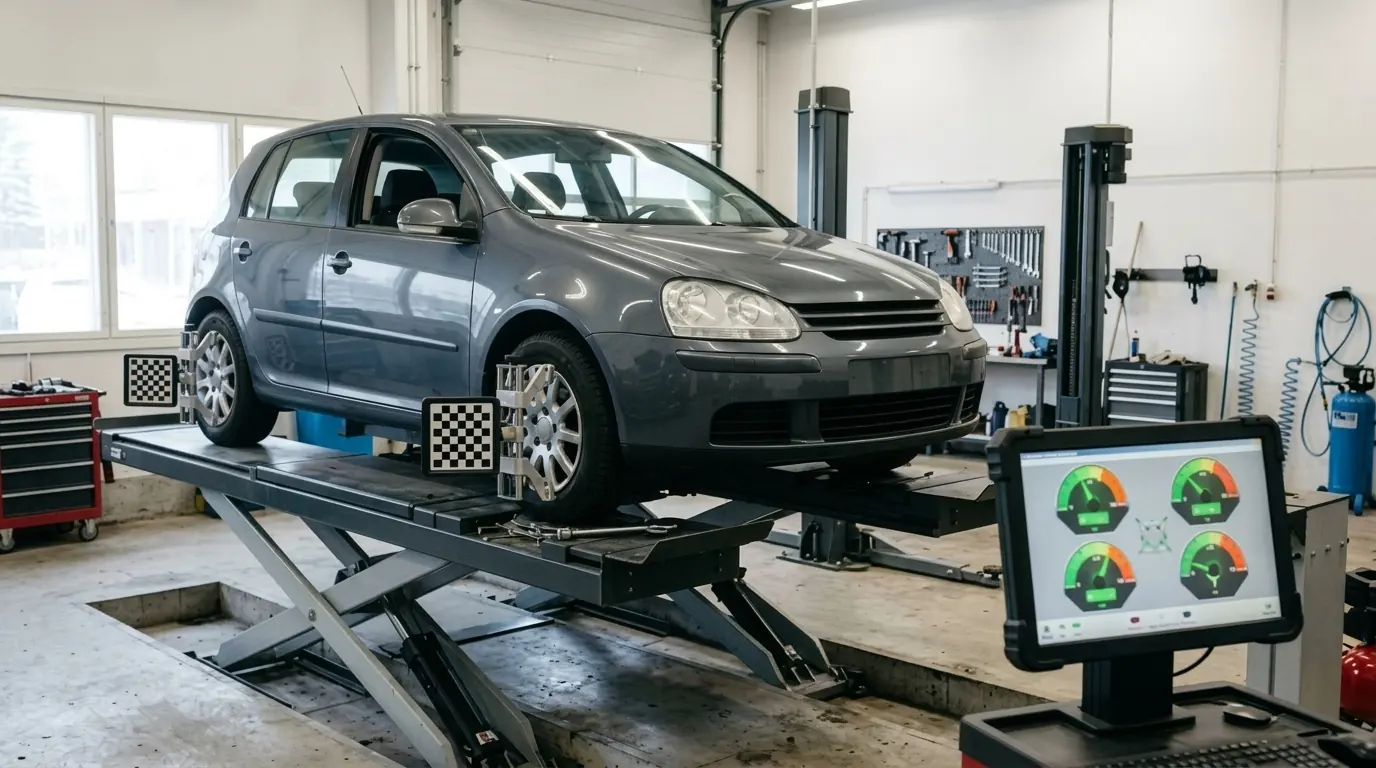
Four-wheel alignment
All four wheels measured and adjusted. The steering and suspension joints are checked first.
approx. 95 €
Shall we agree a time?
Leave a booking request online or call. We confirm the time and tell you the price before any work starts.
typical price range
120–
We tell you the exact price for your car before the work starts.
- Address
- Lampputie 12 C 67
00750 HelsinkiShow on the map - Opening hours
- Mon–Fri8.00–18.00Sat9.00–15.00Sunclosed
- Phone
- 045 262 5950
- huolto@caron.fi