Anti-roll bar link replacement
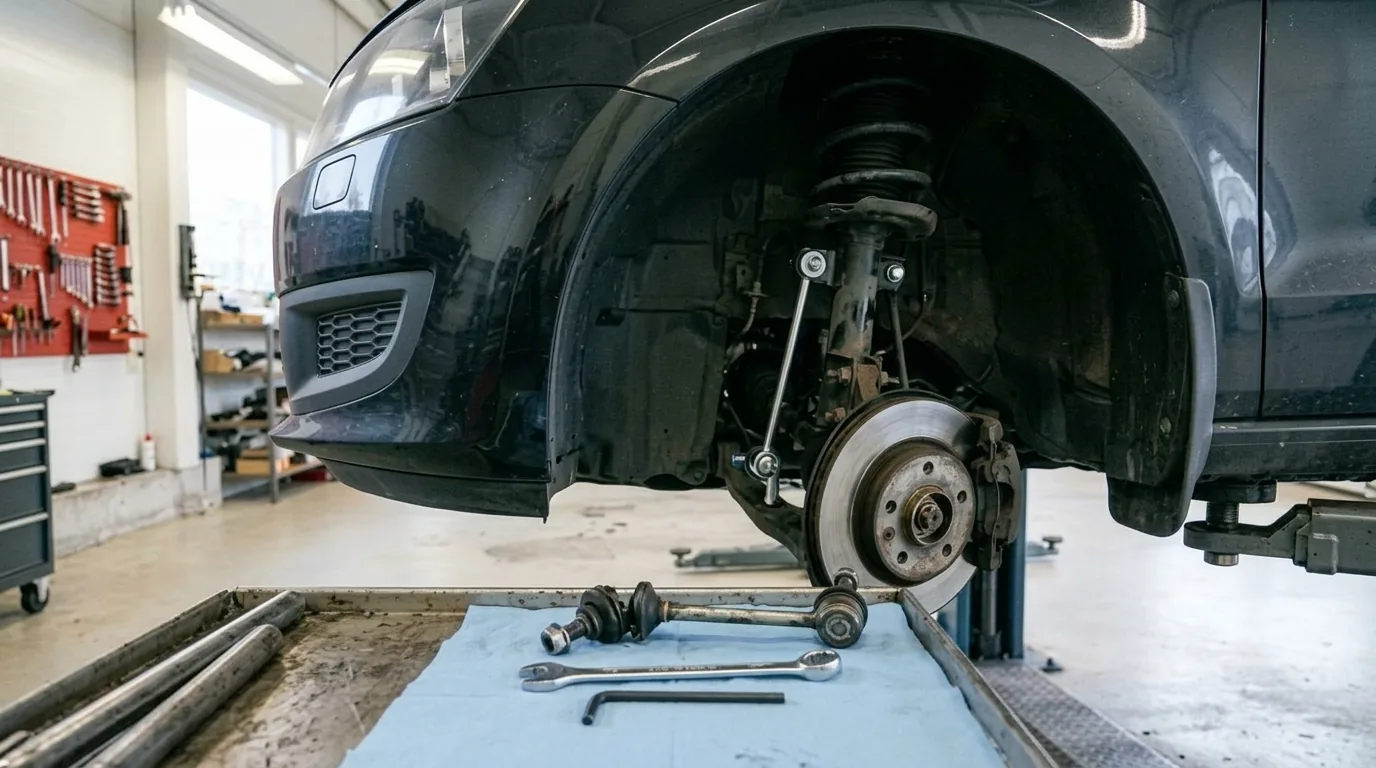
The anti-roll bar link, called «koiranluu» (dog bone) in Finnish, is a common reason why a car's front end knocks over speed bumps and potholes. We replace anti-roll bar links on all makes, and the job usually takes less than an hour. We first check the suspension on the lift and tell you the price before the work starts.
typical price range
80–
We tell you the exact price for your car before the work starts.
- Prices include VAT
- 25,5 %
- A suspension check on the lift before the work: anti-roll bar links, anti-roll bar bushes, ball joints and control arm bushes
- One anti-roll bar link replaced with a new one, part and labour
- New nuts, tightened to the manufacturer's torque
How it works
Call us or drop in
Give us the registration. We confirm the price and agree a time in the same call.
We do the work
You get the car back at the time we agreed.
You pay the agreed price
No surprises on the invoice. If we find anything else, we call before we touch it.
If your inspection certificate says «kallistuksen vakaajan kiinnitys, välyksellinen» (anti-roll bar mounting, play), it usually means the link. Bring the certificate with you when you bring the car.
Call 045 262 5950What the price includes
What the price includes
- A suspension check on the lift before the work: anti-roll bar links, anti-roll bar bushes, ball joints and control arm bushes
- One anti-roll bar link replaced with a new one, part and labour
- New nuts, tightened to the manufacturer's torque
- A check of the link on the other side, and a word on whether it is worth replacing too
- Road test, confirming that the knock has gone
- Replaced part shown on request
What the price does not include
- The anti-roll bar bushes, which hold the bar to the body. Replacing them is a job of its own, and the inspection certificate usually marks them «sisempi» (inner).
- The link on the other side. If it is worn too, it can be replaced at the same visit.
- Replacing the anti-roll bar itself, if the bar is bent or broken.
- Repairing the mounting point on the shock absorber or control arm, if rust has damaged it. We agree on it before we carry on.
- Repairs to ball joints, control arm bushes, track rod ends and shock absorbers, if they are faulty.
About this work in detail
What the anti-roll bar link does
The anti-roll bar is a spring steel bar that runs across the car and connects the suspension of the left and right wheels. In a corner the body leans towards the outside of the bend. The bar then twists and resists the lean, and the car stays steadier. Almost every car has an anti-roll bar on the front axle, and many have one at the rear as well.
The bar is fixed to the body or the subframe with two rubber bushes. Each end is connected to the shock absorber or the control arm by a short rod, officially the anti-roll bar link, «kallistuksenvakaajan yhdystanko» in Finnish. In everyday Finnish it is the «koiranluu», the dog bone. On today's cars a link usually has a ball joint at each end.
The joint's ball moves in a greased cup, and a rubber boot keeps water and grit out. When the boot cracks, road salt and water get in, the grease washes out and the joint wears loose. The link moves every time the wheel rises or drops, so even slight play is heard as a knock.
Read the full guide
How to tell an anti-roll bar link is worn
The most common symptom is a knock heard at low speed. Book a time if you notice any of these:
- There is a knock or clunk from the front or the rear over speed bumps, potholes and cobbles, often from one side only.
- There is a clunk when you drive at an angle over a kerb or into a driveway, that is, when one wheel rises before the other.
- The body leans more than usual in corners. That can mean a link has broken.
- The joint's rubber boot is torn, with grease around it.
A worn anti-roll bar link is not usually felt in the steering. If the steering is loose or the car wanders in ruts, the cause is more likely a track rod end, a ball joint or the control arm bushes. The anti-roll bar bushes and a shock absorber top mount cause a similar knock, and a loose exhaust heat shield is easily mistaken for a suspension fault. So we look on the lift for where the noise comes from before we replace anything.
When an anti-roll bar link is replaced
An anti-roll bar link has no replacement interval in kilometres or years. It is replaced when the joint has play, the boot is broken or the rod has broken. Many links last more than 100 000 km. When a link is replaced, the odometer often reads 140 000–250 000 km. Salted roads, frost-damaged streets and speed bumps wear the joints faster.
Anti-roll bar links do not have to be replaced in pairs. The joint on the other side has as many kilometres behind it, though, so we check it at the same time. If it is worn as well, both are worth replacing at the same visit, because the car is already on the lift.
Replacing an anti-roll bar link does not change the wheel angles. So the toe does not need setting after the replacement, unlike with a track rod end.
How the work is done
- We lift the car and check the suspension. We move the links, the anti-roll bar bushes, the ball joints and the control arm bushes and see where the play is. We tell you what we found and what the work costs. The work starts only once you have accepted the price.
- We remove the wheel and undo the nuts at the top and bottom of the link.
- The joint's stud often spins with the nut. Then we hold the stud still by the hex socket in its end or by its spanner flats.
- We fit the new link and tighten the new nuts to the manufacturer's torque.
- We refit the wheel and tighten the wheel bolts to torque.
- Finally we road test the car over speed bumps to make sure the knock has gone.
On a car driven on salted roads, the nut has often rusted onto the stud. If it will not undo, we cut the nut or the stud, since the old link is coming out anyway. Sometimes rust has also eaten into the mounting point on the shock absorber or the control arm. Then we tell you what the repair needs and what it costs before we carry on.
How long it takes
Replacing one anti-roll bar link takes less than half an hour on many cars. With the check on the lift and the road test included, it usually takes less than an hour. It takes longer if the nuts have rusted in place or if the links are replaced on both sides. We agree when the car will be ready at the same time as the price.
What the price depends on
The price of an anti-roll bar link replacement varies from car to car. It depends on:
- Front or rear. On most cars the front link is easy to reach. At the rear the mounting is sometimes in a tighter spot, and the work takes longer.
- One side or both. If both links are worn, they are replaced at the same visit.
- Rust. A nut or stud rusted in place adds work.
- Parts. Original and aftermarket parts differ in price. We tell you which parts we use.
So we check the car and tell you the price before the work starts.
The anti-roll bar link and the inspection
At the inspection the anti-roll bar mountings are checked by eye, on a play detector and by rocking by hand. Under Traficom's inspection regulation, a mounting counts as having play when the play exceeds one millimetre. For a mounting with play, the inspector gives a repair notice or fails the car, depending on how serious the fault is. If the anti-roll bar has come loose, the car fails, and in a dangerous case it is also banned from the road.
A repair notice does not stop the car from passing, but the law says the fault must be repaired within a reasonable time. A car that failed must be repaired as soon as possible and taken to the re-inspection within a month.
According to Traficom's statistics, in the periodic inspections of passenger cars in 2025 a fault in the front axle was grounds for a fail 126 260 times. That is about 16 % of all grounds for a fail, and among inspection items the front axle was the most common reason for a fail. On top of that, 54 334 repair notices were given for the front axle. For the rear axle, 51 338 grounds for a fail and 13 731 repair notices were recorded. The anti-roll bar mounting is one of the parts checked under these items, but the statistics do not say how many of the faults concerned anti-roll bar links.
On the inspection certificate the fault is often written like this: «Kallistuksen vakaajan kiinnitys, välyksellinen, oikealla edessä ulompi, yhdystanko» (anti-roll bar mounting, play, front right outer, link). The outer mounting usually means the link, and the inner one the anti-roll bar bush. Bring the certificate with you, and we see straight away which side and which mounting it is. If the certificate names other faults too, our inspection repairs cover the whole fault list.
What you can check yourself
- Turn the steering wheel to full lock and look behind the front wheel with a torch. The link is a short rod, usually close to vertical, between the end of the anti-roll bar and the shock absorber or control arm. If the joint's rubber boot is torn or there is grease around it, the joint will soon wear loose.
- Drive slowly over a speed bump or a kerb with the window open and listen for which side and which end of the car the noise comes from. Tell us when you book.
- With the car standing on its wheels, you can take hold of the link and try whether it moves at its joint. If the joint clunks when moved by hand, it is worn.
- Leave the closer check to us. Do not go under a car that stands on a jack.
When not to drive the car
A car with a knocking anti-roll bar link can usually be driven to the workshop, but book a time soon. A joint with play wears further quickly, and in the end the joint can come apart or the rod break. Do not keep driving if
- the link has broken and the end of the rod swings loose
- the knock has turned into hard banging, or there is a sound of metal scraping from underneath
- the car leans clearly more than before in corners
- the inspector has banned the car from the road.
A rod swinging loose can hit the brake hose or the ABS sensor wire. A car under a driving ban may not be driven until the fault has been repaired and the car has passed the inspection. In that case the car comes to the workshop on a tow truck, unless the inspection station has issued a certificate that says where and how the car may be moved for repair. If you are not sure whether the car can be driven, call us before you set off.
If something else needs fixing
We do not start work you do not know about. If the car needs something else fixed, we call and tell you what the extra work costs and what happens if it is left undone. You decide.
Once we have seen the car, we tell you the price and whether it is a fixed price, a maximum price or an estimate. The work starts only once you have accepted the price.
We work to the motor vehicle service and repair terms approved by the consumer advisory board of the Finnish motor trade.
Related work

Inspection repairs
We repair the faults on the rejection list, item by item. The price comes from the list, before any work starts.
Ask the price
Suspension repair
Control arms, joints and shock absorbers. The price is assessed from what the lift shows.
Ask the price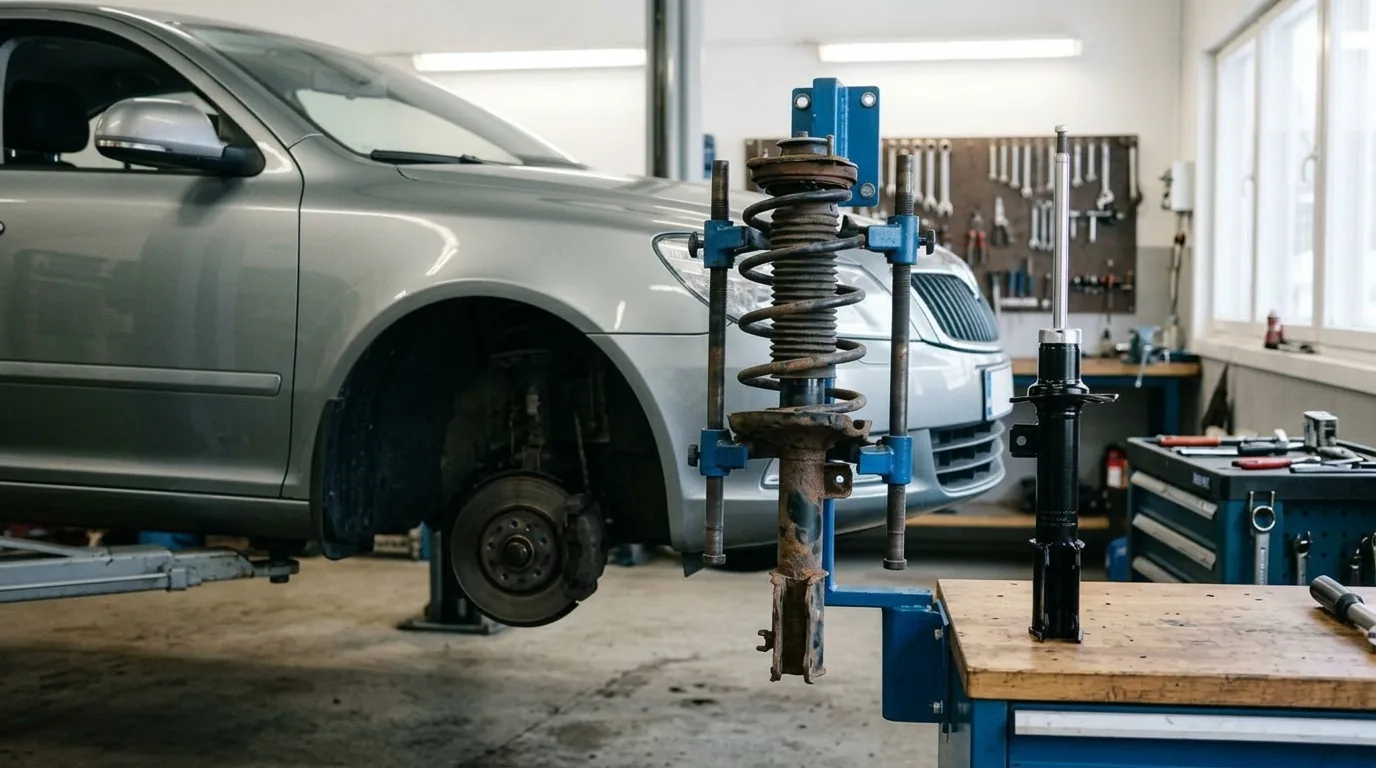
Front shock absorbers
Both front shock absorbers, as a pair. We check the springs and top mounts at the same time.
390–550 €
Shall we agree a time?
Leave a booking request online or call. We confirm the time and tell you the price before any work starts.
typical price range
80–
We tell you the exact price for your car before the work starts.
- Address
- Lampputie 12 C 67
00750 HelsinkiShow on the map - Opening hours
- Mon–Fri8.00–18.00Sat9.00–15.00Sunclosed
- Phone
- 045 262 5950
- huolto@caron.fi