Published
Age and mileage alone do not explain the gap. Even at the same age, French cars failed more often, although they had been driven less. The biggest difference is in the front axle, where they had about twice as many faults as the average for all makes. The figures cover passenger cars first registered between 2005 and 2021.
Peugeot, Citroën and Renault at inspection in 2025
Traficom, the Finnish Transport and Communications Agency, publishes the results of the periodic inspection (katsastus) by make, using two measures. The rejection rate shows how many cars failed. The number of rejection faults per hundred inspections shows how many faults were found, since one car can have several.
| Make | Inspections | Failed | Rejection faults / 100 | Median mileage |
|---|---|---|---|---|
| Citroën | 34 809 | 38.5 % | 70.8 | 170 000 km |
| Peugeot | 44 930 | 36.5 % | 67.9 | 168 000 km |
| Renault | 27 110 | 38.3 % | 66.1 | 142 000 km |
| All makes | 1 672 937 | 26.9 % | 46.8 | 187 000 km |
The two measures tell you different things. Citroën's 70.8 means that on average about 71 rejection faults were found for every hundred inspections. Yet the share of Citroëns that failed was 38.5 %, because a failed car often has more than one fault.
Among the makes inspected more than 20 000 times, Citroën and Peugeot had the most rejection faults. Mazda came third (67.7) and Renault fourth. For comparison, the figure was 44.8 for Volkswagen and 35.2 for Toyota. Note the mileage: all three French makes had a lower median than the fleet as a whole.
Figures by model
In 2025, seven French models were inspected more than 5 000 times:
| Model | Inspections | Failed | Faults / 100 | Median mileage |
|---|---|---|---|---|
| Renault Clio | 9 132 | 37.4 % | 60.8 | 112 000 km |
| Citroën C3 | 8 114 | 35.2 % | 61.1 | 115 000 km |
| Citroën C4 | 7 782 | 43.8 % | 85.5 | 183 000 km |
| Peugeot 308 | 7 188 | 38.2 % | 69.9 | 167 000 km |
| Renault Mégane | 6 748 | 43.7 % | 80.3 | 191 000 km |
| Citroën C5 | 5 773 | 39.1 % | 72.9 | 251 000 km |
| Peugeot 307 | 5 219 | 48.7 % | 103.3 | 234 000 km |
The Peugeot 307 stands out from the crowd. On average it had more than one rejection fault per inspection, and nearly half of all 307s failed. It also had the second-highest mileage. The model driven furthest was the Citroën C5, at a median of 251 000 km.
The newer models stay well below the figure for all makes. The Peugeot 208 had 34.4 rejection faults per hundred inspections (4 553 inspections, median 90 000 km), the Renault Captur had 33.8 (3 038 inspections, 78 000 km) and the Peugeot 2008 had 29.6 (2 596 inspections, 78 000 km). They have been driven far less, so they cannot be compared directly with the older models.
What fails a French car?
On all seven models, the most common rejection item was the front axle. The figures are rejection faults per hundred inspections:
| Model | Most common | Second most common | Third most common |
|---|---|---|---|
| Clio | Front axle 19.2 | Suspension 10.3 | Steering joints 7.2 |
| C3 | Front axle 15.3 | Suspension 7.5 | Sills 6.0 |
| C4 | Front axle 18.0 | Suspension 11.1 | Sills 9.9 |
| 308 | Front axle 13.9 | Suspension 8.2 | Petrol engine emissions test 7.7 |
| Mégane | Front axle 16.7 | Steering joints 13.0 | Suspension 11.9 |
| C5 | Front axle 20.5 | Parking brake test 10.9 | Steering joints 7.7 |
| 307 | Front axle 20.0 | Steering joints 13.3 | Parking brake test 12.4 |
On the Citroëns, rust comes to the fore. On the C4, the sills and floor pan were the third most common rejection item, at 9.9 per hundred inspections: almost quadruple the figure for all makes. On the C3, the same item came third with 6.0.
For all makes, the matching figures were: front axle 7.5, suspension 6.1, parking brake test 4.6, steering joints 2.9, sills 2.7 and petrol engine emissions test 1.9. «Suspension» means Traficom's item «springs and shock absorbers». In practice, «sills and floor pan» means rust damage, and the parking brake test measures the handbrake's braking force on rollers.
At make level the picture is the same, but it also shows where the French makes do better than average. Again, the figures are rejection faults per hundred inspections:
| Item | Citroën | Peugeot | Renault | All makes |
|---|---|---|---|---|
| Front axle | 16.9 | 15.6 | 15.9 | 7.5 |
| Springs and shock absorbers | 7.5 | 6.2 | 10.7 | 6.1 |
| Steering joints and track rods | 6.4 | 4.9 | 9.2 | 2.9 |
| Sills and floor pan | 6.7 | 5.4 | 0.4 | 2.7 |
| Petrol engine emissions test | 3.1 | 5.1 | 1.2 | 1.9 |
| OBD system | 3.0 | 3.3 | 3.2 | 1.8 |
| Rear axle | 1.0 | 1.5 | 0.7 | 3.1 |
On the rear axle, all three had fewer faults than the average car, and Renault's underbody rust faults were only a fraction of the average. The faults pile up at the front. On the front axle, the figure was 4.7 for Volkswagen and 2.6 for Toyota, so the French figures are several times those of the two most common makes.
What is checked on the front axle?
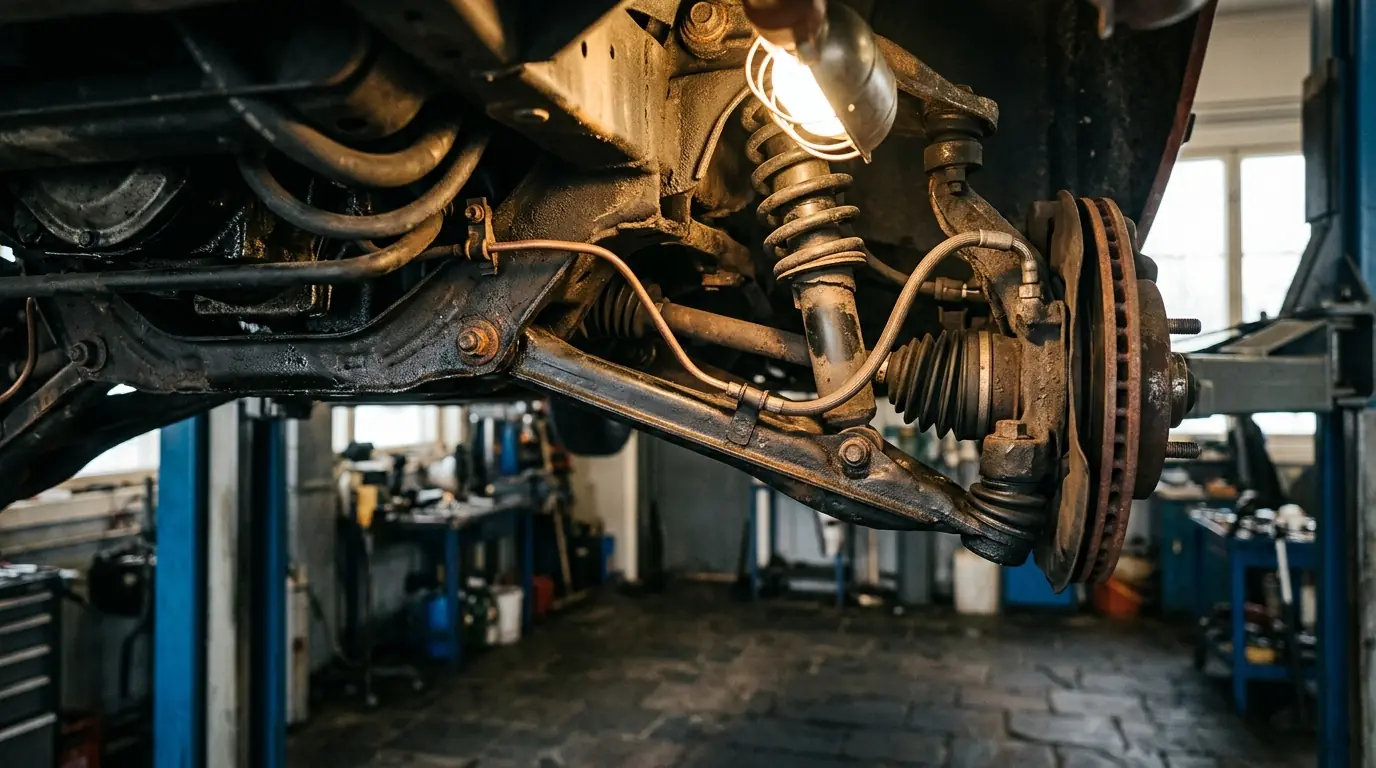
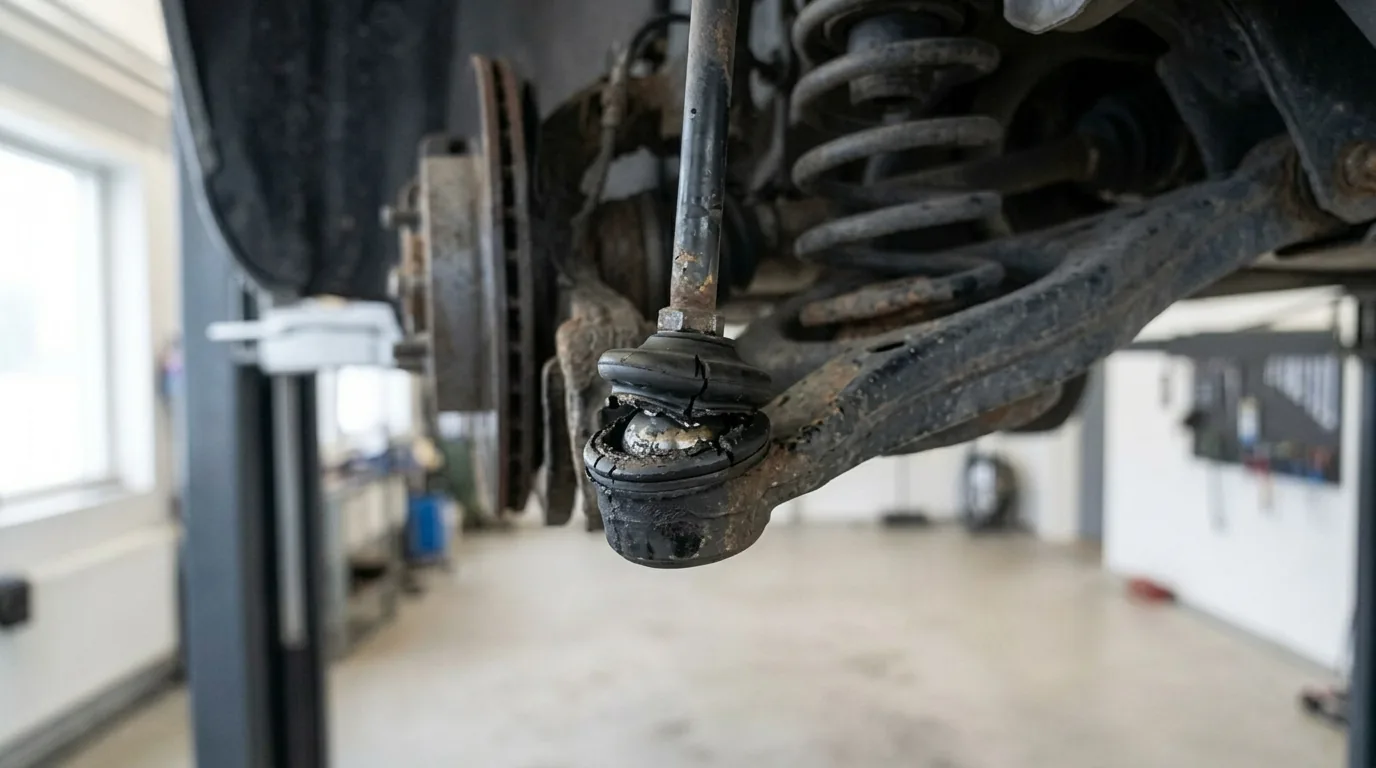
In Traficom's inspection criteria, the front axle is an item of its own (D8). The inspector checks it visually, on a play detector and by rocking it by hand, and also with the weight taken off the front axle. A wheel bearing's condition is judged by feel as the wheel is spun. Nothing is taken apart at an inspection. These findings lead to a rejection or a repair notice (korjauskehotus):
| Finding | Result |
|---|---|
| Play in a ball joint caused by wear | Failed or driving ban (ajokielto) |
| Ball joint mounting loose, defective or damaged | Failed or driving ban |
| Play in the control arm and radius rod bearings caused by wear | Failed or driving ban |
| Damage, rust damage or deformation in a control arm mounting | Failed or driving ban |
| Vulcanised bond of an axle bearing detached over more than 1/3 of its circumference | Failed or driving ban |
| Too much play in a wheel bearing, or the bearing too tight or damaged | Failed or driving ban |
| More than 1 mm of play in an anti-roll bar mounting | Repair notice or rejection |
| Damaged ball joint boot | Repair notice |
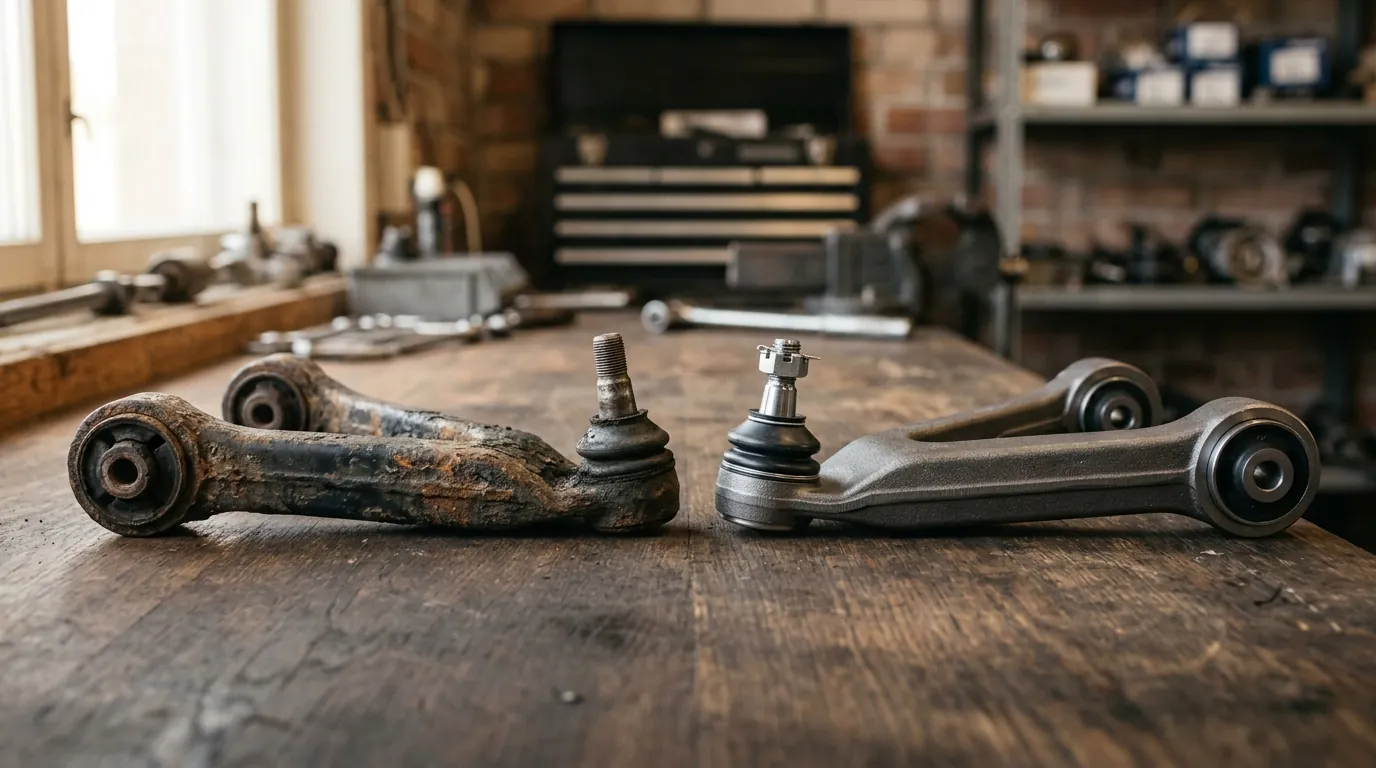
In practice, a control arm's bearings are its rubber bushes. When the rubber comes away from the metal or works loose, the wheel moves out of position under braking and over potholes, and the front end starts to clunk. The same criteria also appear in the new regulation, which comes into force on 1 February 2027.
The steering joints are assessed under an item of their own (D9). Play caused by wear in the steering linkage joints, such as a loose track rod end, leads to a rejection or a driving ban, and a damaged boot on a joint or on the steering rack leads to a repair notice. This item weighs especially heavily on Renault, and on the Mégane and the Peugeot 307.
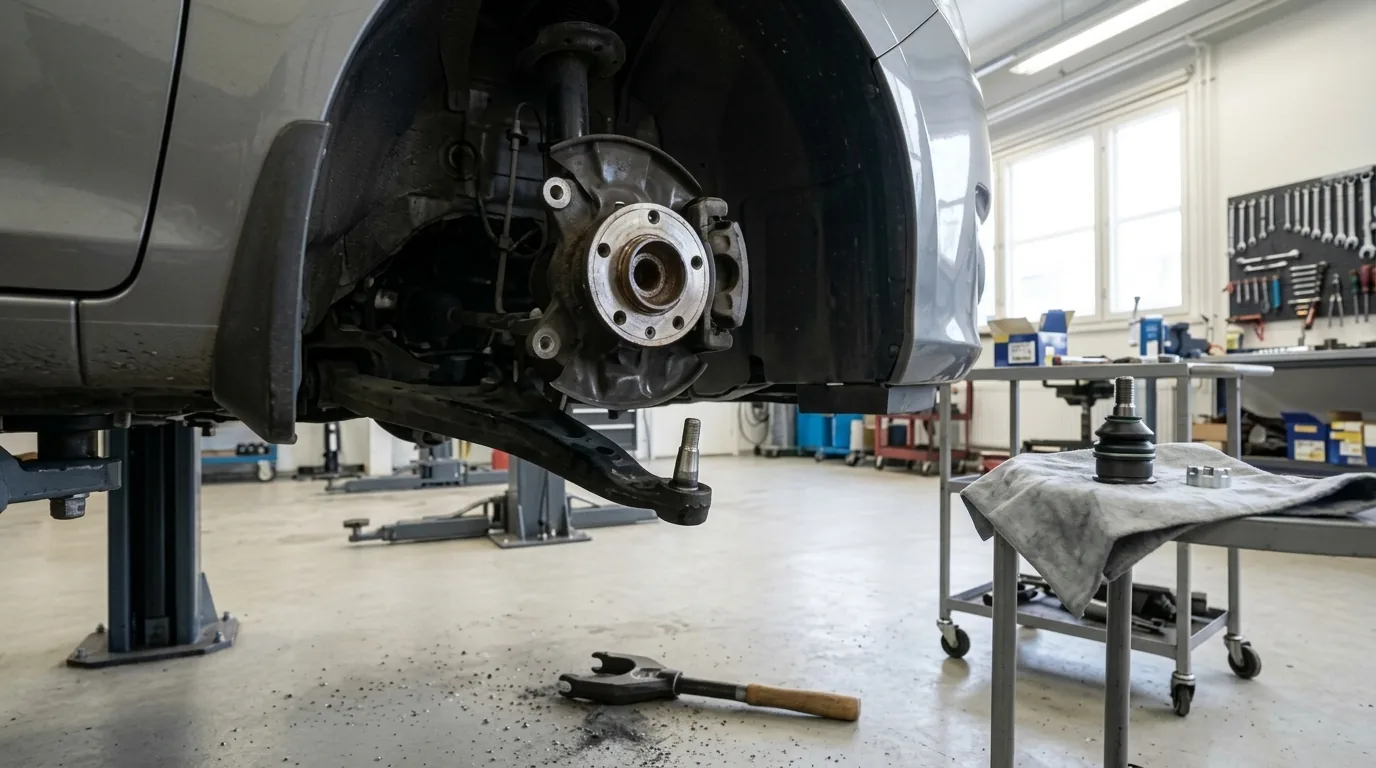
The repair is ordinary work on a lift. The worn ball joint, the control arm bushes or the whole control arm is replaced, and if needed the wheel angles are set with a four-wheel alignment. See ball joint replacement and anti-roll bar link replacement. With steering joint faults, the job is usually a track rod end replacement.
What does the emissions test look at?
The Peugeot 308's third most common rejection item was the petrol engine emissions test, and for Peugeot as a whole the item's figure was 5.1 per hundred inspections, against an average of 1.9. Under Traficom's regulation, a petrol car more than 10 years old has its exhaust emissions measured at a raised engine speed, and at the same time the engine warning light is checked to see that it works and the fault memory of the OBD system is read. On the OBD item, all three makes had almost twice the average number of rejections. Renault, on the other hand, had fewer emissions test rejections than average, at 1.2 per hundred inspections.
The statistics do not show which part pushes the emissions up. In our experience the cause is often the lambda sensor, the ignition or the catalytic converter, and it is tracked down from the fault codes and by measuring, not by guessing. If the warning light is on, start with the article on the engine warning light. We cover replacing the sensor on the lambda sensor replacement page.
What about repair notices?
The French makes also received more repair notices than average: Citroën 91.1, Peugeot 84.2 and Renault 78.4 per hundred inspections, against 59.9 for all makes. The gap shows clearly in the lights: all three had 11.9–12.5 notices for dipped beams per hundred inspections, against an average of 7.9.
Citroën and Peugeot also had 6.3–6.4 notices for oil leaks and 4.7–5.0 for the exhaust system per hundred inspections. The averages were 2.6 and 2.2, so their figures were more than double. A notice does not make the car fail, but a leak that has got worse can fail it next time. Read more in the article on repair notices at the inspection.
Is a French car a bad choice?
Not necessarily, but the statistics are worth reading carefully. The first question is age. In these statistics, Citroëns and Peugeots are on average slightly older than the fleet as a whole, and Renaults slightly younger. Had they failed at the same rate as cars of the same age on average, about 30.1 % of Citroëns, 29.8 % of Peugeots and 26.1 % of Renaults would have failed. The actual figures were 38.5 %, 36.5 % and 38.3 %. Age explains less than a third of the gap for Citroën and Peugeot, and none of Renault's.
The second question is mileage. When cars are compared by year of first registration, the French cars had been driven less than the average car of the same age in every year. Even so, a larger share of them failed:
| Year first registered | All makes | Citroën | Peugeot | Renault |
|---|---|---|---|---|
| 2006 | 43.1 % | 49.3 % | 45.4 % | 51.6 % |
| 2010 | 33.2 % | 43.2 % | 45.8 % | 45.4 % |
| 2013 | 23.6 % | 33.7 % | 31.0 % | 38.2 % |
| 2016 | 17.4 % | 30.8 % | 26.8 % | 29.8 % |
| 2019 | 10.7 % | 20.8 % | 20.5 % | 24.4 % |
| 2021 | 8.2 % | 9.0 % | 9.0 % | 16.8 % |
For example, cars first registered in 2010 had a median mileage of 229 000 km, against 183 000 km for Citroëns, 194 000 km for Peugeots and 203 000 km for Renaults. Citroëns and Peugeots first registered in 2021 were already close to the average.
Front axle faults also start early. In the same comparison, these were the front axle rejection faults found per hundred inspections:
| Year first registered | All makes | Citroën | Peugeot | Renault |
|---|---|---|---|---|
| 2006 | 12.0 | 21.1 | 19.4 | 22.2 |
| 2010 | 9.0 | 17.9 | 19.6 | 15.9 |
| 2013 | 6.4 | 14.2 | 13.3 | 17.9 |
| 2016 | 5.6 | 19.9 | 15.9 | 13.3 |
| 2019 | 3.1 | 9.5 | 15.5 | 13.2 |
| 2021 | 1.5 | 4.4 | 4.8 | 1.3 |
Cars first registered in 2019 were about six years old when they were inspected. Among them, Peugeots and Renaults had four or five times the average number of front axle faults. The gap does not wait until the cars are old.
The third question is use and servicing, and the statistics do not answer it. They do not show how the cars have been serviced, what kind of roads they have been driven on or how many have changed owners without a service history. What the statistics do show is that the gap is concentrated in the front axle and the steering joints, the wearing parts of the suspension.
For a buyer, the conclusion is a practical one. When buying a used French car, have the front axle checked on a lift before you buy, and allow for a greater chance of replacing suspension parts than on an average car of the same age. The service receipts tell you more about an individual car than the badge on its bonnet.
How to check a used French car before you buy
- Look up the inspection details. Traficom's Tarkista ajoneuvon tiedot service shows, free of charge, the faults and notices from the car's latest periodic inspection, item by item.
- Ask for the service receipts. Look especially at whether the front axle joints, control arms or shock absorbers have been replaced, and when.
- Test-drive it on a bad road. Listen for clunks from the front end over potholes and speed bumps, and feel for play in the steering.
- Try the handbrake on a hill. The parking brake test was the C5's second and the 307's third most common rejection item.
- Check the instrument panel. The engine warning light must not stay on after the car has started.
- Have the car checked on a lift. The front axle joints, the bushes and underbody rust only show from underneath.
When should you visit a workshop?
Before the inspection, and whenever you notice any of these:
- the front end clunks over potholes or speed bumps
- the steering feels loose, or the steering wheel is off-centre on a straight road
- the car pulls to one side, or braking feels unstable
- a front tyre is wearing at the edge
A lift shows the front axle joints and bushes before the inspector sees them. If you have already had a notice on the front axle, bring the inspection certificate with you, and we will start with that item.
A French car does not need to go to a franchised dealer for suspension work. Joints, bushes, shock absorbers and brakes are replaced with the same methods as on other cars, and the wheel angles are set to the manufacturer's specifications. We repair all makes and tell you the price before the work starts: see suspension repair. The article clunking noise from your car explains how to recognise the noise.
If the car has already failed, we repair the items on the fault list, and you take the car for its re-inspection (jälkitarkastus) within a month of the rejection: see inspection repairs. We do not carry out inspections ourselves, because we do not hold an inspection licence. All makes are compared in the article inspection results by make, 2025.