
Timing chain replacement
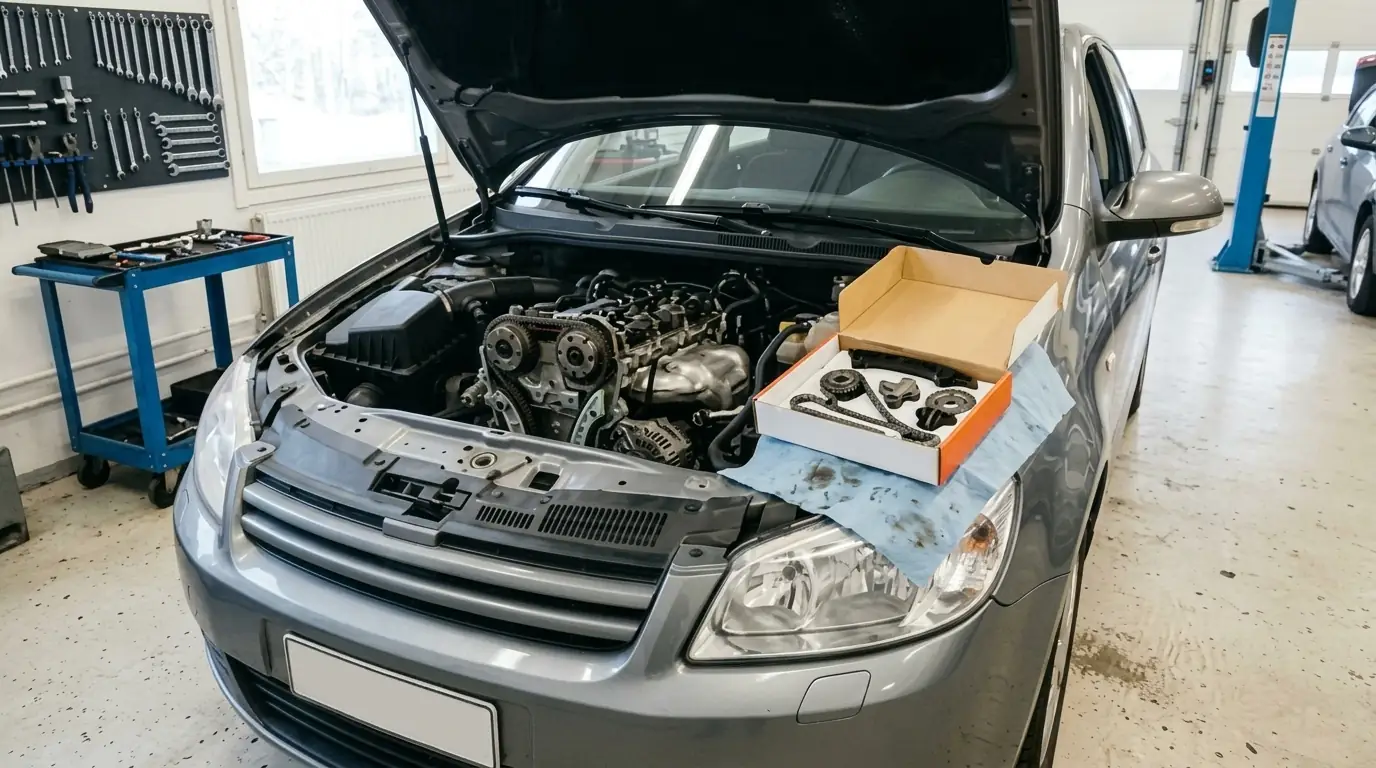
We replace the timing chain, tensioner and guide rails on all makes. Depending on the engine the work takes anything from a few hours to more than a working day, so we check the car and tell you the price before the work starts.
typical price range
820–
We tell you the exact price for your car before the work starts.
- Prices include VAT
- 25,5 %
- Timing chain, chain tensioner and guide rails
- Sprockets, where they are part of the manufacturer's kit
- Timing cover gaskets, and the bolts the manufacturer specifies as single-use
How it works
Call us or drop in
Give us the registration. We confirm the price and agree a time in the same call.
We do the work
You get the car back at the time we agreed.
You pay the agreed price
No surprises on the invoice. If we find anything else, we call before we touch it.
If the engine rattles on a cold start, book a time soon. A stretched chain is cheaper to replace before it jumps a tooth.
Call 045 262 5950What the price includes
What the price includes
- Timing chain, chain tensioner and guide rails
- Sprockets, where they are part of the manufacturer's kit
- Timing cover gaskets, and the bolts the manufacturer specifies as single-use
- Timing set with the manufacturer's locking tools and procedure
- Engine oil and oil filter changed at the end of the job
- Fault memory cleared and any basic settings made with a diagnostic tool
- Road test and leak check
What the price does not include
- Engine repair, if the chain has already jumped or broken. We then first check whether the valves are damaged.
- Camshaft adjusters, if they are worn and not part of the kit.
- Water pump and auxiliary belt. If the water pump sits behind the timing cover, it is worth replacing at the same time.
- Oil leak repairs anywhere other than the timing end.
About this work in detail
The timing chain connects the crankshaft to the camshaft or camshafts and keeps the valves in step with the pistons. The chain runs inside the engine under the timing cover, lubricated by the engine oil. A hydraulic tensioner keeps it tight using oil pressure, and plastic guide rails stop it from whipping.
A manufacturer always gives a timing belt a replacement interval, but on most cars it gives a timing chain none. The chain is designed to last the life of the engine, but it does not always do so. The joints between the links wear and the chain gets longer. This is called chain stretch. The tensioner and the guide rails wear at the same time. Once the tensioner runs out of travel, the chain starts to rattle and the valve timing drifts.
Read the full guide
How to recognise a stretched timing chain
- The engine rattles or clatters on a cold start, and the noise stops after a few seconds. The tensioner only gets oil pressure once the engine is running, so a slack chain is heard at exactly that moment.
- The noise lasts longer week by week, or can be heard when warm as well, usually from the timing end of the engine.
- The engine warning light comes on. The fault memory then often holds a code saying that the crankshaft and camshaft positions do not match, such as P0016.
- The engine runs unevenly, starts poorly or pulls less strongly than before.
A similar noise can also come from the auxiliary belt tensioner, the hydraulic valve lifters or an exhaust manifold leak. So we do not replace a chain on the strength of the noise alone.
When the chain is replaced
Since there is usually no interval, the chain is replaced on condition. On many engines the stretch can be estimated from the engine control unit's measured values, on some from the tensioner's position through an inspection opening. The surest picture comes with the timing cover off. If the manufacturer has given the chain an interval, it is in the service book.
Above all, oil decides how long a chain lasts. Long oil change intervals, the wrong oil grade, a low oil level and constant short trips wear the chain and the tensioner faster. Mileage alone says little. In a well-serviced engine the chain can last the life of the engine; in a poorly serviced one it can stretch much sooner.
The trouble is concentrated in particular engines. The best known are the Volkswagen group's older 1.2 TSI and 1.4 TSI petrol engines and the Peugeot and Citroën 1.6 THP, which was also used in Mini. BMW's N47 diesel is well known too: its chain sits at the gearbox end of the engine, so the job is more laborious than usual. The newer 1.2 TSI and 1.4 TSI engines run a timing belt. So the badge on the tailgate does not tell you whether the car has a chain or a belt. The engine code does.
When the chain jumps or breaks
A stretched chain rarely snaps without warning. More often a slack chain jumps a tooth on a sprocket, or a worn guide rail breaks. If the timing shifts far enough, in most current engines the valves hit the pistons and bend. What follows is an engine repair that costs considerably more than a chain replacement. A rattling chain is not worth driving until it fails.
How the work is done
- We listen to the engine cold and warm, read the fault memory and the measured values, and check the oil level and condition.
- We tell you what we found, what the kit contains and what the work costs. Parts are ordered only once you have accepted the price.
- We remove the auxiliary belt, an engine mount where needed and finally the timing cover. We lock the crankshaft and camshafts with the manufacturer's locking tools.
- We replace the chain, the tensioner and the guide rails, and the sprockets the manufacturer's kit specifies. Gaskets and single-use bolts are replaced with new ones.
- We check the timing marks, turn the engine by hand at the crankshaft through two full revolutions and check the marks again.
- We refit what was removed, change the oil and filter and make any basic settings with a diagnostic tool. Finally we road test the car and check that nothing leaks.
How long it takes
The time varies a great deal with the engine. On the easiest engines the replacement is a couple of hours' work; on many it takes about five hours. On a V engine, or one where the chain is at the gearbox end, the work can take more than a working day. The kit is ordered for the engine, so we tell you when the car will be ready at the same time as we agree the price.
What the price depends on
The price of a timing chain replacement varies a great deal from car to car. It depends on:
- The engine's layout. Where the chain sits, how many chains there are, and whether the engine has to be supported, raised or removed.
- What the kit contains. Depending on the engine, the kit holds the chain, tensioner, guide rails and sprockets. On some engines the camshaft adjusters are worn as well.
- The parts. Original and aftermarket parts differ in price. We tell you which parts we use.
- Extra findings. Seized or broken bolts, leaking gaskets and a water pump behind the timing cover can add work.
So we check the car and tell you the price before the work starts.
The timing chain and the inspection
The inspection does not check the timing chain as such, but the on-board diagnostics (OBD) are part of it. A stretched chain can show up exactly there, as a fault code and a lit engine warning light. In Traficom's inspection statistics for 2025, the OBD system accounted for 30 779 rejecting faults. The statistics do not say how many of them came from a timing chain. Either way, a lit warning light is worth sorting out before the inspection, not after it.
What you can check yourself
- Listen to the engine after the car has stood overnight. Open the bonnet and ask someone to start the car. If the engine rattles, record it on your phone and bring the recording.
- Check the oil level on the dipstick, or on the car's display if it has no dipstick. Look in the service book for when the oil was last changed and with which grade.
- Look in the service book to see whether the service schedule includes a timing belt replacement. If it does, the engine has a belt, not a chain. If you are not sure, ask us.
- If the warning light is on and you have a code reader, write the codes down. Do not clear them before the car has been checked.
When not to drive the car
If the chain rattles for only a few seconds on a cold start, the car can usually be driven to the workshop, but a time is worth booking soon. Do not keep driving if
- the rattle continues when the engine is warm, or grows louder as the revs rise
- the engine warning light flashes, or the engine misfires and loses power
- the oil pressure warning light comes on
- the engine stalled with a bang and will not start normally.
The chain may then have jumped a tooth, or the engine has another serious fault. Do not try to restart the engine, since every attempt can make the damage worse. Have the car towed to the workshop.
If something else needs fixing
We do not start work you do not know about. If the car needs something else fixed, we call and tell you what the extra work costs and what happens if it is left undone. You decide.
Once we have seen the car, we tell you the price and whether it is a fixed price, a maximum price or an estimate. The work starts only once you have accepted the price.
We work to the motor vehicle service and repair terms approved by the consumer advisory board of the Finnish motor trade.
Related work

Oil change
Up to 5 litres of oil to the manufacturer's specification, and the filter. Each further litre 15 €. We check the fluid levels and tyre pressures at the same time.
139 €
Timing belt replacement
The price depends on the engine. We check the car and tell you the price before the work starts.
580–890 € 
Diagnostics
The first hour. We credit it against the repair if you have the work done here.
69 €
Shall we agree a time?
Leave a booking request online or call. We confirm the time and tell you the price before any work starts.
typical price range
820–
We tell you the exact price for your car before the work starts.
- Address
- Lampputie 12 C 67
00750 HelsinkiShow on the map - Opening hours
- Mon–Fri8.00–18.00Sat9.00–15.00Sunclosed
- Phone
- 045 262 5950
- huolto@caron.fi