Published
In 5W-30, the first number and its W tell you how the oil flows on a cold start: the lower the number, the better. The second number describes how thick the oil is in an engine at operating temperature. Viscosity alone does not decide which oil your car needs. The deciding factors are the manufacturer's approval and the ACEA class, both given in the car's owner's manual.
Viscosity describes how readily the oil flows. Cold oil is stiff and hot oil is thin, and the engine must be lubricated either way. The viscosity grades are defined in SAE J300, a standard from SAE International, and the European ACEA classes use the same grading as well.
What does 5W-30 mean?
The W stands for winter. The number before it shows how cold the oil can be and still pass the standard's cold tests. The number after the hyphen shows how thick the oil is in an engine at operating temperature. That grade is based on the oil's viscosity at 100 °C and its HTHS viscosity at 150 °C. The higher the number, the thicker the oil is when hot.
There are currently eight hot grades: 8, 12, 16, 20, 30, 40, 50 and 60. An oil with a two-part marking must meet the requirements of both grades. So a 5W-30 is an oil that passes the 5W cold tests and, when hot, is as thick as a 30-grade oil. The numbers are not temperatures: 30 does not mean 30 degrees, and 5W does not mean five degrees below zero. Both are simply grade labels.
What is the difference between 0W-20, 5W-30 and 5W-40?
They differ when cold, when hot, or both. The table puts the most common markings side by side:
| Marking | Cold grade | Hot grade | In practice |
|---|---|---|---|
| 0W-20 | 0W | 20 | Passes the cold tests in the coldest grade and is thin when hot. Only for engines the manufacturer has approved it for. |
| 0W-30 | 0W | 30 | Like 0W-20 in the cold, thicker when hot. |
| 5W-30 | 5W | 30 | Cold tests run five degrees warmer than for a 0W oil. When hot, the same grade as 0W-30. |
| 5W-40 | 5W | 40 | Like 5W-30 in the cold, thicker when hot. |
Thin oils such as 0W-20 and 0W-16 reduce friction and save fuel, but only in an engine designed for them. A thicker oil is not better, even as a precaution. The engine's clearances, the oil pump and the parts that run on oil pressure are sized for the oil given in the manufacturer's table. If the owner's manual allows more than one viscosity, it usually also says when to use which.
What does the W number mean in freezing weather?
There are two cold tests. The first simulates starting and measures how stiff the oil is while the starter motor cranks a cold engine. The second measures whether the oil pump can draw oil up from the sump. An oil gets the W grade of the coldest tests it passes. So a 5W oil passes the 5W tests but not the 0W ones. These are the standard's test temperatures:
| Grade | Cranking test | Pumping test |
|---|---|---|
| 0W | −35 °C | −40 °C |
| 5W | −30 °C | −35 °C |
| 10W | −25 °C | −30 °C |
| 15W | −20 °C | −25 °C |
These are the temperatures at which the tests are run. They do not promise that the engine will start all the way down to those temperatures, because the battery, the starter motor and the fuel also affect starting. The difference between 0W and 5W oil is greatest in the hardest frosts, when the oil has to reach the bearings and the turbo as quickly as possible.
In hard frosts, preheating also makes starting easier. According to Motiva, it reduces engine wear and makes the engine start more readily. You will find heating times in the article on using a block heater.
HTHS viscosity and why it matters
HTHS stands for high temperature, high shear. It is the oil's viscosity at 150 °C and at a very high shear rate: the hot, heavily loaded conditions the oil works under in the bearings and between the piston rings and the cylinder. ACEA measures it at 150 °C and a shear rate of 10⁶ s⁻¹.
A low HTHS viscosity means less friction and lower fuel consumption. At the same time, the oil film is thinner, so the engine must be designed for it. That is why ACEA's fuel-saving classes C5, C6 and C7 are intended only for engines that are designed for those oils and approved for them by the manufacturer. For the same reason, Škoda says that the Volkswagen Group's VW 508 00 and VW 509 00 are not suitable for older engines, because their HTHS viscosity is lower.
ACEA classes and ash
ACEA, the European Automobile Manufacturers' Association, divides engine oils for passenger cars into two groups. A/B oils contain plenty of ash-forming additives. C oils contain less ash, phosphorus and sulphur, so that they can be used with a catalytic converter and a particulate filter. According to ACEA, C oils extend the life of the particulate filter and the catalytic converter. Ash, phosphorus and sulphur are known collectively by the abbreviation SAPS.
The limits in the 2023 classification are as follows:
| Class | Sulphated ash | HTHS viscosity | Use |
|---|---|---|---|
| A3/B4 | 1.0–1.6 % | at least 3.5 mPa·s | Petrol and diesel, high ash |
| A5/B5 | at most 1.6 % | 2.9–3.5 mPa·s | Engines designed for thinner oil, not suitable for all |
| A7/B7 | at most 1.6 % | 2.9–3.5 mPa·s | Like A5/B5, plus protection for turbo engines |
| C2 | at most 0.8 % | at least 2.9 mPa·s | Exhaust aftertreatment, medium ash |
| C3 | at most 0.8 % | at least 3.5 mPa·s | Exhaust aftertreatment, medium ash |
| C4 | at most 0.5 % | at least 3.5 mPa·s | The lowest-ash class |
| C5 | at most 0.8 % | 2.6–2.9 mPa·s | Fuel saving, approved engines only |
| C6 | at most 0.8 % | 2.6–2.9 mPa·s | Like C5, plus protection for turbo engines |
| C7 | at most 0.8 % | 2.3–2.6 mPa·s | At C6 level, thinner still |
For C5 and C6, the HTHS viscosity is at least 2.6 but below 2.9 mPa·s, and for C7 at least 2.3 but below 2.6 mPa·s. «Protection for turbo engines» means that A7/B7 and C6 oils are required to protect against pre-ignition in turbocharged direct-injection petrol engines and against deposits in the turbo's compressor in direct-injection diesels. C7 is based on the C6 requirements but saves even more fuel. ACEA does not name an SAE viscosity grade for the classes: the limit comes from the HTHS value instead.
An ACEA class sets a minimum level for the oil. ACEA itself stresses that the carmaker is responsible for deciding which class suits which engine, and that the manufacturer may demand more than the class requires. On the bottle, the class may be followed by a year, for example C3-23. This shows which year's requirements the oil has been tested to. From 12 September 2024, new oils must be tested to the 2023 requirements, and oils with 2021 markings could be marketed until 1 August 2025.
Manufacturer approvals
Carmakers have their own oil standards, which go further than the ACEA class. Škoda, for example, describes the Volkswagen Group's standards like this:
- VW 504 00 for petrol engines and VW 507 00 for diesel engines. Both are low-ash, fuel-saving oils that are compatible with exhaust aftertreatment systems and suitable for extended change intervals. VW 507 00 is also made for diesels fitted with a particulate filter.
- VW 508 00 and VW 509 00 are the equivalent oils with a lower HTHS viscosity. They may be used only in engines approved for them.
The same model can need a different oil depending on its service schedule. In the Octavia owner's manual, petrol engines on the flexible service interval take VW 504 00 and those on the fixed interval VW 502 00. Diesels take VW 507 00 on both intervals, and diesels without a particulate filter can also use VW 505 01.
An oil approved by the Group must have the words «approved according to VW» and the number of the standard on its bottle. According to Škoda, a standard may appear on the bottle on its own or together with others, so look on the bottle for the standard your own car needs. Mercedes-Benz, BMW, Ford and other makes have their own standards that work on the same principle.
ILSAC is the joint standard of American and Japanese carmakers. The starburst symbol on an oil bottle shows that the oil meets the ILSAC GF-7A requirements, and the symbol may not be used on a 0W-16 oil. The shield symbol stands for the GF-7B standard and appears only on 0W-16 oils. These classes came into use in March 2025, and the previous GF-6A and GF-6B became obsolete on 1 October 2026. GF-7A and GF-7B oils are used in their place. The latest API category for petrol engines is SQ. The previous one, SP, is still valid for 2025 and older engines. According to API, the latest category includes the properties of the earlier ones and is also suitable for older petrol engines for which an earlier category was recommended. These details come from the oil guide of API, the American Petroleum Institute.
How to read the label on an oil bottle
A bottle often carries several markings side by side. Go through them in this order:
- Viscosity. For example 5W-30. It must be the same as in the manual, or one of those the manual allows.
- ACEA class. For example C3-23. The letter and number give the class, and the figure after them the year of the test requirements.
- Manufacturer approval. On a Volkswagen Group oil, the approval appears as the words «approved according to VW» and the number of the standard. A mere statement that the oil is suitable for or meets the standard is not the same thing as an approval.
- API or ILSAC symbol. These are needed if the manual requires them.
- Compare with the manual. If the first three all match the manual, the oil is right for the car. If even one is missing, ask before you pour.
Can you mix oils, and can you use a thicker oil?
A little in an emergency, otherwise no. The Škoda Octavia owner's manual allows at most half a litre of another oil in an emergency. For a petrol engine it may be an ACEA A3/B4 or API SN oil, and for a diesel an ACEA C3 or API CJ-4 oil. Otherwise, top up with the same oil that is already in the engine, or at least an oil with the same approval and a permitted viscosity.
Changing the viscosity on your own is not advisable, in either direction. A thinner oil does not suit an engine that was not designed for it: according to ACEA, some classes are not suitable for certain engines at all, and according to Škoda, the VW standards with a lower HTHS value are not for old engines. A thicker oil, on the other hand, does not suit an engine designed for a thin one. If the manufacturer's table says 0W-20, then 5W-40 is not the oil for that engine, however good its quality, because thick oil circulates more slowly when cold. Škoda forbids adding additives altogether, because they can damage the engine.
How to check and top up the oil
An engine always uses a little oil. According to Škoda, an Octavia may use as much as half a litre per thousand kilometres, depending on driving style and conditions, and slightly more during the first 5 000 kilometres. Check the level regularly as follows:
- Park the car on level ground. The engine must be at operating temperature.
- Switch off the engine and wait a few minutes for the oil to drain back into the sump.
- Pull out the dipstick, wipe it with a clean cloth and push it back in all the way.
- Pull the dipstick out again and read the level. It must be between the marks on the dipstick.
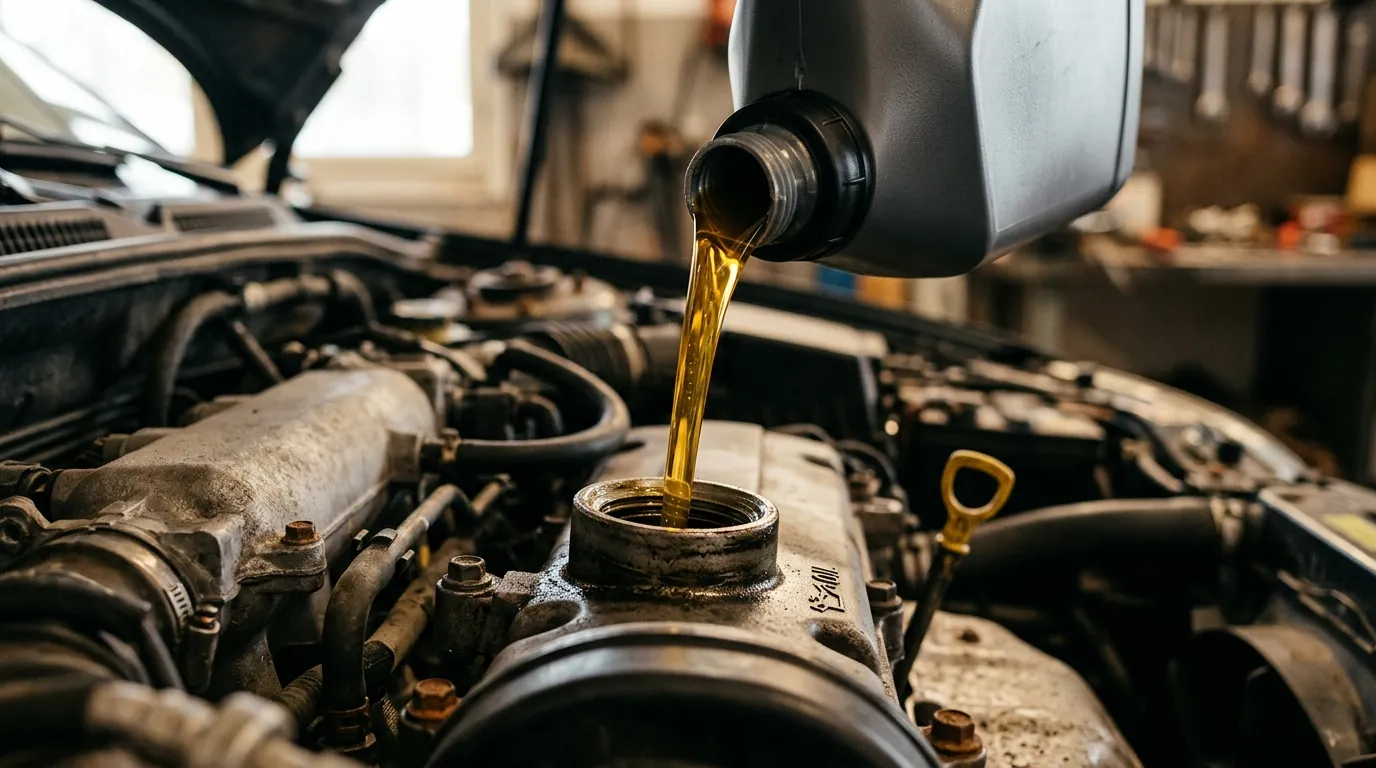
- If oil needs adding, add half a litre of the right oil at a time and check the level again.
- Do not add oil above the upper mark. Škoda advises you not to drive on if the level is above the mark or if oil cannot be added.
If the red oil pressure warning light comes on while you are driving, stop in a safe place and switch off the engine. We cover the red warning lights in our article on the engine warning light.
Where can I find out which oil my car needs?
Your car's oil standard and the permitted viscosities are given in the owner's manual, often in a table for each engine. As the Octavia example shows, the service schedule affects the standard, so check at the same time whether your car is on a fixed or a flexible service interval. The service history shows which oil last went into the engine. We cover the digital service book in an article of its own.
What the manual says is not always the last word. Škoda writes that engine oils are constantly being developed and that the information in the manual is correct at the time of publication. If the manual is lost or unclear, give us the registration number and we will look up your engine's oil in the manufacturer's table.
Longlife oil and the change interval
Longlife oil is oil that the carmaker has approved for an extended change interval. However, it is the car's service schedule that sets the change interval, not the oil. In a car on a fixed interval, longlife oil does not extend the interval. If the car is on the manufacturer's flexible service schedule, it needs an oil with the approval that schedule requires.
Winter is hard on oil. Short trips do not give the engine time to reach operating temperature, so fuel and water condense into the oil and do not evaporate out again. In city driving, it is therefore worth keeping the change interval shorter than the longest interval in the service schedule.
We check the service book and the car's details to see which of the two schedules your car follows. We explain how often to change the oil on the oil change page.
The wrong oil only shows up years later
The wrong oil does not usually cause a fault straight away. In our experience, it shows up only years later, in the particulate filter, the turbo and the chain tensioner.
With the particulate filter, the link is direct. A high-ash oil leaves ash in the filter that regeneration does not burn off, and the filter fills up faster. That is why engines with a particulate filter take a low-ash oil. We say more about ash on the particulate filter cleaning page.
The turbo is another example. Turbocharged direct-injection engines need an oil that protects against pre-ignition and against deposits in the turbo's compressor, and ACEA requires this only of classes A7/B7, C6 and C7. The descriptions of classes A5/B5 and C5 contain no such requirement, so an oil of the wrong class may be good in other respects and still lack this very protection.
The timing chain tensioner uses oil pressure to keep the chain tight, and the engine oil also lubricates the chain. Oil of the wrong quality and change intervals that are too long wear the chain and the tensioner. We describe the symptoms of a worn chain on the timing chain replacement page.
When should you take the car to a workshop?
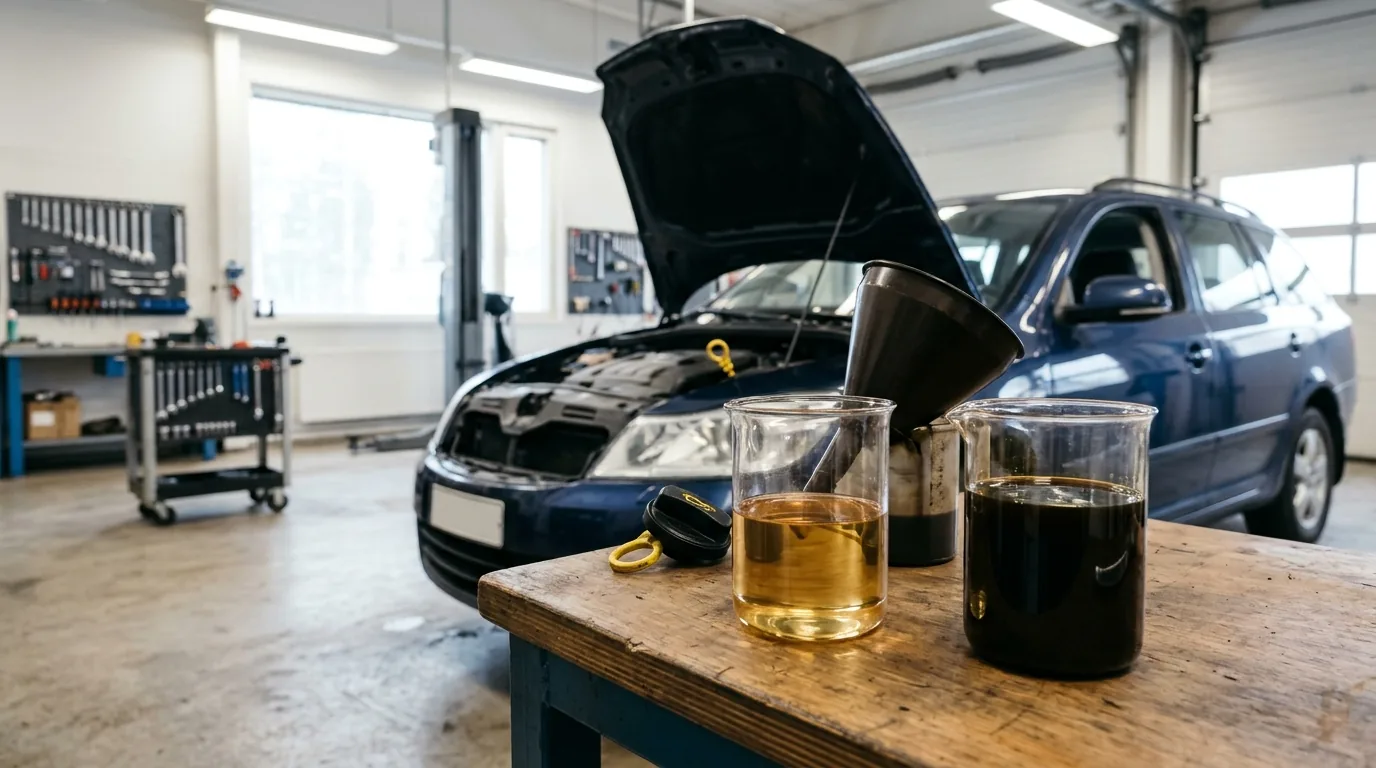
Come and see us when an oil change is due under the service schedule, or if you do not know which oil is in the engine. We choose the oil from the manufacturer's table by registration number, not by whatever happens to be on the shelf. We record the oil used in the service book, so that next time it is clear what is in the engine. We work this way at every oil change and scheduled service, and we tell you the price before the work starts.
Book the car in for diagnostics if the engine uses clearly more oil than the manual says, the oil pressure light comes on, or the wrong oil has been added to the engine by mistake. If the wrong oil has gone in, it is worth telling us straight away, so that it can be changed before it has a chance to do any harm.