Published Updated
There are two separate questions to ask about a battery: is it full, and is it healthy? A multimeter answers the first in a few seconds. The second needs a battery tester, which judges whether the battery can deliver the current needed for starting. Many people replace a battery needlessly, because a flat battery looks faulty. Many others end up stranded at the roadside, because a full battery looks healthy.
What voltage should a car battery have?
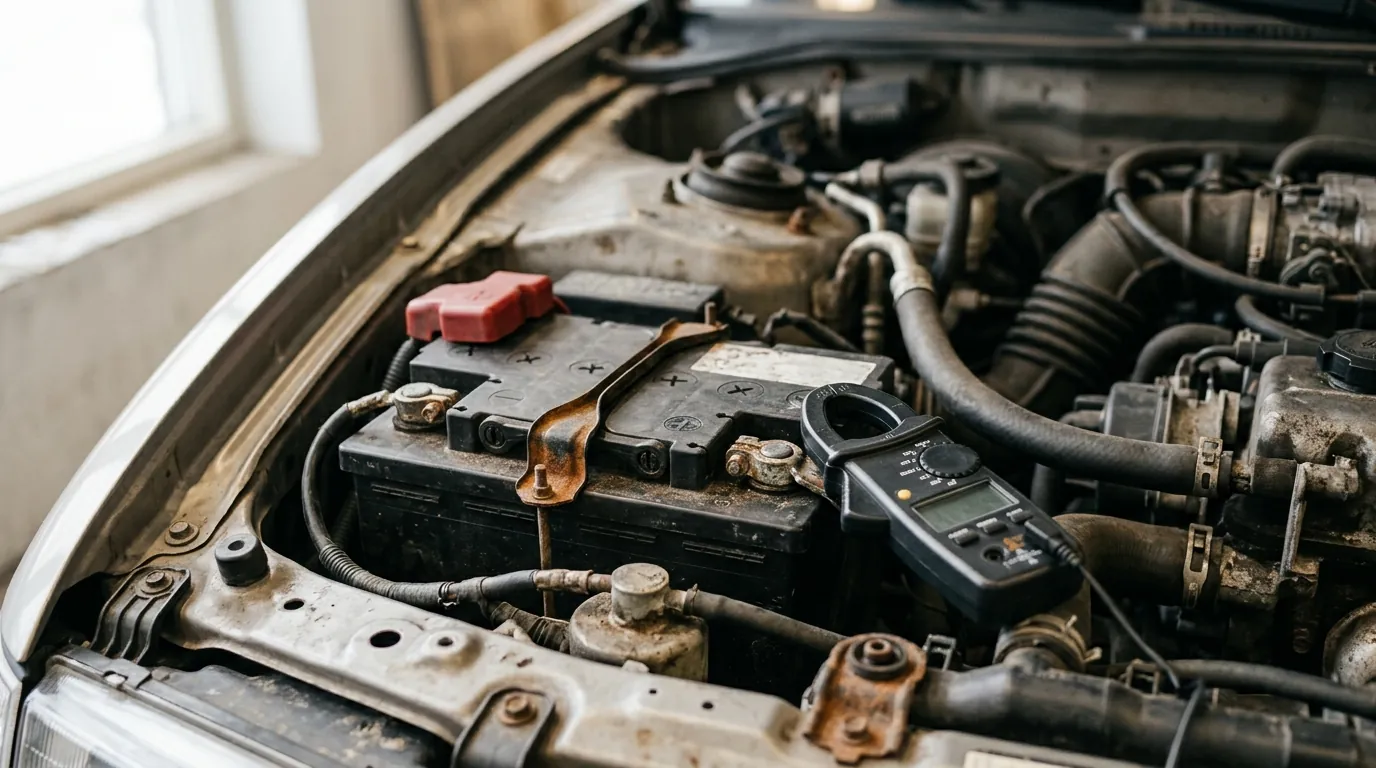
Measure the voltage directly at the battery terminals once the engine is off and the car has been standing. The ideal time is in the morning, before you start the car. Immediately after a drive the reading is inflated and does not show the true state of charge. After charging, the battery maker Varta advises waiting at least an hour before you measure.
A lead-acid battery has six cells, and when fully charged they give about 12.7 volts in total. Varta's guidance gives these thresholds:
| Resting voltage | What it means |
|---|---|
| 12.7–12.8 V | The battery is full. |
| 12.5 V or less | It is worth charging the battery. |
| Below 12.4 V | Charge the battery as soon as possible. |
How to measure the battery voltage
- Let the car stand for a few hours, preferably overnight, and switch off all electrical equipment.
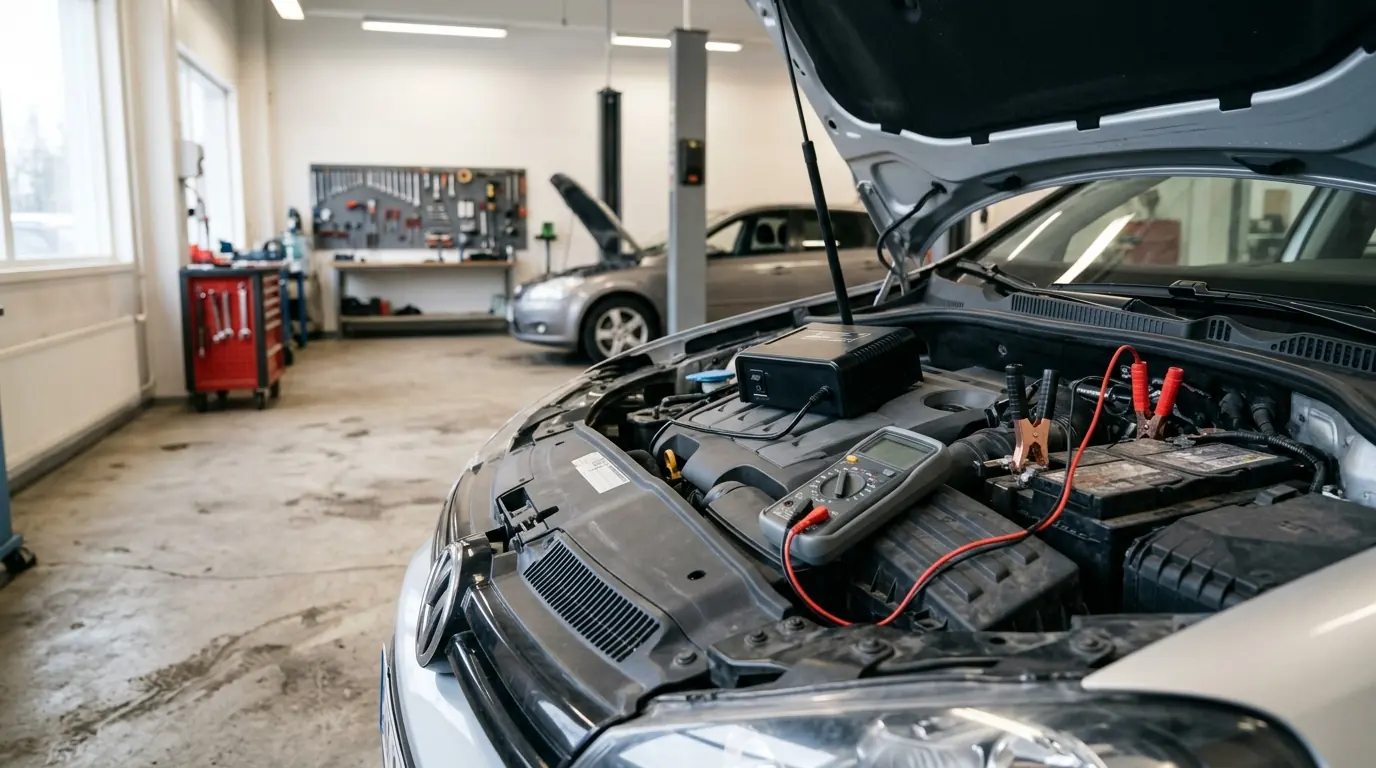
- Set the multimeter to a DC voltage range, for example 20 V.
- Touch the red probe to the battery's positive terminal and the black probe to the negative terminal.
- Read the value to one decimal place and compare it with the table above.
- If the reading is below 12.4 volts, charge the battery and measure again an hour after charging has finished.
A single reading is a snapshot. If the same battery reads lower and lower each morning even though the car is being driven, either it is not getting enough charge on the road or something is draining it while the car is parked.
The voltage with the engine running is a different matter. When the car's alternator is charging, the voltage rises above the resting voltage. In modern cars an energy management system adjusts the charging to suit the driving, so a single reading says little about the charging system, and there is no one correct value for it. That is why the alternator is checked with a tester.
What does the battery label tell you?
The label on the battery gives the details you need to charge and test it. The voltage is 12 volts. The capacity is given in amp hours (Ah), and you need it to estimate the charging time. The cold cranking current is given in amps, and according to Varta it is followed by the test standard, for example EN, DIN, IEC, JIS or SAE. Both the current and the standard are entered into the tester. The label also states the battery type, such as AGM or EFB, and you choose the charger mode to match it.
How long does it take to charge a car battery?
Varta gives a rule of thumb: divide the battery's capacity in amp hours by the charger's current in amps, then add about ten per cent to the result. For example, a 70 Ah battery and a 5 A charger: 70 ÷ 5 = 14 hours, and the extra brings it to about 15 hours. Varta's own example gives the same figure. The table applies the rule to common battery sizes, starting from a flat battery. The last column shows the highest charging current that, for example, the Škoda owner's manual advises: at most a tenth of the battery's capacity.
| Battery capacity | With a 4 A charger | With a 5 A charger | Maximum charging current |
|---|---|---|---|
| 44 Ah | about 12 h | about 10 h | 4.4 A |
| 60 Ah | about 17 h | about 13 h | 6 A |
| 70 Ah | about 19 h | about 15 h | 7 A |
| 80 Ah | about 22 h | about 18 h | 8 A |
| 95 Ah | about 26 h | about 21 h | 9.5 A |
The capacity is printed on the battery's label. By the same rule, a half-empty battery charges in roughly half the time. According to Varta, a typical charging time is 12–24 hours, and in its example a two-hour charge takes a flat battery to only about 15 %. A small charger is not suitable for recharging a flat battery: on a 2 amp charger even a 44 Ah battery would need more than a full day. A charger like that is better suited to maintaining a battery.
Varta's advice is not to leave a battery on the charger for more than a full day, even though a good charger does not overcharge. In maintenance mode, however, a charger can keep a battery full even when the car is left standing for a long time.
Charging a car battery with a charger, step by step
A smart charger detects the battery's state of charge, adjusts the charging current itself and stops when the battery is full. Choose the charger mode to match the battery type (see below). You do not usually need to disconnect the battery. Here is how:
- Switch off the car and all electrical equipment.
- Attach the charger's red clamp to the battery's positive terminal, then the black clamp to the negative terminal or, if the car's manual says so, to the engine earth point.
- Plug the charger into the mains only once the clamps are on.
- When the charger shows the battery is full, unplug the charger from the mains first and only then remove the clamps.
- Wait at least an hour and measure the resting voltage.
On a start-stop car the connection may be different. According to the Škoda owner's manual, for example, the charger's negative clamp on a start-stop car must not be connected directly to the battery's negative terminal, only to the engine earth point. So check your own car's manual before you attach the clamps.
Can you charge the battery in the car?
Yes, and it is usually better. According to the battery maker's instructions, charging in the car is simpler and recommended for safety reasons, although it is not always possible. The Škoda manual says the cables do not usually need to be disconnected when the battery is charged at a low current. If you lift the battery out of the car, disconnect the negative cable first and then the positive. They go back on in the reverse order. Carry the battery upright.
In some cars the battery sits in the boot or under a seat, with separate connection points in the engine bay. The owner's manual tells you where to connect the charger. The car's own manual always takes precedence over general advice.
Charging AGM, EFB and start-stop batteries
Charging an AGM battery needs a smart charger suitable for AGM batteries. A charger's gel-battery mode is not suitable for an AGM battery. Start-stop cars usually have an AGM or EFB battery. According to Varta, charging them is otherwise the same as charging a conventional battery, but the charger must be suitable for batteries with start-stop technology. The type is on the battery's label, and the modes below follow the guidance of the battery makers Varta and GS Yuasa:
| Battery type | Charger mode | Note |
|---|---|---|
| Conventional flooded battery | Standard mode | Not suitable for a start-stop car |
| EFB | Usually the flooded-battery mode | The charger must be suitable for start-stop batteries |
| AGM | A mode suitable for AGM batteries | The gel-battery mode is not suitable for AGM batteries |
A battery sensor tells you which kind of battery belongs in the car. Varta notes that a car with a battery sensor is either a start-stop car or at least has a smart charging system that requires an AGM or EFB battery. The sensor usually sits on the battery's negative terminal clamp, and the car's energy management uses its readings to control the charging.
A battery does not need to be registered after charging, but after a replacement it often does. According to Varta, cars with advanced energy management, such as BMW, Mercedes and Volkswagen Group cars, need the new battery registered with a diagnostic tool when the battery is replaced. The car then knows that the battery is new and charges it correctly.
Hydrogen and sparks
A lead-acid battery gives off hydrogen as it charges, and hydrogen is explosive. Tukes, the Finnish Safety and Chemicals Agency, says a space where a battery is charged must be adequately ventilated. So charge outdoors or in a space with a supply of fresh air. Keep naked flames, cigarettes and sparking tools away from the battery. Wear safety glasses and gloves, and do not let any metal object touch both terminals at once.
Do not charge a battery whose case is cracked or swollen, or which is leaking fluid. Battery acid burns the skin. If acid gets on your skin, rinse the area with plenty of water and see a doctor. A damaged battery is replaced, not charged. According to the Škoda owner's manual, quick charging is dangerous and needs a special charger and professional skill, so it is a job for a workshop.
Charging a car battery by driving: how long do you need to drive?
Driving charges the battery if the journey is long enough. Starting takes a lot out of the battery, and the alternator only has time to make that up on a longer drive. According to Varta, after many short trips the battery's charge balance turns negative: the battery loses more energy than the alternator has time to put back. In winter things are even worse. A cold battery charges more slowly, and at the same time the lights, the heated rear window, the heated seats and the blower take part of the alternator's output.
A longer drive charges the battery quickly, and you do not need high speeds for it. There is no fixed number of minutes, however, and the battery maker does not give one. The time needed depends on the battery's state of charge, its condition and which electrical equipment is on during the drive. If you make a lot of short trips in winter, charge the battery with a charger every so often, and switch off the heated seats and other comfort features when you do not need them.
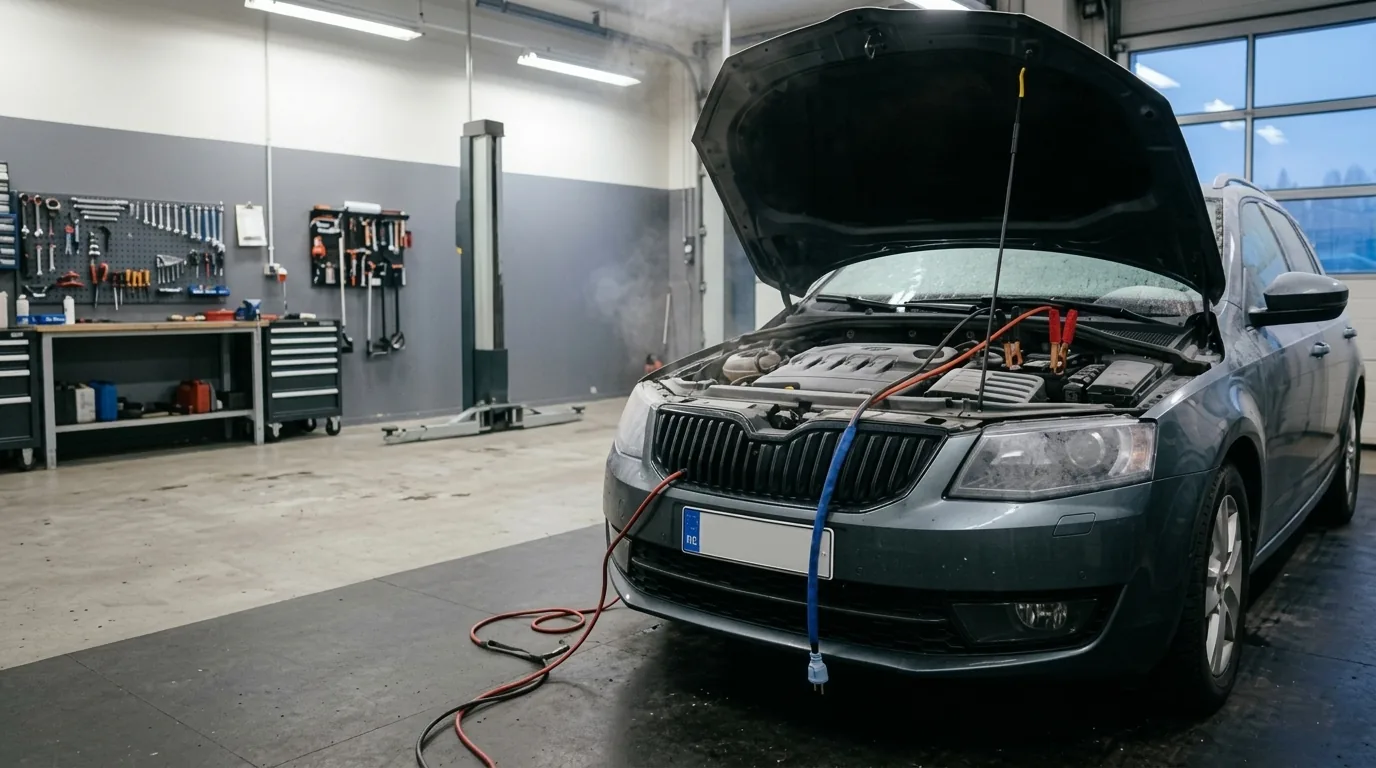
The same applies after a jump start. Once the car has been started with help from another car, the battery is still almost flat, and a short drive will not recharge it. Charge the battery with a charger afterwards and measure the voltage the next morning.
Some car makers give a guideline time for their own cars. The Kia Niro's manual says that after a jump start you drive for about half an hour in total so that the 12-volt battery charges fully. In the Polestar 1's instructions the time depends on the temperature: at about +15 degrees the car must charge the battery for at least an hour, and in colder weather the time can grow to 3–4 hours. Polestar also recommends an external battery charger. Idling at a standstill is not a way to charge the battery, because under section 55 of the Road Traffic Act (tieliikennelaki) the engine of a stationary car must not be kept running for longer than two minutes. When it is more than 15 degrees below zero, the engine may run for up to four minutes before you set off.
Why does the battery go flat while the car is parked?
A car draws on its battery even while it is parked. The alarm, the clock, the keyless entry system and the control units use current even when the car is locked. The Škoda owner's manual, for example, says the battery discharges if the car is not driven for more than 3–4 weeks, because some electrical components draw current even when idle.
The Škoda manual advises preventing the discharge either by disconnecting the battery's negative cable or by charging the battery continuously at a very low current. On newer cars, disconnecting can reset settings, so for a car left standing for a long time, a maintenance charger is usually the easier solution.
If the battery goes flat within just a few days, some device is probably staying on when it should go to sleep. A fault like that is tracked down through diagnostics.
Is it worth charging the battery before winter?
It is, if the car spends a lot of time parked or your daily journeys are short. Varta advises monitoring and charging the battery regularly, especially during long periods of disuse and winter storage, and having it tested at least once a year before winter. A full battery also gives more starting current: according to Varta, the less charge a battery holds, the lower the current it can deliver when starting.
Frost exposes a weak battery
In the cold, the battery's chemical reactions slow down and it delivers less starting current. At the same time, engine oil thickened by the frost makes the starter motor draw more current. A battery that coped all autumn can therefore fail on the first morning of hard frost.
The weakness does not come from the frost, though. According to the battery maker, summer heat also ages a battery, and the damage does not show in summer or autumn. It only comes to light in winter, when starting demands the most. A block heater helps, because a warm engine and warm oil need less current to start; see how to use a block heater. If the car does not start at all, read why a car will not start in the cold, and if you need power from another car, see how to jump-start a car.
When does charging no longer help?
The resting voltage tells you the battery's state of charge, not its condition. Even an old battery can show 12.7 volts at rest and still give up when the starter motor draws current from it. A battery's ability to deliver a high current declines with age and wear, and a multimeter cannot see that.
Being left undercharged damages a battery. Varta explains that in a battery which is constantly run at too low a charge (below 80 %), the acid starts to separate into layers, and the result is sulphation: lead sulphate crystals grow on the plates of the cells and weaken the battery's ability to accept a charge and deliver starting current. A deep discharge leaves the battery permanently damaged, even if it can still be charged back up.
In our experience, these are the signs: the battery charges fully but goes flat again within a few days, or the engine cranks slowly right after a full charge. That is when the battery's condition is measured with a battery tester. The battery type and the cold cranking current marked on the label are entered into the tester, and it shows how much of the starting power is left. In Varta's guidance, a condition check covers the cold cranking capability, the remaining capacity and the battery's ability to accept a charge. If the battery is in the boot or the cabin, the tester is connected to the battery's own terminals, not to the connection points in the engine bay, because the resistance of the car's wiring would distort the measurement. On AGM and EFB batteries the test is more demanding, because the battery must also recharge quickly between engine stops.
A start-stop car often gives you a clue itself. If the engine switches off at traffic lights less often than it used to, the car's energy management may be sparing a weakened battery. Then it is worth testing the battery.
There is no single figure for a battery's service life, and the battery maker does not give one either. It depends on the battery type, temperatures, the number of charge and discharge cycles, the depth of the discharges and how often the car is driven. An AGM battery should always be replaced with another AGM battery, and if a conventional battery is fitted to a start-stop car, it wears out quickly, even if the start-stop function is switched off. Have the battery tested at least once a year before winter, and whenever starting begins to feel slow. We go through the signs of an ageing battery and how to choose a new one in the article when a car battery has to be replaced.
When should you visit a workshop?
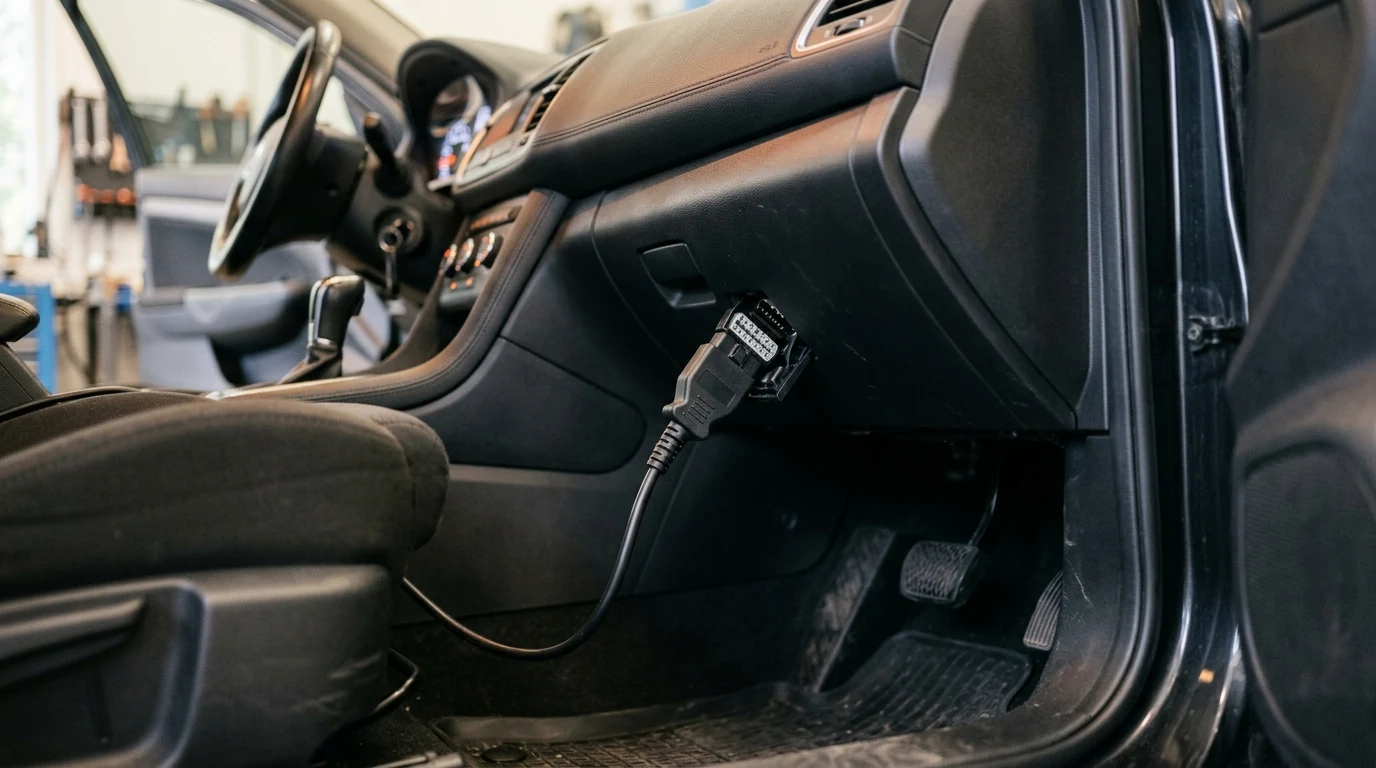
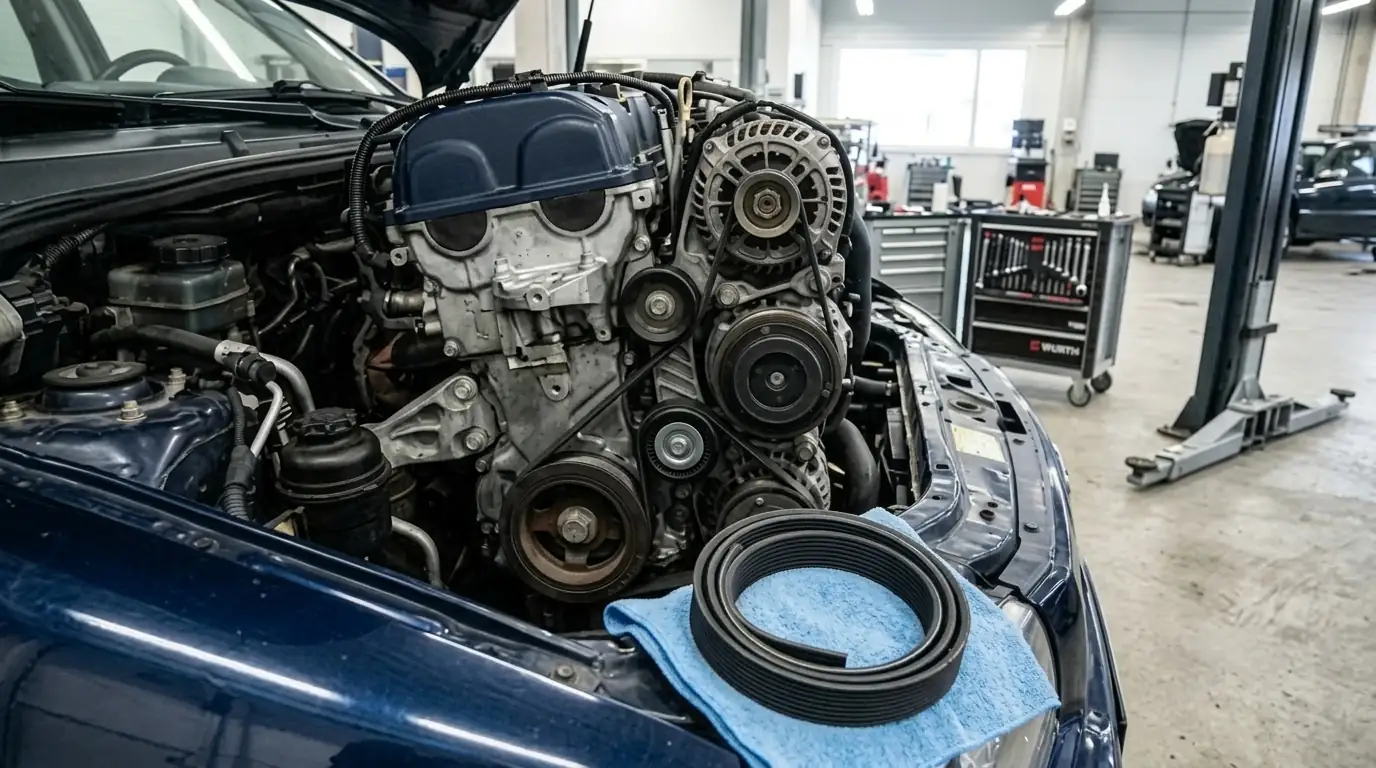
When starting slows, the battery goes flat while the car is parked, or charging no longer helps. Our battery test takes minutes. We measure the battery's condition with a tester and check at the same time whether the alternator is charging as it should. The alternator is driven by the auxiliary belt, so we check that too. A worn belt slips and does not turn the alternator properly, and the battery is left undercharged even if the battery and the alternator are both sound. We cover the belt's symptoms on our auxiliary belt replacement page.
If the battery is sound but flat, we say so plainly. If it has reached the end of its life, we tell you the price of a battery replacement before anything is disconnected, and we register the new battery if the car requires it. If the fault turns out to be in the alternator, we tell you that too, because a new battery would not fix it. Come straight in without an appointment while the car still starts.