Published Updated
Finally, disconnect the leads in the reverse order. The instructions here are based on car manufacturers' manuals, which agree on the principle: the black lead goes on last, to an earth point well away from the flat battery. The differences lie in the details, and below we name the maker for each one. If you are not sure, check your own car's manual. Mazda and Kia advise leaving the job to a professional if you do not feel confident about jump-starting.
Before you connect the leads
- Both cars must have a 12-volt system. In passenger cars 12 volts is standard, but a 24-volt source, such as a lorry or two batteries connected in series, can damage the car's electrical equipment.
- The donor battery must not be much smaller than the flat one.
- The cars must not touch each other. Drive them close enough for the leads to reach.
- Switch off both cars and turn off any electrical equipment you do not need, such as the lights, the heater fan and the radio. Kia's instructions say to select P and apply the handbrake.
- Check the manual for where the leads go. On many cars they connect to separate jump-start points in the engine bay instead of the battery.
Do not jump-start if…
| Situation | Why not | What to do |
|---|---|---|
| The battery is frozen | It can crack or explode | Replace the battery; do not charge it |
| The battery is swollen, cracked or leaking | Risk of explosion | Do not use the battery at all |
| The battery's fluid level is too low | Explosion and chemical burns | Do not jump-start; have the battery checked |
| The power source is 24 volts | It damages 12-volt electrical equipment | Use a 12-volt source only |
| The donor car's maker forbids it | A fuse can blow | Check the donor car's manual |
A flat battery can freeze when the temperature is only just below zero. If the battery case is swollen or you can see ice in the battery, you must not attempt a jump start.
Connection order
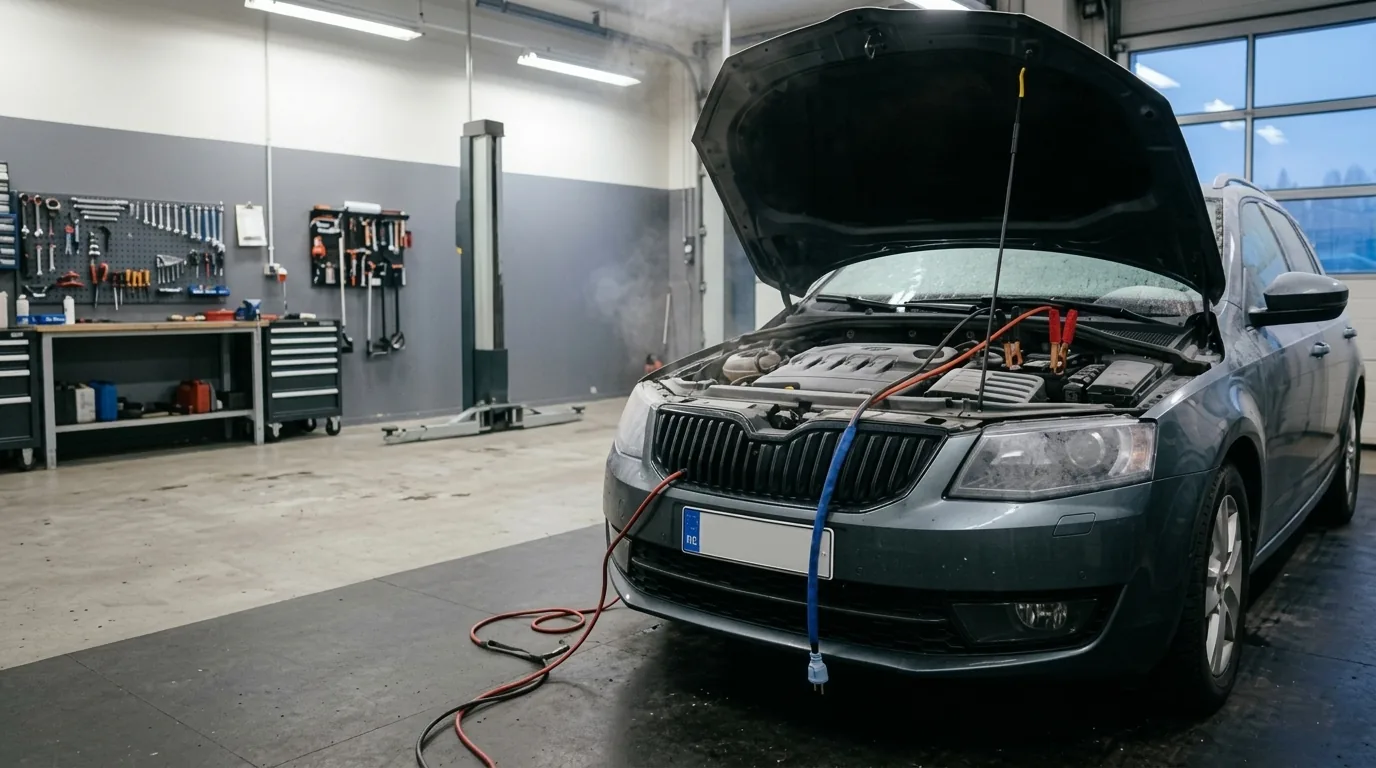
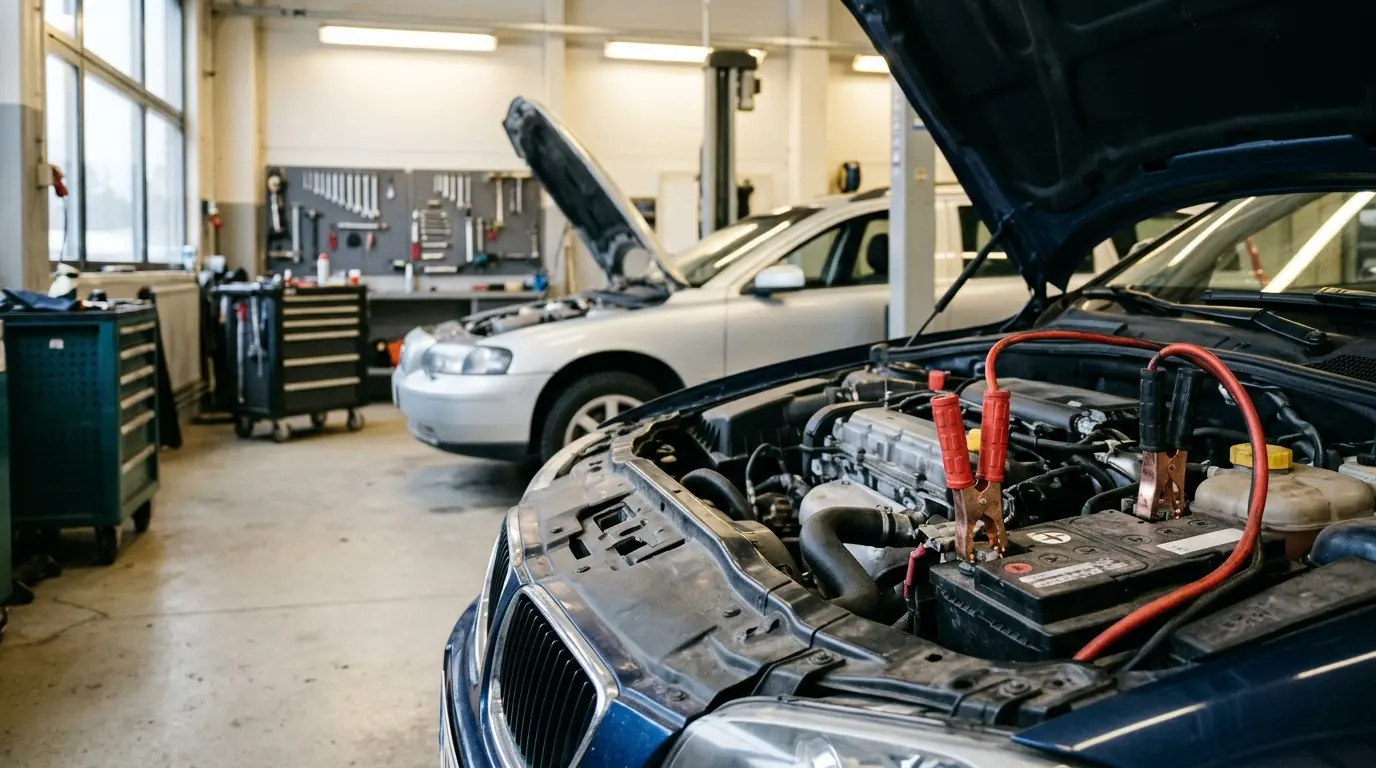
- Connect the red lead to the flat battery's positive terminal (+), or to the positive jump-start point shown in the manual.
- Connect the other end of the red lead to the donor battery's positive terminal.
- Connect the black lead to the donor battery's negative terminal (−).
- Connect the other end of the black lead to an earth point on the car being started. Use an unpainted metal part solidly fixed to the engine, or the earth point shown in the manual. Do not connect it to the flat battery's negative terminal.
- Check that the metal parts of the clamps are not touching each other and that the clamp on the positive terminal is not touching any other metal on the car. Route the leads so that they will not touch the fan or the belts.
- Start the donor car and let it run for a few minutes.
- Start the car with the flat battery.
- Once the engine is running, disconnect the leads in exactly the reverse order.
| Step | Connecting | Disconnecting |
|---|---|---|
| 1. | Red to the flat battery's positive terminal | Black from the started car's earth point |
| 2. | Red to the donor battery's positive terminal | Black from the donor battery's negative terminal |
| 3. | Black to the donor battery's negative terminal | Red from the donor battery's positive terminal |
| 4. | Black to the earth point on the dead car | Red from the started car's positive terminal |
Kia's manual adds that you must not lean over the battery while making the connections. Polestar's instructions put the red lead on the donor battery first, but they too have the black lead go on last, to the earth point of the car being started.
On a start-stop car, a dedicated control unit monitors the battery's state of charge. Škoda's manual, for example, says that in that case the black lead goes to the engine's earth point. If you charge the battery in the car, the charger's negative clamp goes on the same point.
Why does the negative go to an earth point and not to the flat battery?
A battery gives off hydrogen, and according to Mazda's manual it does so even in normal use. Hydrogen is highly flammable. The last connection completes the circuit, and that is exactly where a spark can occur. When the last connection is made at an earth point well away from the battery, a spark cannot ignite the hydrogen that has built up around the battery. Škoda's and Mazda's manuals set this out as a warning.
You can still find instructions online that put the black lead on the flat battery's negative terminal. Not one of the manufacturers' instructions we have read says to do that. Electrically the connection would work, but it puts the spark next to the battery.
Plus or minus first?
Which terminal goes on first depends on what you are doing. A jump start begins with the positive. When a battery is taken out of the car, you begin with the negative.
| Situation | First | Last |
|---|---|---|
| Jump start | Red lead to the flat battery's positive terminal | Black lead to the dead car's earth point |
| Removing a battery | Negative cable | Positive cable |
| Fitting a battery | Positive cable | Negative cable |
When a battery is removed, the negative or earth cable comes off first, so that no short circuit can occur between the positive terminal and the body. The battery maker Varta advises this, as does Kia's owner's manual, for example. According to Kia, the negative cable also goes back on last. The full battery replacement order can be found in the article on replacing a battery.
How long does the donor car need to run?
Mazda's, Kia's and Polestar's instructions say to leave the donor car running for a few minutes before you start the car with the flat battery. Škoda advises letting it idle. The Polestar 1's instructions are the most precise of these: raise the donor car's idle speed to about 1 500 rpm, and if the car does not start, leave the battery to charge for another 10 minutes before the next attempt.
It is not a good idea to keep the starter turning for long at a stretch. Škoda's manual advises stopping an attempt after ten seconds and waiting half a minute before the next one. You will sometimes see advice to run the donor car at high revs for a quarter of an hour before the first attempt. No manufacturer's manual we have read contains such an instruction.
The car will not start even with jump leads
According to Kia's manual, a car that does not start after a few attempts probably needs servicing. Before you give up, check three things. Are the clamps firmly attached to clean metal? A corroded terminal or a painted spot does not conduct current properly. Is the donor car's own battery in good condition? And when you try to start the car, do you hear only a click, or does the engine turn over but not start?
If the starter turns the engine over briskly but the engine will not fire, the fault probably lies somewhere other than the battery, for example in the fuel supply or the ignition. A click on its own can mean that too little current is still getting through, or that the starter motor is faulty. You must not try to jump-start a frozen battery at all. There is a separate article on fault finding: car will not start in the cold.
Giving another car a jump start
If you are giving a jump start from your own car, first check its manual to see whether the car may be used to start another one. Some manufacturers forbid it, as we explain below. A checklist for the donor:
- Check that both cars have a 12-volt system.
- Drive your car close enough for the leads to reach, but do not let the cars touch each other.
- Switch off your car before the leads are connected.
- Connect the red lead to your own battery's positive terminal only once its other end is on the flat battery's positive terminal. The black lead goes on your own battery's negative terminal, and its other end is connected last, to an earth point on the dead car.
- Start your car and let it run for a few minutes before anyone tries to start the other car.
- Once the other car is running, the leads come off in the reverse order: first the black from the other car's earth point, and last the red from the other car's positive terminal.
According to Autoliitto, you should not give a jump start to today's cars, or from them, on your own, because connecting the leads wrongly, for example, or using poor leads can seriously damage the electrical systems of both cars.
Can an electric car or a hybrid jump-start another car?
Not always. The manuals of many hybrids explain how to jump-start the car's own 12-volt battery, but some manufacturers forbid using the car to start another one. According to the Polestar 1's instructions, the car's jump-start point is meant only for starting that car, and starting another car through it can blow a fuse. Honda's instructions likewise say that the positive terminal of the jump-start point cannot be used to start another car.
A hybrid itself can usually be jump-started with leads, as its manual describes. The Toyota Prius v has a separate jump-start terminal in the engine bay for this, and on the Kia Niro hybrid you press the 12-volt battery reset button before starting. Always check the donor car's manual before you connect the leads.
Jump starter or jump leads?
According to Kia's manual, a flat 12-volt battery can be jump-started either with a jump starter, also called a booster pack, or with leads from another car's battery. Use a jump starter as its own instructions say, and look up the connection points in the car's manual just as you would with leads. A jump starter does not need a second car, which makes it practical for anyone who drives alone.
What kind of jump leads?
Škoda's manual says the leads must have a sufficiently thick conductor and insulated clamps, and that the lead maker's instructions must be followed. A thin lead heats up and may not carry the current needed for starting. The clamps must bite firmly onto the terminal or the earth point, and the leads must be long enough that the cars do not have to be driven right up against each other.
What next after a jump start?
When the engine starts, the battery is not yet full. The Kia Niro's instructions say to drive for about half an hour in total so that the 12-volt battery charges fully. Polestar advises keeping start-stop switched off until the battery has recharged, because the engine may not restart automatically. According to its instructions, at around +15 °C the car must charge the battery for at least an hour, and in colder weather this can stretch to 3–4 hours. Polestar says an external battery charger is advisable.
A short drive does not give the battery time to charge, so you may face the same problem the next morning. A battery always goes flat for a reason: it may be tired, the alternator may not be charging, or something may be drawing current while the car is parked. According to Škoda's manual, a battery also goes flat if the car is not driven for three or four weeks. We explain how to measure a battery's voltage and charge it yourself in the article car battery charge and voltage.
When to take the car to a workshop
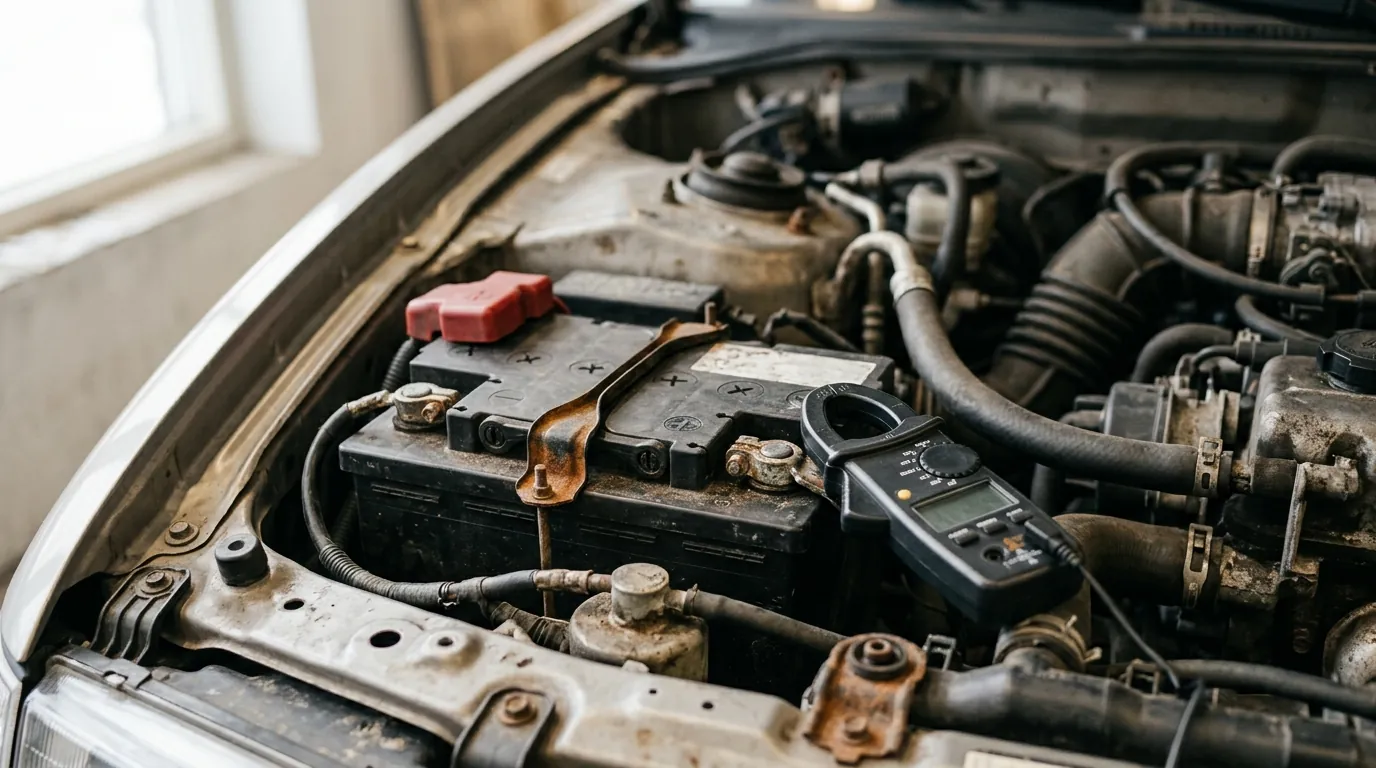
If the car needed a jump start without an obvious cause such as lights left on, it is worth having the battery and the charging system tested before the next frosty morning. If the car started, you can drive straight to us without an appointment. We test the battery and the charging system, and you take the result away with you, even if the battery does not need replacing. The test comes as part of battery replacement, and we tell you the price before anything is replaced.
If the battery and the alternator are fine but the car drains its battery while parked, tracing the cause is a job for diagnostics. The same goes for a car that will not start even with jump leads: the fault then often lies somewhere other than the battery.