Published
Volkswagen, Škoda, Audi and Seat belong to the same group, and many of their models share technology. We have gathered the figures for the four makes and their most common models from the 2025 inspection statistics of Traficom, the Finnish Transport and Communications Agency. These include the rejection rates, the number of rejection faults per hundred inspections and each model's most common rejection items. We also compared every figure with cars of the same age, because in the inspection statistics age explains more than the make does.
Volkswagen and the VAG group at inspection in 2025
Traficom's model-level statistics cover passenger cars first registered between 2005 and 2021. Of these, cars of the four VAG makes were inspected a total of 398 548 times in 2025, almost one inspection in four. The biggest single make was Toyota, inspected 212 612 times.
| Make | Inspections | Failed, % | Same-age cars, % | Rejection faults / 100 inspections | Median mileage, km |
|---|---|---|---|---|---|
| Volkswagen | 182 456 | 25.9 | 26.2 | 44.8 | 190 000 |
| Škoda | 109 003 | 23.2 | 23.3 | 38.8 | 188 000 |
| Audi | 86 387 | 21.0 | 27.2 | 33.5 | 220 000 |
| Seat | 20 702 | 22.1 | 22.9 | 35.7 | 161 000 |
| All makes | 1 672 937 | 26.9 | 26.9 | 46.8 | 187 000 |
The «Same-age cars» column shows what the rejection rate would have been if the make's cars had failed at the same rate as all cars first registered in the same year. We worked it out from Traficom's figures for each year of first registration.
The comparison changes the picture. Volkswagen and Škoda are almost exactly level with cars of the same age. So Škoda's lower rejection rate mostly comes down to its cars being younger. Audi stands out: 21.0 % of its cars failed, even though 27.2 % of cars of the same age did. Audis also had the highest mileage in the group, with a median of 220 000 km.
A breakdown by year of first registration shows the difference in more detail. The table gives the share of cars that failed, as a percentage, for every other year of first registration.
| Year first registered | All makes | Volkswagen | Škoda | Audi |
|---|---|---|---|---|
| 2005 | 44.3 | 47.6 | 48.3 | 41.9 |
| 2007 | 41.2 | 43.2 | 43.1 | 36.0 |
| 2009 | 35.9 | 36.3 | 35.9 | 27.6 |
| 2011 | 29.8 | 29.7 | 30.1 | 21.3 |
| 2013 | 23.6 | 23.9 | 20.9 | 15.5 |
| 2015 | 17.8 | 14.6 | 14.3 | 12.8 |
| 2017 | 17.2 | 17.2 | 15.3 | 11.8 |
| 2019 | 10.7 | 9.4 | 10.7 | 6.3 |
| 2021 | 8.2 | 6.0 | 8.6 | 4.6 |
Volkswagens and Škodas first registered between 2005 and 2008 failed more often than cars of the same age on average. From 2014 onwards, Volkswagens were below the average in most years. For Škoda, the cars from 2013 to 2017 were below the average, while the youngest were level with it or slightly above. Audi was below the average in every year of first registration from 2005 to 2021. Seat's yearly numbers are so small that we left them out of the table.
Golf, Passat, Polo and other models
The table lists the models of the four makes that were inspected at least 5 000 times in 2025. The Škoda Octavia was the most inspected of all models in Finland, at 61 732 inspections, and the Volkswagen Golf was second, at 60 538.
| Model | Inspections | Failed, % | Same-age cars, % | Rejection faults / 100 inspections | Median mileage, km |
|---|---|---|---|---|---|
| Volkswagen Golf | 60 538 | 25.6 | 27.5 | 46.3 | 189 000 |
| Volkswagen Passat | 36 920 | 26.6 | 25.5 | 41.4 | 240 000 |
| Volkswagen Polo | 21 420 | 26.2 | 26.0 | 44.8 | 128 000 |
| Volkswagen Tiguan | 9 043 | 16.9 | 21.6 | 23.4 | 180 000 |
| Volkswagen Jetta | 8 748 | 40.5 | 34.1 | 77.9 | 219 000 |
| Volkswagen Touran | 7 460 | 35.1 | 28.7 | 65.3 | 236 000 |
| Volkswagen Golf Plus | 6 909 | 32.2 | 35.1 | 60.5 | 182 000 |
| Volkswagen Caddy | 5 595 | 31.0 | 23.7 | 54.7 | 250 000 |
| Škoda Octavia | 61 732 | 23.2 | 24.8 | 40.3 | 209 000 |
| Škoda Superb | 13 470 | 28.2 | 21.7 | 42.6 | 235 000 |
| Škoda Fabia | 12 842 | 26.3 | 26.1 | 46.3 | 143 000 |
| Škoda Yeti | 5 382 | 23.1 | 25.0 | 35.0 | 186 000 |
| Audi A4 | 28 637 | 23.4 | 29.8 | 38.1 | 245 000 |
| Audi A3 | 17 626 | 20.5 | 26.4 | 33.4 | 180 000 |
| Audi A6 | 16 771 | 24.0 | 28.8 | 38.5 | 266 000 |
Audi's three most common models and the Tiguan were more than four percentage points below the level of cars of the same age. The Caddy, Superb, Jetta and Touran were more than six percentage points above it. The other models in the table were within three percentage points of the same-age level.
The Caddy and the Superb are among the high-mileage models in the table. The Superb's median mileage was 235 000 km and the Caddy's 250 000 km, against 143 000 km for the Fabia and 128 000 km for the Polo. The Audi A4's most common rejection items were springs and shock absorbers (6.6 faults per hundred inspections) and the front axle (6.5). None of Seat's models reached 5 000 inspections: the Leon was inspected 4 218 times and the Ibiza 3 327 times.
The Polo's most common rejection item was the service brake roller test, at 6.2 faults per hundred inspections, almost twice the 3.2 for all makes. Next came the sills and floor pan (5.7) and the front axle (5.5). The brake rollers measure the braking force and how evenly it is shared between the wheels, so the result depends on the condition of the whole brake system.
A model's row includes all of its cars first registered between 2005 and 2021, whatever their generation. So the Golf row holds Golfs of several generations. According to Traficom, the rejection rates of different car models are not directly comparable, because the models' average mileages can differ considerably.
What are the Golf's most common inspection faults?
The Golf's most common rejection item was the sills and floor pan. It accounted for 7.8 rejection faults per hundred inspections, nearly triple the average for all makes.
| Rejection item | Golf, faults / 100 | All makes, faults / 100 |
|---|---|---|
| Sills and floor pan | 7.8 | 2.7 |
| Springs and shock absorbers | 7.6 | 6.1 |
| Service brake | 4.7 | 4.9 |
| Service brake roller test | 4.1 | 3.2 |
| Petrol engine emissions test | 3.9 | 1.9 |
Under the inspection regulation, the inspector checks this item by systematically tapping the underbody with a tyre iron and pressing on any suspect spots. More extensive rust damage in the sills and rust damage in the strut towers fail the car. Rust at the axle mounting points can also get the car banned from driving (ajokielto). A single small rust hole, at most the size of the tip of a tyre iron, gets a repair notice (korjauskehotus).
The statistics do not show the cause of the rust or the Golf's generation, but they do show the year of first registration. Rejection faults in the sills and floor pan are concentrated on Golfs first registered between 2005 and 2011:
| Year first registered | Golf, faults / 100 | All makes, faults / 100 |
|---|---|---|
| 2005 | 19.1 | 9.4 |
| 2007 | 22.3 | 7.6 |
| 2008 | 26.2 | 6.2 |
| 2009 | 14.4 | 4.1 |
| 2010 | 9.6 | 2.6 |
| 2011 | 5.6 | 1.4 |
| 2013 | 2.3 | 0.4 |
On Golfs first registered in 2008, these faults were recorded at more than quadruple the rate for all cars from the same year. Golfs first registered from 2015 onwards had practically none. So on a Golf more than ten years old, it pays to check the floor and the sills before the inspection. More detailed Golf figures are on the Volkswagen Golf page.
What are the Passat's most common inspection faults?
Passats failed most often on springs and shock absorbers, at 10.5 faults per hundred inspections. The average for all makes was 6.1. The second most common item was the front axle (7.4), followed by the service brake and the rear axle (3.2 each) and tyres and wheels (3.0).
Passats have covered a lot of kilometres. Their median mileage was 240 000 km, the highest of Volkswagen's most common models after the Caddy's 250 000 km. Even so, the Passat's rejection rate was only slightly above the level of cars of the same age. Suspension wear follows mileage, so on a high-mileage Passat it pays to check the shock absorbers and the spring mountings before the inspection.
What are the Octavia's most common inspection faults?
On the Octavia, the most common rejection item was springs and shock absorbers, at 7.9 faults per hundred inspections. Next came the front axle (4.1), the service brake (4.0) and the sills and floor pan (3.9). The front axle figure was well below the all-makes average of 7.5, and the Octavia's rejection rate stayed below the level of cars of the same age.
More detailed Octavia figures are on the Škoda Octavia page.
Why do the Jetta and the Touran get more rejection faults than the Tiguan?
The main reason is age. From Traficom's figures, we worked out the median year of first registration of each model's inspected cars. It was 2009 for the Jetta, 2011 for the Touran and 2014 for the Tiguan. Mileage differs too: the median was 219 000 km for the Jetta, 236 000 km for the Touran and 180 000 km for the Tiguan.
Age does not explain everything. If Jettas had failed at the same rate as cars of the same age on average, their rejection rate would have been 34.1 %. The actual figure was 40.5 %. For the Touran the figures were 28.7 % and 35.1 %, so the gap was just as large. The Tiguan, on the other hand, came in at 16.9 %, below the 21.6 % for cars of the same age.
Item by item, the differences are clear. The Jetta's most common rejection item was the sills and floor pan, at 17.4 faults per hundred inspections, with springs and shock absorbers second at 12.4. On the Touran, springs and shock absorbers came first (11.6) and the sills and floor pan second (7.8). The Tiguan's biggest item, springs and shock absorbers, stopped at 7.2.
Shared technology
According to Volkswagen, the MQB modular toolkit has been the common base of many transverse-engined models since 2012, and by 2022 more than 32 million cars had been built on it. The group's first MQB model was the third-generation Audi A3, and production of the Golf VII began in Wolfsburg in October 2012. Škoda's annual report says the company first used the toolkit in the third-generation Octavia, which was unveiled in December 2012. In the same year, production of the new generation of EA211 petrol engines began at Škoda's plant in Mladá Boleslav.
Volkswagen says the EA211 petrol engines and EA288 diesel engines introduced with the MQB have standardised interfaces to the drivetrain. They can therefore be combined with the same gearboxes and driveshafts, and the number of engine and gearbox versions almost halved. The toolkit also makes it possible to build models of different makes on the same production line.
For a workshop, shared technology means that the same part and the same job often turn up on cars of different makes. Even so, a part is always matched to the car's vehicle identification number (VIN), because one model comes in different engine, gearbox and chassis versions. You cannot see shared technology in the inspection statistics, because they give only the make and the model.
What we check on a VAG car on the lift
The most common rejection items in the statistics are the same ones we check on the lift before an inspection:
- Sills, floor pan and axle mounting points. We look for rust the same way the inspector does, by tapping and pressing.
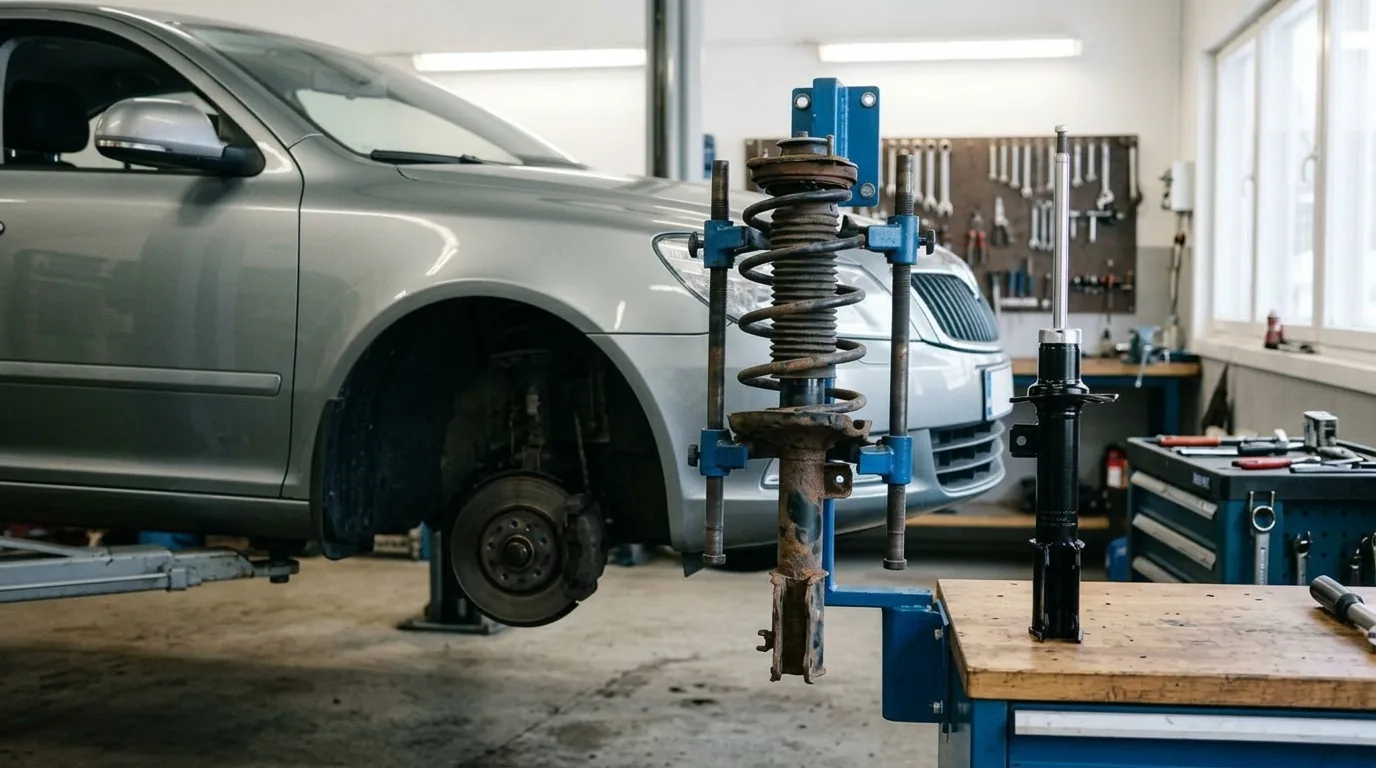
- Springs and shock absorbers. We check the dampers for leaks, the condition of the springs and the top mount bearings.
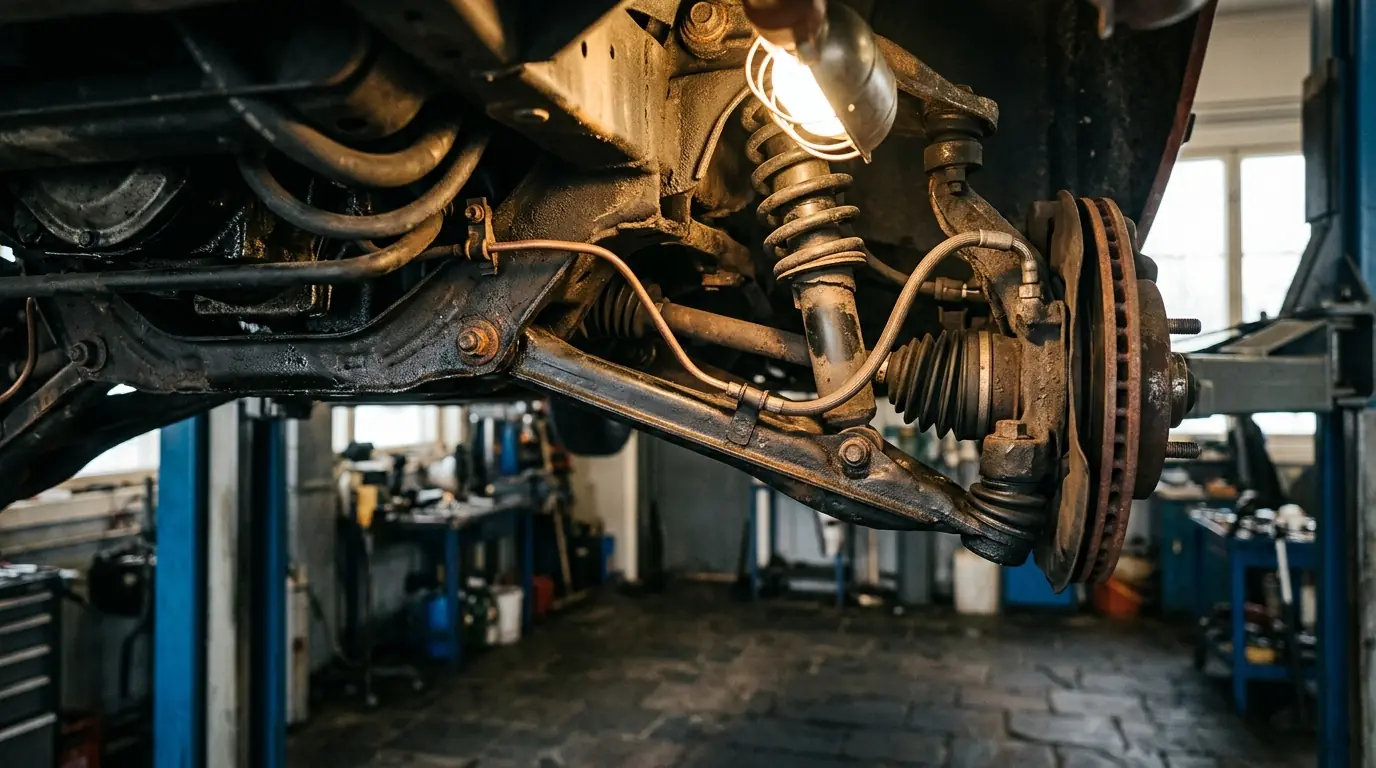
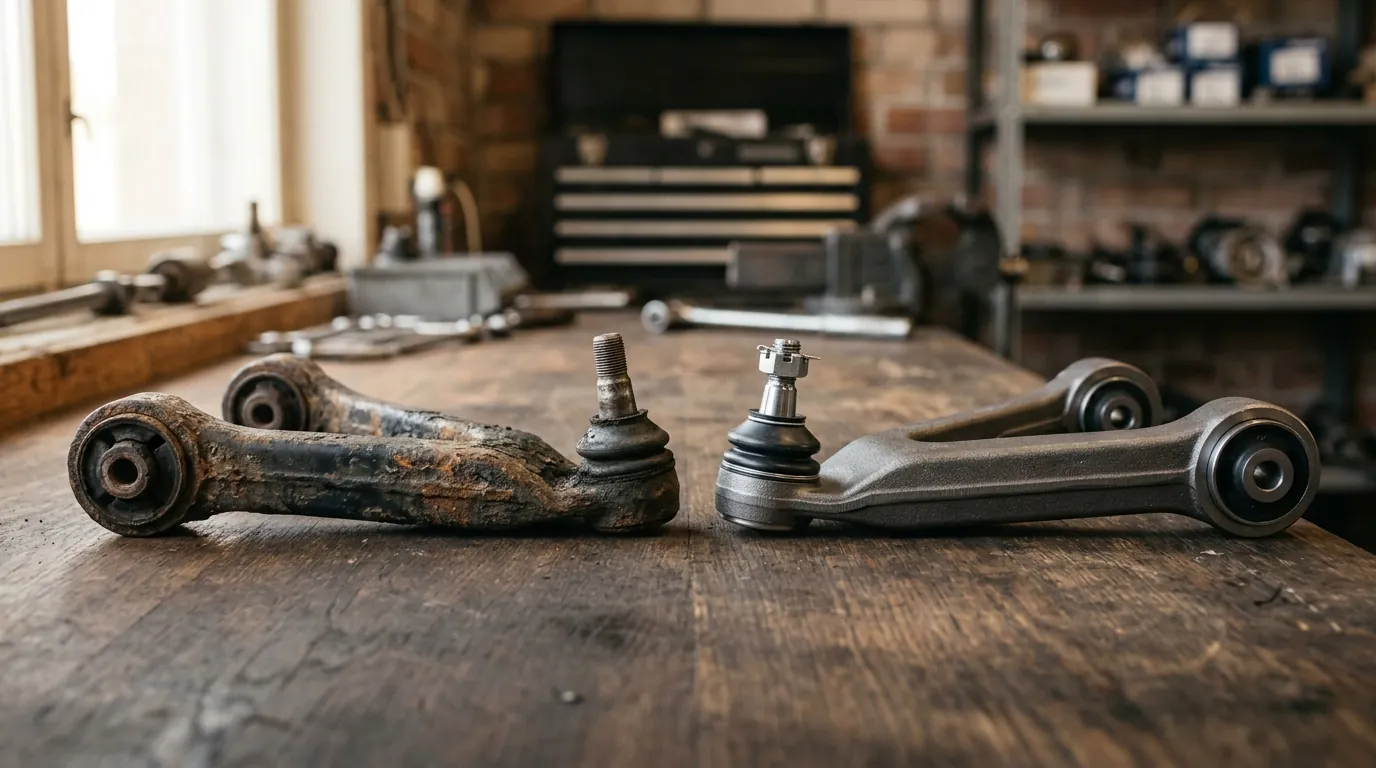
- Front and rear axles. We check the control arm joints, the bushes and the ball joints for play.
- Brakes. We look at the condition of the discs and pads, the calipers, the brake pipes and hoses, and how the parking brake works.
- Fault codes. If the engine warning light is on, we read the fault memory before the inspection, because at the inspection a fault reported by the warning light is a rejection fault.
Once the check is done, we tell you what we found and what the repair will cost. We tell you the price before the work starts, and you decide what gets repaired.
When should you visit a workshop?
We do not carry out inspections, because we do not hold an inspection licence. We repair what the inspection found, and we also check the car before the inspection if you want to know where you stand in advance.
- If the car failed, bring the inspection certificate with you. An inspection repair targets exactly the items that failed.
- If the cause of the rejection was in the sills, the axles or the suspension, see suspension repair and shock absorber replacement.
- If the cause was in the brakes, the job is often a brake pad replacement or a brake caliper replacement.
- If the engine warning light is on, book diagnostics.
- At a regular scheduled service, many wear faults are found before an inspector records them.
The makes have pages of their own: Volkswagen and Škoda. The national figures by fault group are in the article inspection statistics 2025, and the rejection rates of all makes in the article inspection results by make, 2025.