
Published
So the winter tyre requirement starts with the first slippery morning, not with the calendar. A dry, warm day in November does not force you to change tyres, but an icy November morning does. The same condition applies in spring: until the end of March, winter tyres must stay on if the road conditions require them.
The rules fit in a single table:
| Tyre | When | Minimum tread depth | Provision |
|---|---|---|---|
| Winter tyre | November to March, if the weather or road conditions require it | 3.0 mm | Road Traffic Act, section 105 |
| Studded tyre | 1 November to 31 March, and at other times if the weather or road conditions require it | 3.0 mm when winter tyres must be used | section 106 |
| Non-studded winter tyre | no time limit; must carry the 3PMSF or POR marking | 3.0 mm when winter tyres must be used | section 105 and Traficom's regulation |
| Summer tyre | all year round, except when the weather or road conditions require winter tyres | 1.6 mm | section 104 |
| Trailer of 0.75–3.5 t | as for the towing car; always winter tyres if the towing car has studs | 3.0 mm | sections 105 and 106 |
Are winter tyres compulsory in Finland?
Yes. The winter tyre requirement is laid down in section 105 of the Road Traffic Act (729/2018), and the current act has been in force since 1 June 2020. The section begins: «If the weather or road conditions so require, winter tyres whose main tread grooves are at least 3.0 millimetres deep must be used during November, December, January, February and March».
Many guides still repeat the old rule. In the original text of the Decree on the Use of Vehicles on the Road, winter tyres were compulsory in December, January and February, whatever the weather. The current act has no fixed month. The requirement spans five months, but it applies only when the road conditions demand it.
The law makes a few exceptions. Winter tyres are not needed, for example, on a temporary drive of up to 20 kilometres when the car is being sold, repaired or taken to its inspection (katsastus). A car for which no winter tyres are available must be fitted with tyres that have a coarse tread pattern suitable for winter use. According to Traficom, the Finnish Transport and Communications Agency, a car registered abroad must follow the same rules in Finland as a Finnish car.
How do I know if the conditions require winter tyres?
The law specifies neither a temperature nor a date. It is the driver who makes the call before setting off, and the driver who answers for it. The Finnish Meteorological Institute's advice is practical: it is not wise to set off on summer tyres in the morning if snow or other slippery conditions are expected later in the day. In slippery conditions, you must not drive on summer tyres.
Here is how to judge the conditions before you set off:
- Check the road weather. The Finnish Meteorological Institute classes driving conditions as normal, poor, very poor or extremely poor. Warnings are issued from early October to late April.
- Remember what the warnings cover. Driving condition warnings apply to main roads. On smaller roads and city streets the conditions can be different, so check where you are setting off from and your route as well.
- Follow the overnight forecast. When the forecast promises frost or sleet, a wet road can be icy in the morning even if the afternoon was above zero.
- Check the situation on your route. The Liikennetilanne service shows road weather cameras and readings from road weather stations.
- If slippery roads catch you out on summer tyres, leave the car where it is. According to the Finnish Meteorological Institute, you should not set off without winter tyres, even if you only mean to get home.
When can studded tyres go on, and when must they come off?
Section 106 of the Road Traffic Act allows studded tyres on a passenger car from the beginning of November to the end of March. They may be used at other times too if the weather or road conditions require them. If it snows at the end of October, the studs may already go on. If the road is still icy at the beginning of April, you may keep driving on studs. Once the roads are clear in spring and no longer slippery, studded tyres must come off.
Easter no longer comes into it. In the original text of the old decree, studs were allowed until the Monday after Easter Monday if that fell later than the end of March. The current section 106 has no such extension.
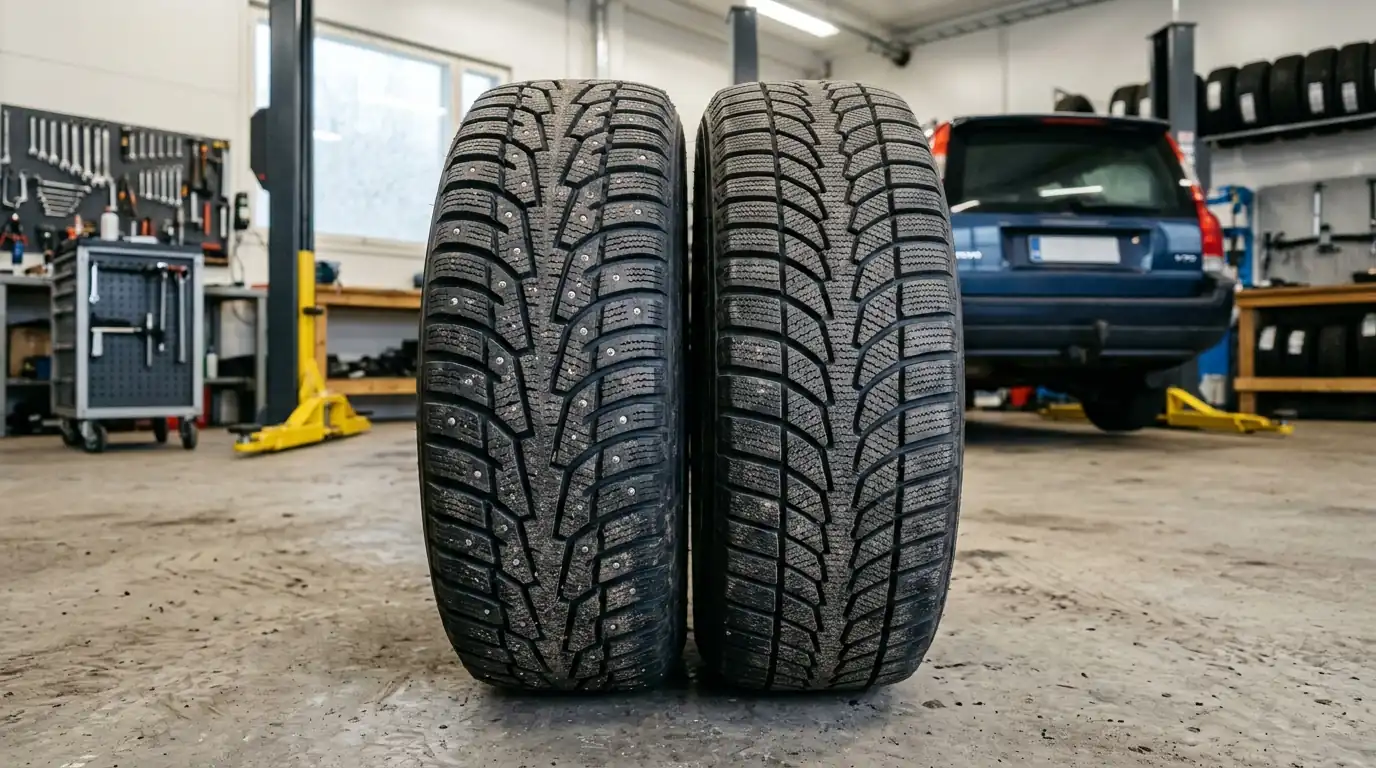
Studded tyres must be fitted to all the wheels of a passenger car. Under Traficom's regulation, the number of studs in each tyre may differ by at most 25 % from the tyre with the most studs. A bigger difference is allowed if every tyre has at least 75 % of the studs of an equivalent new tyre. At the inspection, a mix of studded and non-studded tyres is a rejection fault. The law puts no time limit on non-studded winter tyres. We explain how to choose in our article on studded or non-studded tyres.
Is an M+S marking enough on its own?
Not any more. Under Traficom's regulation, from 1 December 2024 a winter tyre on a passenger car or van is either a tyre marked with the 3PMSF symbol and approved for severe winter conditions, a POR-marked off-road tyre or a studded tyre. A tyre with only the M+S marking counted as a winter tyre until 30 November 2024. On a category O2 trailer, an M+S tyre may be used until 30 November 2029.
If you have old non-studded winter tyres with only the M+S marking, they no longer count as winter tyres on a passenger car, even if they still have tread left. Check the marking on the sidewall before the season starts, so that you have time to get new tyres before the first slippery morning.
The law also requires the tyres on the same axle to be of the same size, construction and characteristics (section 104). Škoda's owner's manual, for example, advises fitting winter tyres to all four wheels so that the car handles at its best in winter conditions.
The 3PMSF symbol is a mountain peak with a snowflake inside it. An ice-grip marking is not compulsory. We check the snow-grip marking at every tyre change. The markings are explained in our article on tyre markings.
How much tread must winter tyres have?
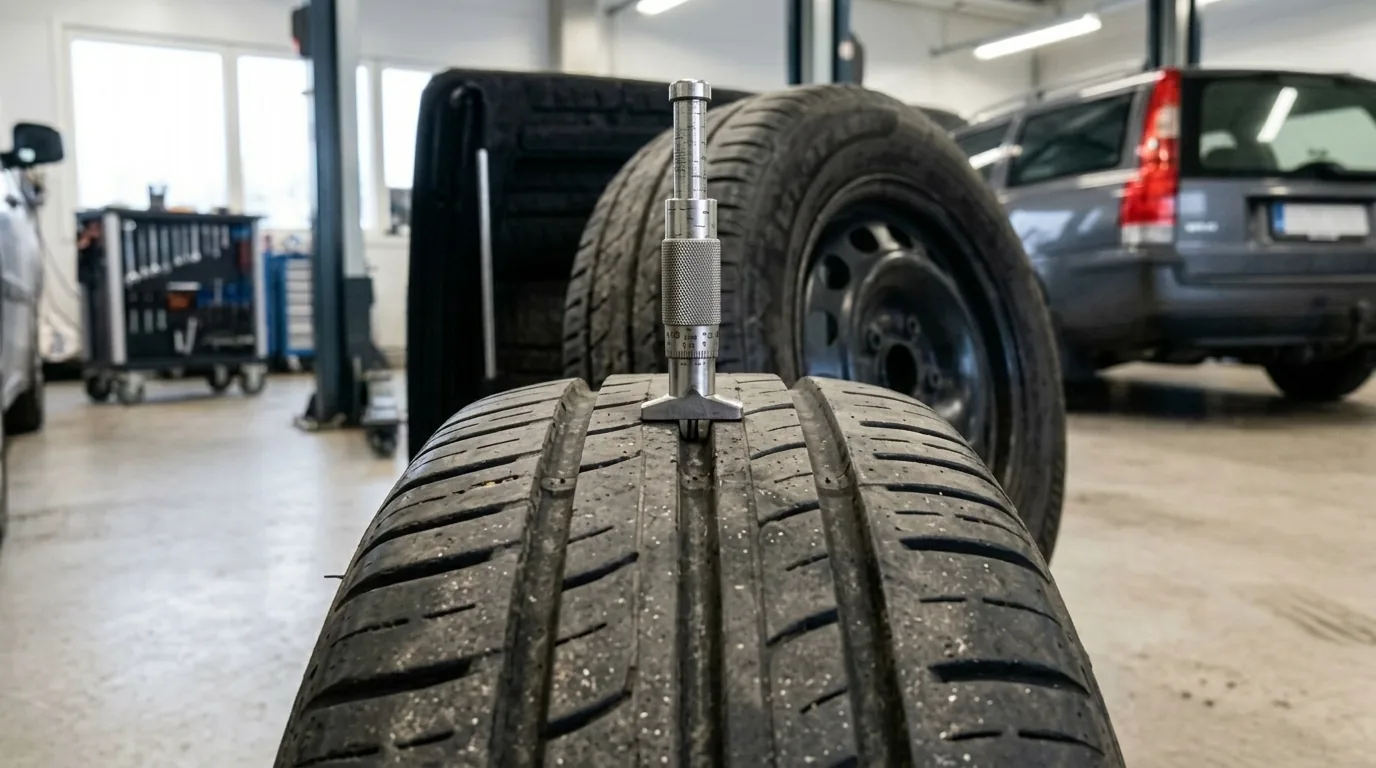
At least 3.0 mm from November to March, whenever winter tyres must be used. At other times the legal limit for all tyres is 1.6 mm (section 104). Traficom recommends at least 5 mm of tread in snow and slush. The limit applies to the main grooves of the tread, so measure them at several points around the tyre.
At the inspection, the limit is the same. Winter tyres with less than 3.0 mm of tread fail from November to March, and less than 1.6 mm puts the car under a driving ban (ajokielto). We explain how to measure tread in our article on tyre tread depth. When we change your tyres, we measure the tread depth of each one and record it, so you know whether they will last another winter.
What does driving on summer tyres in winter cost?
A traffic infringement fee (liikennevirhemaksu) of 100 euros can be imposed on a driver who, deliberately or through negligence, fails to follow the rules on tyres and anti-skid devices (section 171 of the Road Traffic Act). The same provision covers every breach of sections 104 to 106: summer tyres on slippery roads, tyres that are too worn and studded tyres in summer without justification. For a moped rider, the fee is 40 euros.
Grip is a bigger risk than the fee. The law requires winter tyres on precisely the days when the road is slippery.
Does the requirement apply to vans and trailers?
Yes, it does. The list in section 105 of the Road Traffic Act covers passenger cars with a classification mass of up to 3.5 tonnes, all vans, special-purpose vehicles of up to 3.5 tonnes, motorcycles, mopeds, three-wheelers and quadricycles. It also covers a trailer towed by any of these with a classification or coupling mass of over 0.75 and up to 3.5 tonnes.
Heavier vehicles have a rule of their own. On a lorry, a bus or a passenger car of over 3.5 tonnes, the driven axles must have winter tyres with at least 5.0 mm of tread, not counting driven axles that also steer. On the other axles the requirement is 3.0 mm. We change tyres on vans as well as passenger cars.
Sweden, Estonia and Norway
If you are taking the ferry to Stockholm or Tallinn, bear in mind that the rules in the neighbouring countries differ from Finland's. Below are the periods given by each country's transport authority:
| Country | Winter tyres | Studded tyres | Authority |
|---|---|---|---|
| Sweden | 1 December to 31 March, in winter road conditions; tread depth at least 3 mm | 1 October to 15 April, and at other times if winter road conditions exist or are expected | Transportstyrelsen |
| Estonia | compulsory 1 December to 1 March | 15 October to 31 March, and until 30 April in winter road conditions | Transpordiamet |
| Norway | when needed for adequate grip; tread depth at least 3 mm in the winter season | from 1 November to the Sunday after Easter Monday; in Nordland, Troms and Finnmark 16 October to 30 April | Statens vegvesen |
The information on Estonia comes from a Transpordiamet press release of March 2024. Check the dates on the website of each country's authority before you travel, as the rules can change.
When can you switch back to summer tyres?
In spring the rule works the other way round. There is no deadline for non-studded winter tyres, but studded tyres must come off once March is over and the conditions no longer require them. You can put the summer tyres on once the roads are clear for good and the night frosts are over. In its owner's manual, Škoda advises switching back to summer tyres in good time, because on roads clear of snow and ice, and at temperatures above seven degrees, they give better grip, a shorter braking distance and less noise.
You may legally drive on non-studded winter tyres in summer too, but Traficom does not recommend using old winter tyres in summer. According to Traficom, winter tyres usually have considerably poorer grip than summer tyres on wet or dry tarmac. For summer tyres, Traficom recommends at least 4 mm of tread to avoid aquaplaning, even though the legal limit is 1.6 mm.
When should you book the tyre change?
The latest sensible time to fit winter tyres is when night temperatures drop below zero and the mornings turn icy.
On the morning of the first snow, many drivers make the same decision at once, and tyre change slots fill up across the capital region (Helsinki, Espoo, Vantaa and Kauniainen). October and November are busy anyway, and in spring April is the biggest tyre month of the year. The change itself is a quick job. The queue builds because everyone needs it in the same week.
- Check the tread depth, any cracks and the 3PMSF marking on your winter tyres before you even bring them in for the change.
- From the beginning of October, watch the forecast for night frosts.
- Book a tyre change as soon as the forecast turns to frost.
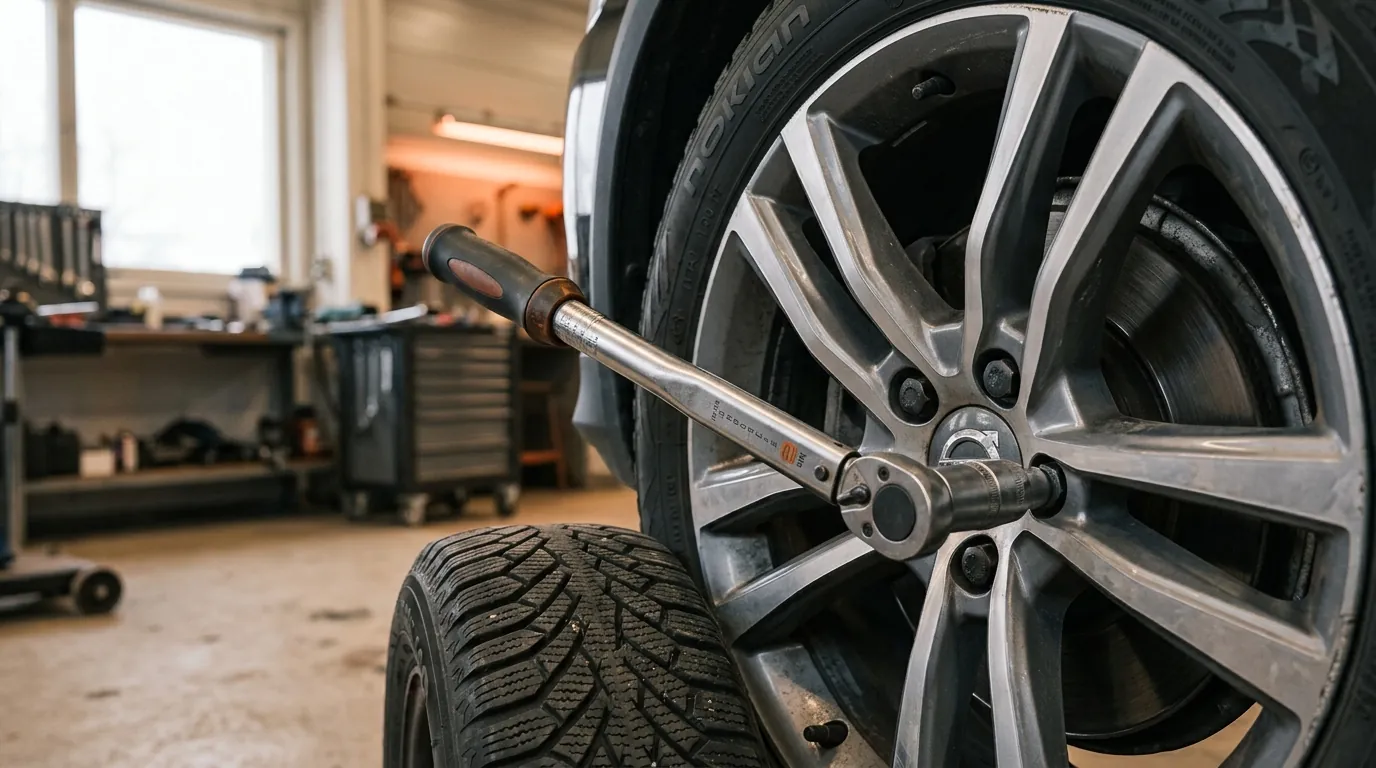
- At the change, we tighten the wheel nuts with a torque wrench, set the tyre pressures to the manufacturer's figures and record the tread depth of every tyre.
When should you bring the car in?
Besides the tyre change, it is worth bringing the car in if your winter tyres are wearing unevenly or the car pulls to one side. The cause may lie in the wheel angles, and then a four-wheel alignment helps. If the tyre pressure warning light comes on with the first frosty morning, read tyre pressures in winter first.