Published
The legal minimum tread depth for summer tyres is 1.6 mm. Winter tyres must have at least 3.0 mm of tread from November to March, when the weather or road conditions require them. At the inspection (katsastus), grooves shallower than 1.6 mm put the car under a driving ban (ajokielto), and in the winter season, winter tyres with less than 3.0 mm fail the car. Grip weakens even before either limit is reached, so it is worth replacing your tyres in good time.
| Tyre | Minimum depth of the main grooves | When | At the inspection, if below the limit |
|---|---|---|---|
| Summer tyre | 1.6 mm | Always | Driving ban |
| Winter tyre | 3.0 mm | November to March, when the weather or road conditions require it | Rejection |
| Winter tyre in the other months | 1.6 mm | April to October | Driving ban |
The limits are laid down in sections 104 and 105 of the Road Traffic Act (tieliikennelaki). What happens at the inspection is set out in the inspection regulation issued by Traficom, the Finnish Transport and Communications Agency.
What is the legal minimum tread depth for summer tyres?
Under section 104 of the Road Traffic Act, the main grooves of the tread on a motor vehicle's tyres must be at least 1.6 mm deep. The limit applies to all tyres in every season, so for a summer tyre it is the only limit. It is an absolute minimum, not a target.
The main grooves are the wide grooves in the central part of the tread. According to UN Regulation No. 30, which applies to the approval of tyres, they also hold the wear indicators. The regulation allows the narrower secondary grooves to disappear over the life of the tyre, and they do not count.
Under the same section, the tyres fitted to one axle must match in dimensions, construction and properties. If a tyre is damaged and you have to fit a spare in its place, neither this requirement nor the winter tyre rule applies to that temporary use.
How much tread must winter tyres have?
The winter tyre limit is in section 105 of the Road Traffic Act. Passenger cars and vans must use winter tyres with main grooves at least 3.0 mm deep in November, December, January, February and March if the weather or road conditions require it. On lorries and buses, the limit is 5.0 mm on driven axles that do not steer, but that does not affect a passenger car.
Two things are often overlooked. First, the limit applies only in these five months. From April to October, a winter tyre needs only the same 1.6 mm as a summer tyre to be legal. That is the legal minimum, not a recommendation. Second, a dry November does not force you onto winter tyres, but snowy conditions do, and judging the conditions is the driver's responsibility. The article on the winter tyre requirement sets out its rules and penalties.
What happens at the inspection if your tyres are too worn?
Traficom's inspection regulation spells out exactly what the inspector does when there is a fault in the tyres. There are three levels of consequence:
- Driving ban: the main grooves are less than 1.6 mm deep. A driving ban is imposed for a dangerous fault, and it comes on top of the rejection.
- Rejection: the main grooves of the winter tyres are less than 3.0 mm deep from November to March, a tyre's load capacity is not sufficient, a tyre has carcass damage, the tyres on the same axle have different properties, or the car has a mix of studded and non-studded tyres.
- Repair notice (korjauskehotus): the tyre pressure is clearly too low, a tyre rotates in the wrong direction or the balancing is inadequate.
A driving ban is more serious than a rejection. Under section 157 of the Vehicles Act (ajoneuvolaki), a car under a driving ban may not be used in traffic until the faults have been repaired and the car has been approved at an inspection. The inspector puts a sticker on the car to show that it is under a driving ban. A rejection on its own gives you time to repair the fault, but a car under a driving ban has to be taken for repair by some means other than driving it. So it pays to replace worn tyres before the inspection, not after it.
Tyres and wheels are not the most common rejection cause at the inspection, but they cannot be ignored. Traficom's statistics for 2025 recorded 29 545 rejection faults and 7 660 repair notices for them. That is 3.8 % of all rejection faults, in statistics covering 1.67 million inspections of passenger cars first registered between 2005 and 2021.
How do you measure tread depth?
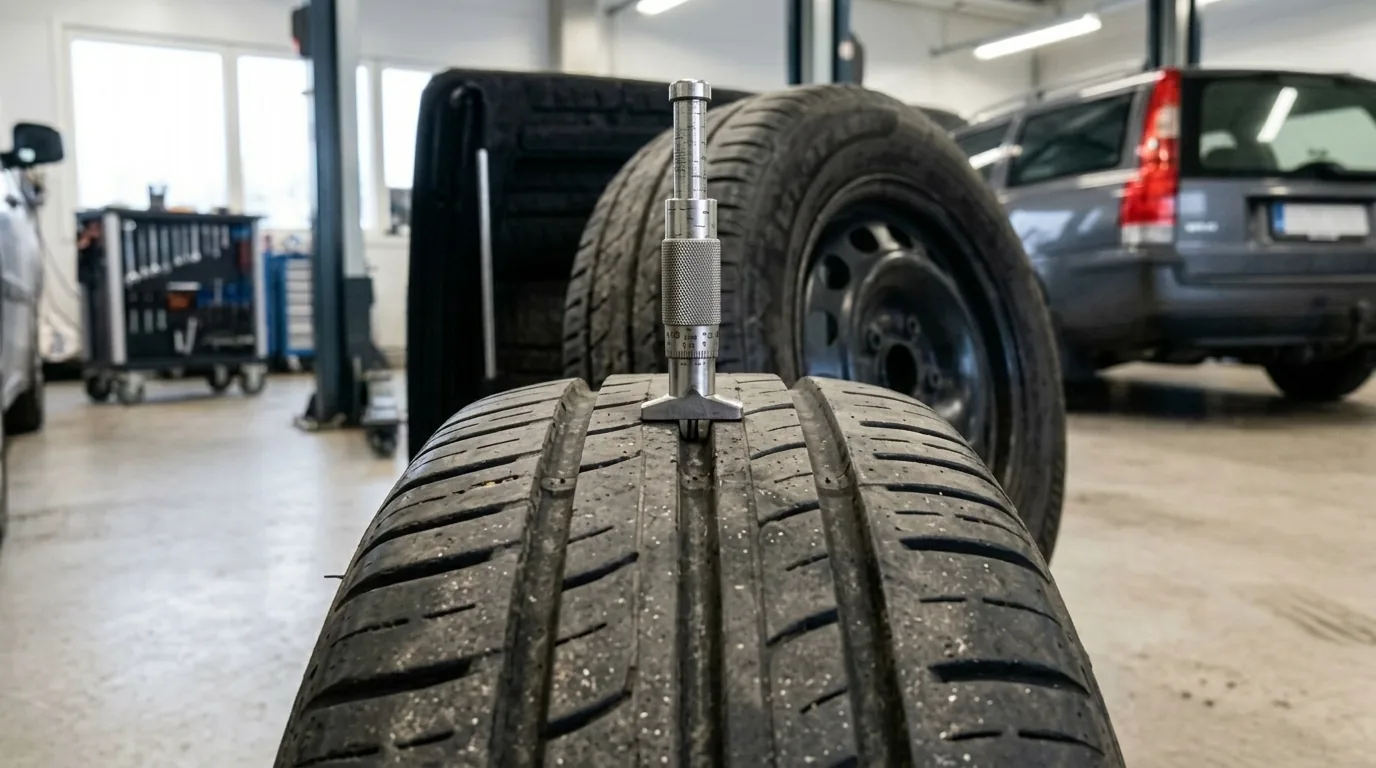
A tread depth gauge is cheap to buy, and measuring takes a few minutes. Measure with the car standing on level ground and the wheels pointing straight ahead. Here is how:
- Find the main grooves. They are the wide grooves in the central part of the tread that run all the way round the tyre.
- Find the wear indicators. A TWI marking, a triangle or another symbol on the sidewall shows where an indicator is. The indicator is a raised section at the bottom of a main groove. Under the UN regulation, it must show when only 1.6 mm of tread is left, and there must be at least six rows of indicators around the tyre.
- Press the tip of the gauge down to the bottom of the groove. Measure from the bottom of the groove, not from the top of an indicator. Read the figure in millimetres.
- Measure across the tread. Take readings from the main grooves on the inner side, in the centre and on the outer side.
- Measure around the tyre. Turn the tyre or move the car, and measure at two or three more points.
- Note down the lowest reading. The law applies to every main groove, so a tyre is only as good as its most worn point.
- Do the same for all four tyres. Front and rear tyres rarely wear at the same rate.
If the tread is already level with the indicator, the tyre is close to the legal limit. The UN regulation allows the indicator an upward tolerance of 0.6 mm, so a tyre worn level with it has between 1.6 and 2.2 mm of tread left. The indicator is therefore not a precise gauge, but a sign that the tyres must be replaced. In the Octavia owner's manual, Škoda writes that the tyres must be replaced at the latest when the tread has worn down to the indicators.
When is it worth replacing tyres before the legal limit?
The grooves are there to move water out from between the tyre and the road. As the grooves get shallower, there is less room in them for water, and it drains away more slowly. On a wet road the braking distance gets longer and the risk of aquaplaning grows. When a tyre aquaplanes, it rides up onto a film of water and loses contact with the road, and the car then no longer responds to the steering or the brakes. In slush the effect is more pronounced, because the grooves have to clear water and snow at the same time.
According to Liikenneturva, the Finnish Road Safety Council, a tyre has already lost a large part of its grip before it reaches the 1.6 mm limit, and the risk of aquaplaning grows, especially in the rain. Liikenneturva gives the same advice for winter tyres: clearly worn tyres are worth replacing even if they have more tread than the 3.0 mm the law requires. Škoda, too, warns in its owner's manual that worn tyres do not grip on a wet road, particularly at high speeds.
In winter the tread pattern matters more. Liikenneturva says that grip on snow and slush depends above all on the tyre's tread pattern and the friction properties of the rubber. As the tread wears down, the pattern no longer bites into the snow in the same way, and the small sipes on the surface of a non-studded winter tyre get shallower along with the tread.
It is not worth relying on any single figure as an exact millimetre limit for replacement, because the rubber compound, the age of the tyre and your own driving all play a part. In our experience, you notice the difference first on wet and slushy roads, and on dry tarmac a worn tyre can feel completely normal. When the tread depth is getting close to the legal limit, it pays to get new tyres before the next season, not halfway through it.
One thing will not wait for the season. If the tread depth of a winter tyre gets close to the 3.0 mm limit in the middle of winter, replace the tyres then, not in the spring. The same goes for a summer tyre and the 1.6 mm limit.
Uneven wear points to a fault
Tyres rarely wear evenly. The wear pattern often tells you the cause, and the cause is worth putting right before new tyres wear the same way:
- Both edges worn, centre intact: the tyre pressure has been too low. We explain how to measure the pressure in freezing weather in our article on tyre pressures in winter.
- Centre worn, edges intact: the pressure has been too high.
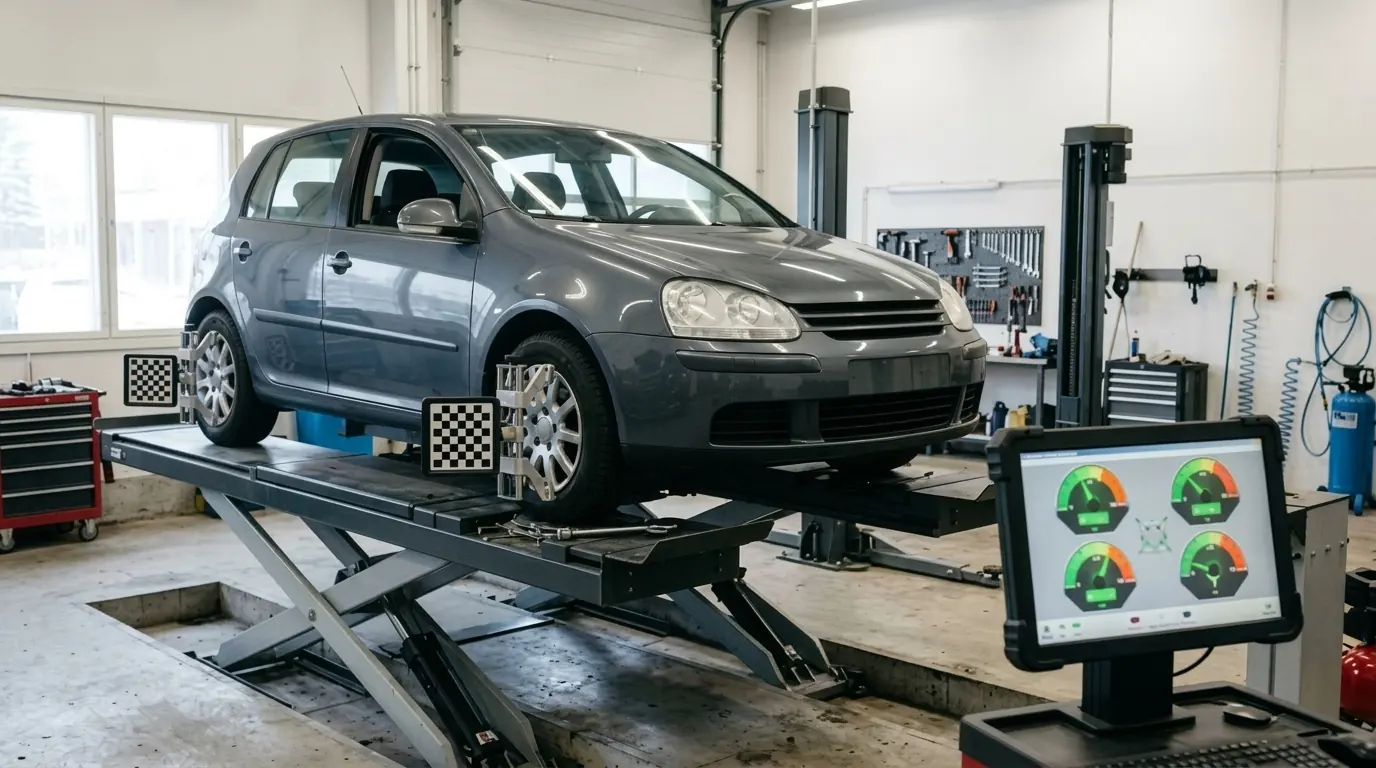
- Only the inner or outer edge worn: the wheel alignment is out. The Škoda owner's manual says that incorrect alignment at the front or rear causes excessive tyre wear. We cover alignment on our four-wheel alignment page.
- Patches or dips in the tread: the shock absorbers are worn or a wheel is out of balance. An imbalance is often felt as vibration in the steering wheel. See shock absorber replacement.
The tyres on each axle wear at their own rate. On a front-wheel-drive car the front wheels both drive and steer, and they usually wear faster than the rear wheels.
Your driving style shows in your tyres too. According to Škoda, fast cornering, hard acceleration and harsh braking increase wear. The same manual advises swapping the wheels round every 10 000 kilometres so that the tyres wear evenly. In that case, directional tyres must stay on the same side of the car, because the wrong direction of rotation is grounds for a repair notice at the inspection.
Tyre age
Tread depth does not tell the whole story. Rubber hardens over the years even if the car is not driven much, so a winter tyre can have good tread depth and still be at the end of its life. Storing tyres in cool, even conditions slows the hardening.
The law sets no age limit for tyres, but the week and year of manufacture are marked on the sidewall. We explain how to read them, and what car and tyre makers recommend on tyre age, in our article on tyre markings.
When should you bring the car in?
We measure the tread depth at every seasonal tyre change. The measurement is part of the tyre change, and we do not charge for it separately. We tell you the reading for each tyre and give you our assessment of whether the tyres will last the next season. Once the readings are recorded, you can see at your next visit how much the tyres wore during the season. We do not sell tyres, so we have no reason to recommend new ones if your old ones are still good enough.
If your tyres are wearing unevenly, we check the tyre pressures, the steering and suspension joints and, where needed, the alignment. We tell you the price before the work starts.
April and October are tyre-change season. If your tread depth is close to the legal limit, it is worth deciding on new tyres before the season. That way you can get a slot for the change without queuing, and you can take your time choosing the tyres.