Published
According to the City of Helsinki, the share of studded tyres in the city's winter traffic was about 60 % in spring 2025. Before autumn 2022 the share had held at about 70 % for several years. So non-studded tyres are becoming more common, but most cars on Helsinki's streets still run on studs. Neither choice is wrong, as long as the tyre suits the way you drive.
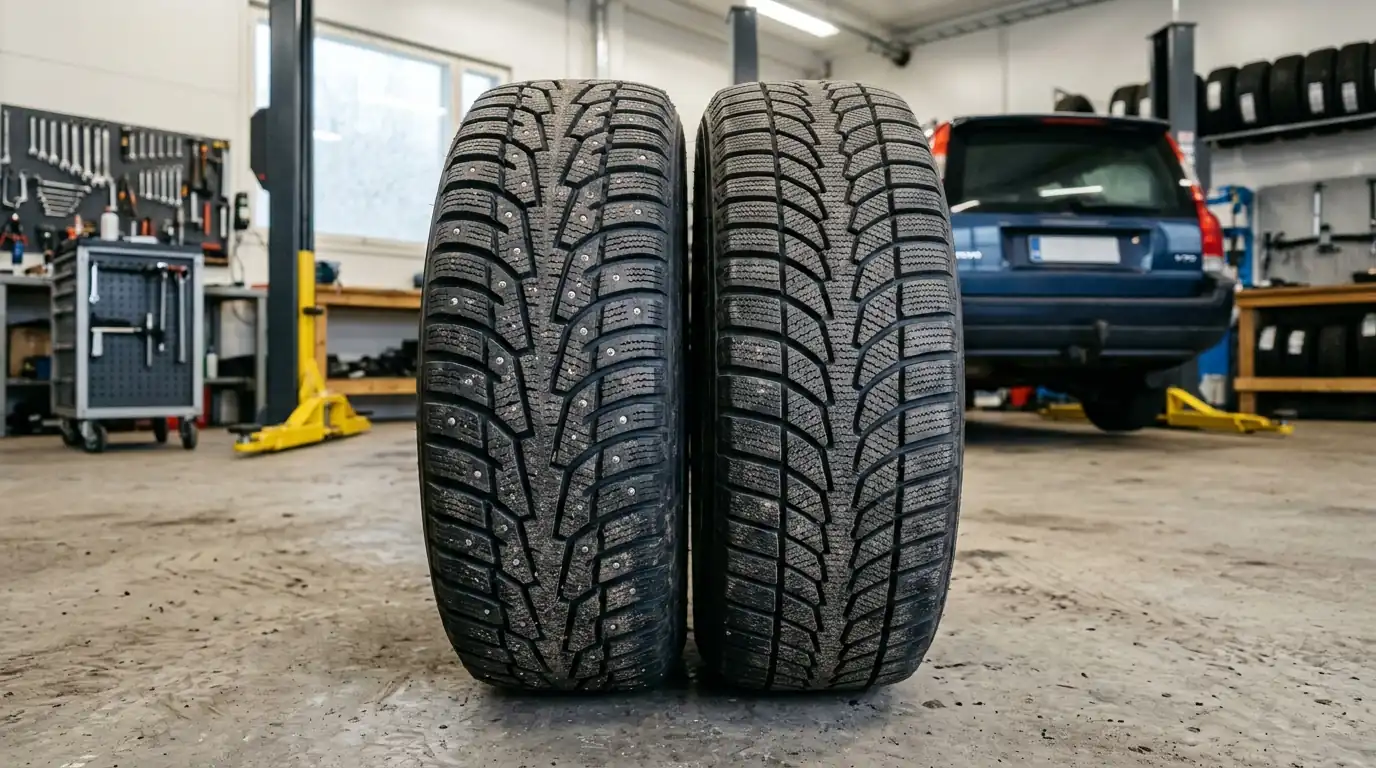
Which grips better: studded or non-studded?
It depends on the road surface. Traficom says non-studded tyres work best on snowy roads. On icy roads studded tyres give better grip, but they wear the roads more and can increase fine particle levels.
You can find independent comparative data, for example, in a study that VTI, the Swedish National Road and Transport Research Institute, published in 2015. The study was commissioned by Trafikverket, the Swedish Transport Administration, to find out how the grip of winter tyres deteriorates with age and wear. It tested 77 winter tyres, 27 of them new and 50 used, on smooth ice and packed snow. Here is what it found:
- On smooth ice, studded tyres gripped clearly better than non-studded tyres, even when worn. As they wore, studded tyres lost more of their grip on ice than non-studded tyres did, but they still gripped better.
- On packed snow, Nordic non-studded tyres usually gripped slightly better than studded tyres.
- Worn Central European non-studded winter tyres had very poor grip on ice, on a par with the two summer tyres in the test.
- Premium tyres gripped clearly better on ice and snow than budget tyres, both new and worn.
According to Liikenneturva, the Finnish Road Safety Council, grip on snow and slush depends above all on the tread pattern and the friction properties of the rubber. Grip is at its worst on wet, smooth ice, and that is when studs improve it. On bare asphalt the studs lose their advantage, but they wear the road even then.
The City of Helsinki says the same: a non-studded tyre does not grip as well on ice as a studded one. But severe icy conditions, the city notes, are clearly rarer in Helsinki than elsewhere in the country, and salt is used to keep the roads from icing over. The city also points out that driving style affects safety more than the type of tyre.
Studded or non-studded in the capital region?
The main roads of the capital region (Helsinki, Espoo, Vantaa and Kauniainen) are ploughed and usually kept clear. Side streets, yards and car parks can still stay icy for weeks. On top of that, the temperature often swings either side of zero over the winter. Water that melts during the day freezes at night, and in the morning the road is slippery. That is why the choice depends more on where and when you drive than on where you live.
| How you drive | Better choice | Why |
|---|---|---|
| You drive mostly in the city and on treated main roads | Non-studded | The streets are often clear and salted, and a non-studded tyre is quieter |
| You can leave the car at home on the slipperiest mornings | Non-studded | You can sit out the iciest conditions |
| You set off early, before the roads have been treated | Studded | The ice that formed overnight is still on the road at that hour |
| Your yard at home, your commute or your local streets are hilly and often icy | Studded | On ice, a studded tyre grips clearly better |
| You drive a lot outside the capital region in winter | Studded, or a good Nordic non-studded tyre | It depends on whether the road is more often icy or covered in snow |
| You often drive or park on Lönnrotinkatu | Non-studded | There, studded tyres are allowed only for driving onto a property |
| Your car has no electronic stability control (ESC) | Studded | A Liikenneturva expert has recommended non-studded tyres only for cars fitted with ESC |
If you are not sure, work through the choice like this:
- Think about which roads you drive on most in winter: city streets, motorways or side roads.
- Think about when you drive. Early morning is often the slipperiest time of a winter's day.
- Consider whether you can stay off the road when conditions are at their worst.
- Check whether your car has electronic stability control. The car's handbook will tell you.
- Look at the tread depth, age and markings of your current tyres before you buy new ones.
Speeds on the motorway are high, but the road has usually been treated. The danger lies in unexpected slippery patches, such as an icy bridge or slip road on a clear, frosty morning. With either tyre, what matters most is matching your speed and following distance to the conditions.
Where are studded tyres banned?
Finland's first studded-tyre ban is on Lönnrotinkatu in Helsinki. It covers a stretch of about 900 metres between Mannerheimintie and Hietalahdenkatu and is marked on the street with traffic signs. The ban applies to taxis too.
| Period | Allowed on studded tyres |
|---|---|
| September 2022 – spring 2025 | Driving to properties and running errands at them |
| November 2025 – spring 2028 | Only driving onto a property, that is, into its inner courtyard or indoor car park. Parking on the street is banned. |
The city reports that during the first ban period the share of non-studded tyres rose from 30 % to 40 % across Helsinki and from 30 % to 55 % on Lönnrotinkatu. On studded tyres you can reach Ruoholahti via Mannerheimintie and Pohjoinen Rautatiekatu, which adds about 300 metres to the trip. Kamppi and Punavuori can be reached along Bulevardi, which adds about 200 metres. There is an air quality monitor on the street, and HSY (Helsinki Region Environmental Services) is tracking particle concentrations throughout the trial.
Street dust and noise
According to the City of Helsinki, half of the street dust comes from material that studded tyres grind off the road surface. In many places in Helsinki, the city says, the EU's new, stricter limit values for inhalable particles are being exceeded, and they must be met by 2030. The city's goal is to bring the share of studded tyres down to 30 % by the winter of 2030–2031.
Dust is not the only reason. Studded tyres are louder than other types of tyre, according to the city, and on the main streets the wear they cause is by far the biggest reason for resurfacing. A survey carried out in spring 2023 found that Helsinki residents who chose non-studded tyres did so in particular because the tyres suit city driving, are comfortable to drive on and make little noise.
Things have gone further in the other Nordic countries. According to figures compiled by the City of Helsinki, Oslo has charged a fee for studded tyres since the early 2000s, and their share fell from 85 % in 1995 to about 10 % in 2020. In Stockholm the share is about 30 % on the streets with a ban and about 50 % across the city.
When studs are allowed, and how many
Studded tyres may be used from the beginning of November to the end of March, and at other times too if the weather or road conditions require it. The law sets no period of use for non-studded tyres, so you can fit them as early as October. The article when to fit winter tyres sets out the rules on the winter tyre requirement.
Under section 106 of the Road Traffic Act (tieliikennelaki), studded tyres on a passenger car must be fitted to every wheel. So you cannot mix studded and non-studded tyres on the same car. There are also limits on how much the stud count may differ from one tyre to another. Under a Traficom regulation, the difference may be at most 25 %, measured against the tyre with the most studs. A bigger difference is allowed if every tyre still has at least 75 % of the studs of an equivalent new tyre. A broken stud does not count.
The rule comes into play when one damaged tyre is replaced with a new one, or when studs have come out of the old tyres. Two new and two older studded tyres can go on the same car, as long as the condition is met.
The road wear caused by studded tyres is also regulated through the number of studs. A Traficom regulation allows a tyre at most 50 studs per metre of rolling circumference. More studs are allowed only if the tyre and its studs have been type-approved on the basis of a road wear test.
Markings on non-studded tyres
A non-studded tyre qualifies as a winter tyre only if its sidewall carries the snow-grip marking: a three-peaked mountain with a snowflake inside it. The marking is known by the abbreviation 3PMSF. Traficom says it shows that the tyre has been tested and meets the minimum requirements for grip on snow.
Until 30 November 2024, an M+S marking on its own was enough to make a tyre a winter tyre. Since then the snow-grip marking has been compulsory on all non-studded winter tyres for cars and vans. The marking is not required on a studded tyre. Old tyres do not always carry it, so it is worth checking for it before you buy used winter tyres on rims.
Ice grip has a marking of its own. It is not compulsory, but according to Traficom it shows that the tyre meets the minimum requirements on icy roads, and Traficom recommends it when you buy new tyres. The test behind the snow-grip marking is run on snow, so it says nothing about grip on ice. The difference matters, because in the VTI study the ice grip of worn Central European winter tyres was on a par with summer tyres. If you are considering non-studded tyres and drive a lot on icy side streets, choose a Nordic non-studded tyre that also carries the ice-grip marking.
If you often drive to Lapland or on country roads
On a long journey the conditions change along the way, and you cannot always time the drive for good weather. In winter the roads of northern Finland are often covered in snow. According to the VTI study, a good Nordic non-studded tyre grips as well as a studded tyre on packed snow, or slightly better.
On the country roads of southern Finland the most difficult conditions are often icy ones: black ice, freezing drizzle and icy bridges when the temperature swings either side of zero. On ice, a studded tyre grips clearly better. If you drive on country roads every week in winter, or set off early in the morning, studs are the safer choice. If you make only a few country-road trips over the winter and can pick the day you set off to suit the weather, a good-quality Nordic non-studded tyre is enough, as long as you match your speed to the conditions.
What we check at a tyre change
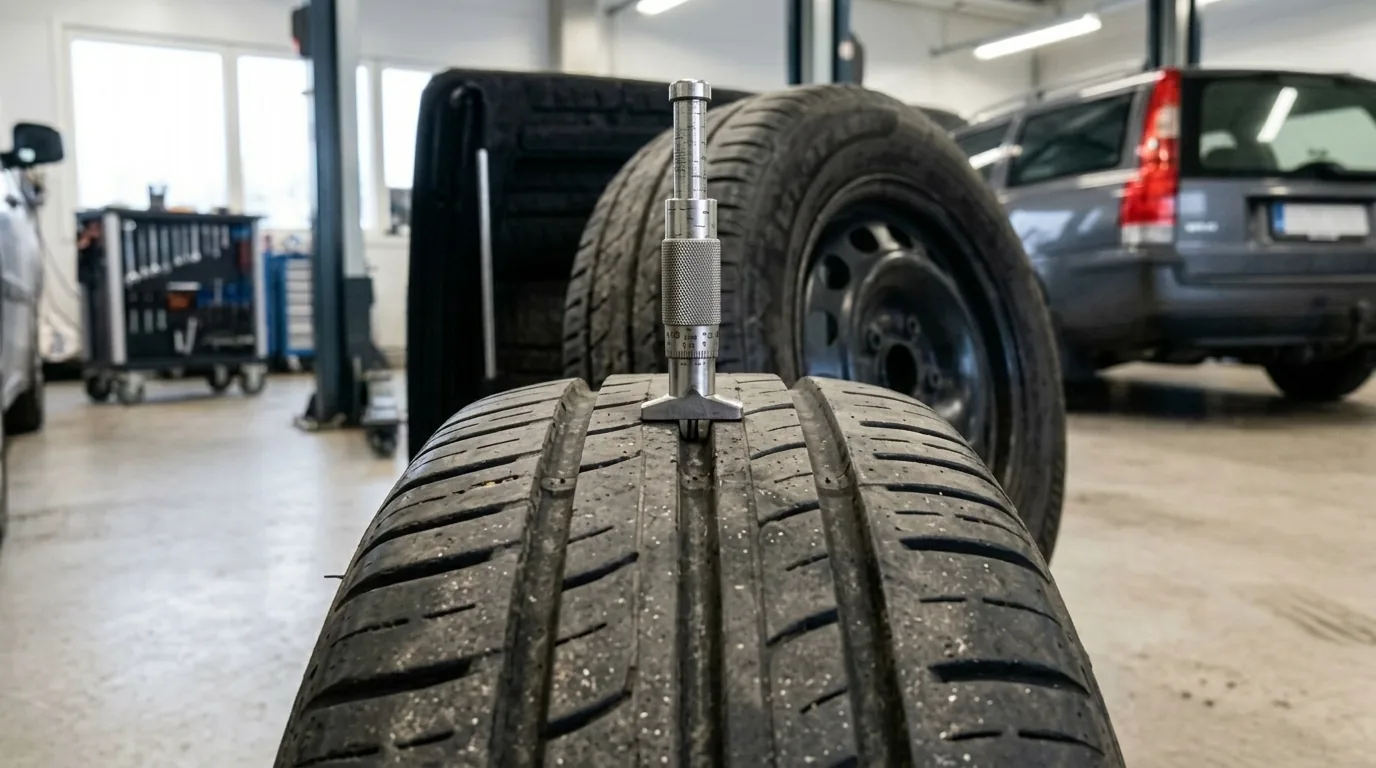
We do not sell tyres, so we have no reason to recommend either type. When we change your tyres, we measure the tread depth of every tyre and check the tyres' condition, their week of manufacture and, on winter tyres, the snow-grip marking. A winter tyre must have at least 3.0 mm of tread whenever winter tyres are compulsory. We explain the limits in more detail in the article on tyre tread depth.
When should you bring the car in?
If you are thinking of switching tyre type, mention it when you book a tyre change. From our measurements we will tell you whether your current tyres are still worth driving on this winter, or whether it is time to replace them now. The decision on new tyres is yours. Book in good time: October and November are the busiest tyre months of the autumn.