Published
Both sets of tyres spend about half a year in storage at a time. The advice is the same for summer and winter tyres, studded and non-studded alike, says Nokian Tyres. Care pays off: according to the maker, a set of tyres kept somewhere unsuitable can become unusable in a single storage season.
Wash and dry the tyres before storing them
Over a season, dirt, sand, salt and brake dust collect on the tyres and rims. They can cause wear, corrosion and damage, so wash the tyres before you put them into storage:
- Rinse the loose dirt off the tyres and rims.
- Wash the tyres and rims with water, a mild detergent and a brush. Washing also prevents the rims from rusting.
- If you use a pressure washer, keep the nozzle well away from the tyre. A pinpoint jet can detach the rubber from the fabric underneath it. The tyre can then fail when it goes back into use, warns an expert at Nokian Tyres.
- Remove stones and debris from the grooves.
- Dry the tyres and rims thoroughly. Only put them in a bag once they are completely dry.
You do not need tyre shine. According to Continental, tyre compounds are designed to resist ozone cracking, and care products can be more of a hindrance than a help. Do not use petrol, oil or solvents for washing at all. According to Pirelli, they can react with the rubber compound and weaken it.
Check the condition and record the tread depth
Faults show up best on a clean tyre. Autonrengasliitto, the Finnish tyre trade association, advises inspecting the wheels as you take them off, with the coming season in mind. Go through every tyre:
- Tread surface. Look for cracks and uneven wear. Uneven wear is a sign of incorrect wheel alignment or tyre pressure that is too low. We cover alignment on our four-wheel alignment page.
- Sidewalls. Look for cuts, cracks and bulges.
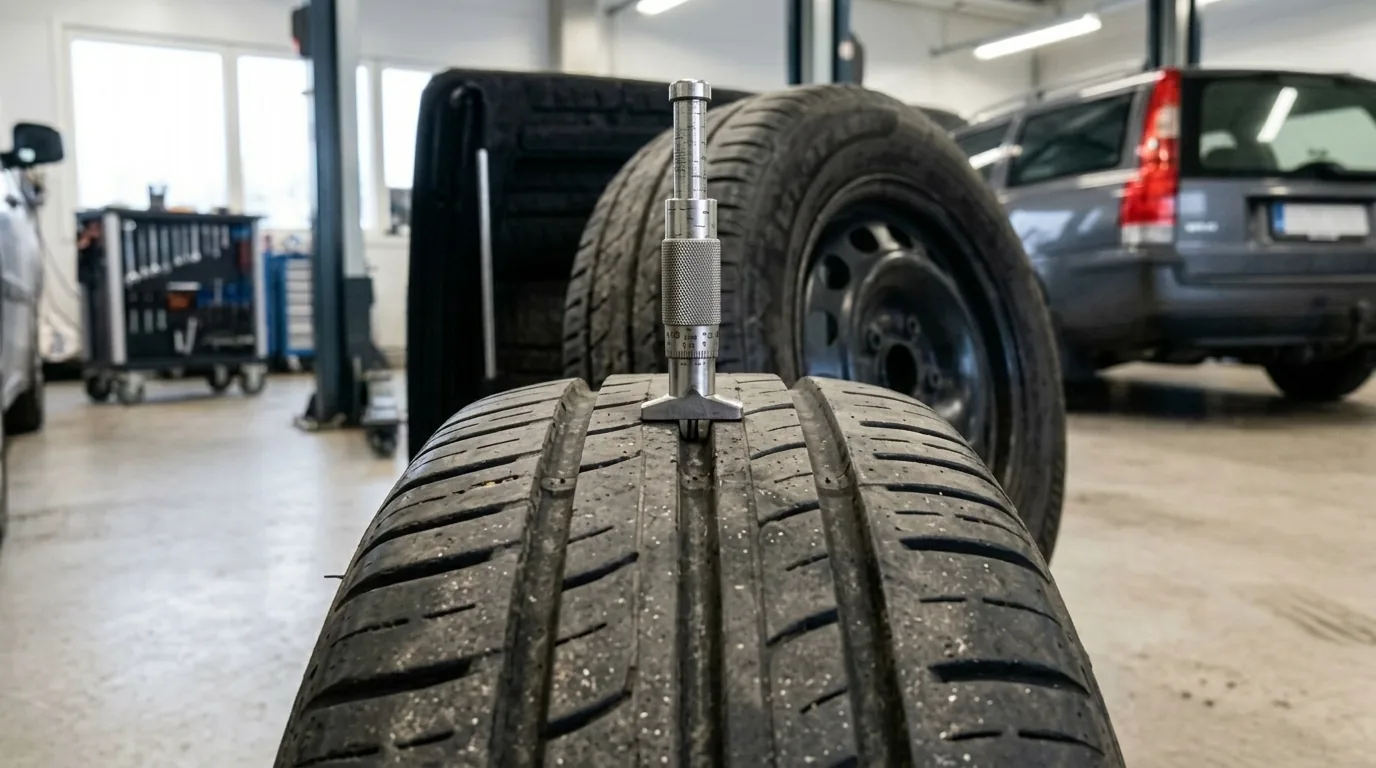
- Tread depth. Measure the depth of each tyre's main grooves and write down the readings together with the tyre's position. Our article on tyre tread depth explains how to measure.
- Week of manufacture. Also write down the four-digit manufacturing code on the sidewall. We explain what it means further down.
Compare the readings with the legal limits and the recommendations of Traficom, the Finnish Transport and Communications Agency:
| Tyre | Legal limit | Traficom's recommendation |
|---|---|---|
| Summer tyre | 1.6 mm | at least 4 mm in difficult conditions, for example to avoid aquaplaning |
| Winter tyre | 3.0 mm from November to March, when the weather or road conditions require winter tyres | at least 5 mm in snow and slush |
If the grooves are already close to the limit, it pays to get new tyres before the next season, not on the day of the change. There is no point putting a tyre that is at the legal limit into storage.
Mark each tyre's position
Mark each wheel with its position on the car. According to Michelin, the markings let you swap the positions next time so that the tyres wear evenly. Short markings will do:
- FL front left
- FR front right
- RL rear left
- RR rear right
Write the marking on the tyre's sidewall with tyre chalk. Pirelli advises marking the position on the side of the tyre bag as well.
Front and rear tyres wear at different rates. That is why Autonrengasliitto and Nokian Tyres advise moving the wheels from one axle to the other at every seasonal change, without changing their direction of rotation. The front left wheel moves to the rear left, and the rear left wheel to the front left. The same goes for the right-hand side. A studded tyre keeps its direction of rotation for its whole service life. The direction also matters for safety: according to Liikenneturva, the Finnish Road Safety Council, the wrong direction of rotation is a significant risk factor in accidents.
Michelin points out that the tyre positions cannot be swapped freely on every car. If the front and rear tyres are different sizes, the wheels are not moved from one axle to the other.
If there is a big difference in condition between the two pairs, the better tyres go on the rear, no matter which wheels drive the car. According to Autonrengasliitto, a sliding rear end is harder to control than a sliding front end. At the next change, the tread depths you recorded before storage tell you which pair is the better one.
Stacked, hung or upright?
The way you store tyres depends on whether they are on rims. The makers' advice is largely the same, but it differs on storing tyres on rims upright:
| Method | On rims | Without rims |
|---|---|---|
| Stacked on their sides | Suitable. According to Michelin, at most two on top of each other. | Not recommended. Michelin and Pirelli advise against stacking them. |
| Hung on a hook | Suitable when the hook goes through the rim. | Never, because the tyre can twist out of shape. |
| Upright | Michelin allows it, Pirelli does not recommend it. | The best method. Turn the tyres now and then during storage. |
Nokian Tyres and Continental advise storing tyres on rims in a stack or hung up. According to Pirelli, the weight of a wheel standing upright rests on one point for a long time and puts strain on it. Michelin's advice means that a set of four wheels goes into two stacks.
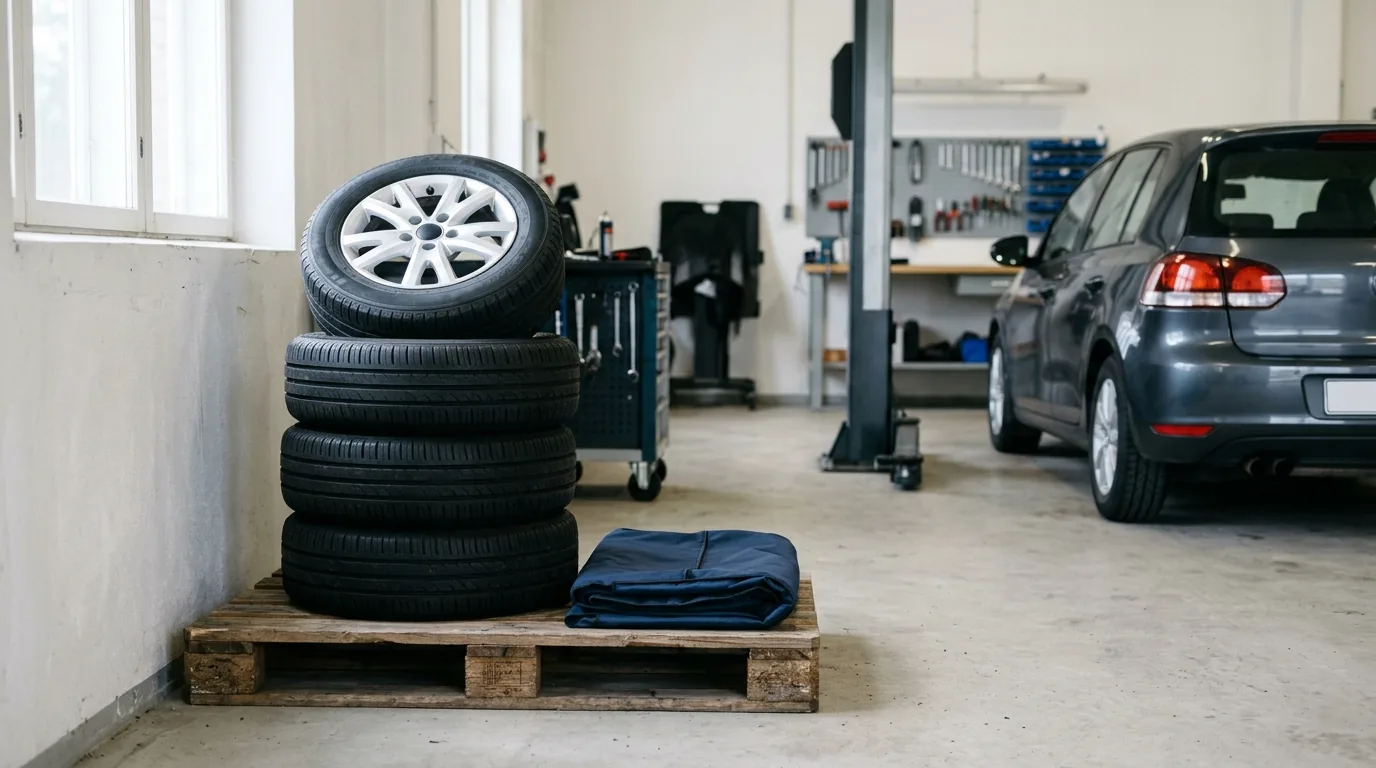
Do not put anything else on top of a stack. Compression, tension and twisting over long storage cause deformations, and the tyre can break at those points when it is inflated again. Turn loose tyres stored upright now and then, so that the rubber does not flatten at the bottom. Pirelli advises raising loose tyres off the floor, for example onto a wooden base. This protects them from moisture, dirt and changes in temperature.
Do not drop a loose tyre. According to Nokian Tyres, a drop of more than one and a half metres can damage the tyre's bead, the edge that sits against the rim. After that, fitting the tyre to a rim is not recommended.
Tyre pressure during storage
Do not let the air out of tyres on rims. According to Pirelli, tyres stored on rims are kept at the pressure the car's manufacturer recommends. For tyres that will be stacked, an expert at Nokian Tyres would add a little pressure, because the bottom tyre carries the weight of the whole stack. Neither advises lowering the pressure.
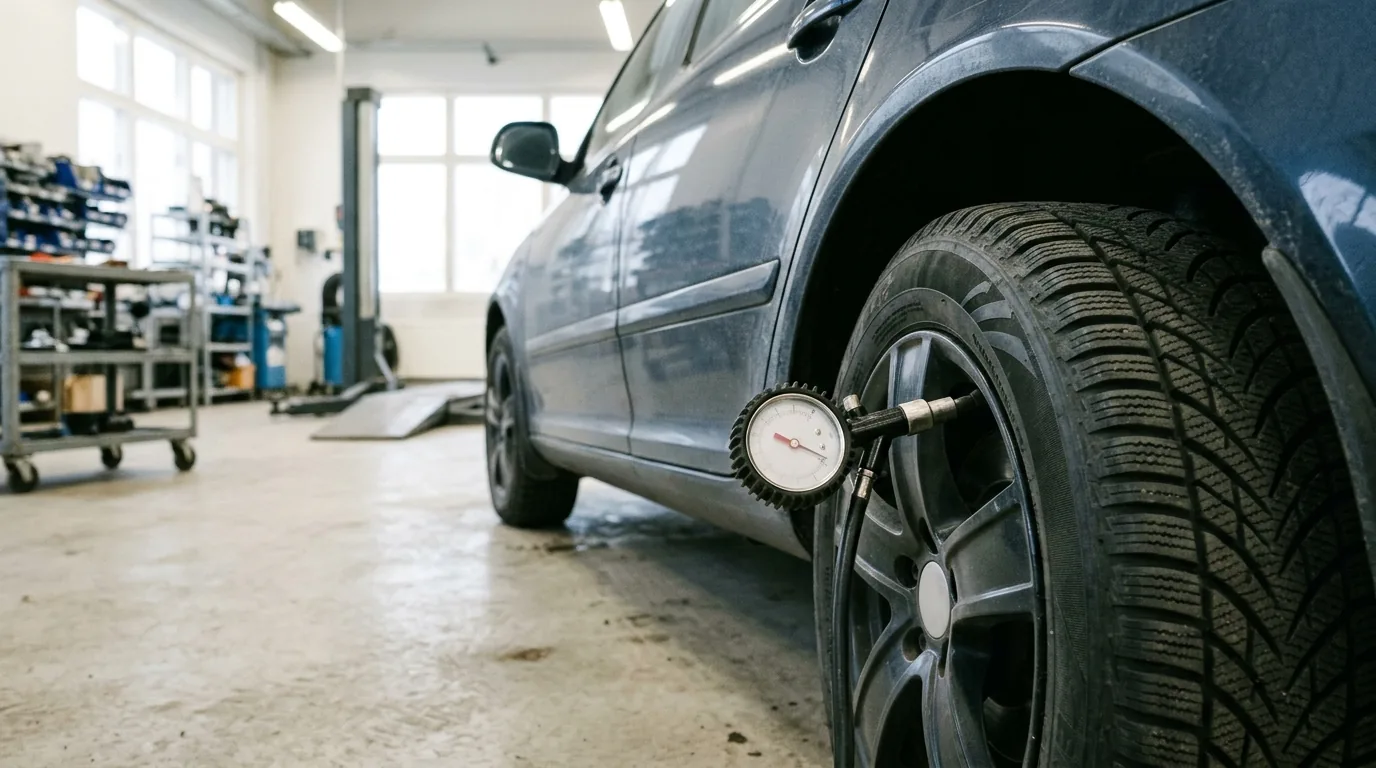
According to Michelin, a tyre naturally loses a little air over time. So set the pressures to the car manufacturer's figures before you drive, which also removes the extra pressure added for the stack. You will find the figures in the car's handbook, and often on the driver's door pillar or the fuel filler flap. There is more about pressures in our article on tyre pressures in winter.
Where should you store tyres?
The best place is a cool, dry, dark indoor space where the temperature stays even. Nokian Tyres advises keeping the storage temperature below 25 °C. Tyres keep best in the dark, below 15 °C. Above 25 °C, and below freezing, the rubber's properties can change and the tyre's service life can shorten.
| Place | Suitable? | Why |
|---|---|---|
| Dry cellar | Well suited | Cool, dark and at an even temperature. In a block of flats, check the housing company's rules first. |
| Dry garage or storeroom with an even temperature | Suitable | As long as there are no devices producing ozone and no oils in it. |
| Storage space inside your home | Fine if the smell does not bother you | Tyres can give off a rubber smell. |
| Damp cellar | Not suitable | Moisture must not condense on the tyre's surface. |
| Cold garage, shed or loft | Poor | The temperature and humidity vary. |
| Balcony | Not suitable | Sun and frost put strain on the rubber. |
| Outdoors, even under a canopy | Not suitable | Moisture, UV light and changes in temperature make the rubber brittle. |
Also keep the tyres well away from the following:
- Sources of ozone. Ozone weakens rubber. It is produced by electric motors with brushes, such as compressors, pumps, generators and central vacuum cleaners. Fluorescent lamps and devices that spark also produce ozone.
- Sources of heat. Radiators, heating pipes and boilers. If it gets too hot, the rubber dries out, hardens and cracks.
- Oils and solvents. Fuels and greases too. The tyre must not come into contact with them even for a short time.
- Light. Direct sunlight and strong artificial light, because UV radiation weakens rubber.
A tyre bag protects against light and moisture, as long as the tyres have been washed and dried before they go into it. Continental advises using a large, airtight plastic sack. The air is sucked out with a vacuum cleaner and the opening is taped shut, so that less oil evaporates from the rubber compounds. According to Pirelli, the bag must be opaque and strong enough not to tear. According to Continental, tyre carry bags and boxes are not airtight, so the sack goes inside them.
The housing company's storage areas
Under the Rescue Act (pelastuslaki), nothing may be stored on exit routes or on the walkways of lofts, cellars and storage areas. So tyres do not belong in the stairwell or in the corridor of the storage area. The Act also prohibits storing goods in a loft or cellar, or under or next to a building, if this creates a fire risk or makes firefighting more difficult. SPEK, the Finnish National Rescue Association, points out that storing combustible goods against a building's outside wall is prohibited.
Whether you may keep tyres in your own storage cage depends on the housing company. According to Nokian Tyres, fire safety regulations often prohibit tyres in the shared storage areas of residential buildings, because they add to the fire load. A burning tyre gives off thick, toxic smoke that slows down rescue work. In a storage cage, the tyres are also exposed to light and changes in temperature. Check the housing company's rules, or ask the property manager, before you take the tyres down to the cellar.
How old can a tyre be and still be worth storing?
A tyre ages even if nobody drives on it. Storing it correctly slows the ageing down but does not stop it. These are the tyre industry's age recommendations:
- Total age: at most 10 years. Autonrengasliitto recommends that a tyre should be at most ten years old, counted from its manufacture. Michelin advises replacing ten-year-old tyres as a precaution, the spare tyre included.
- Service life: at most 6 years. Autonrengasliitto recommends at most six years from first use, but tyres usually wear out much sooner.
- A yearly check after five years. Michelin advises having the tyres checked by a professional at least once a year once they have been in use for five years.
The date of manufacture is shown on the tyre's sidewall as four digits, next to the DOT marking. In Autonrengasliitto's example, 0824 means week 8 of 2024. So the code 4516 means week 45 of 2016, and a tyre like that turns ten years old in November 2026. These age limits are recommendations, not law. Our article on tyre markings covers how to read the code and the car makers' own age recommendations.
A tyre that will turn ten years old before the next season is not worth storing. You can leave worn tyres with a tyre retailer, who, according to Autonrengasliitto, passes them on for recycling as the law requires.
When you put the tyres back on
Check the tyres before they go on the car:
- Cracks, bulges and flattening. A tyre must not have any unusual cracks or bulges. Also check whether a loose tyre that has been standing upright has flattened at the bottom.
- Positions and direction of rotation. Fit the wheels in their new positions according to the markings, so that the direction of rotation stays the same. Tread depth does not change in storage, so the readings you recorded still hold.
- Pressure and valve. A small loss of pressure after storage is normal. If a wheel is almost flat, the fault may be in the valve. The valve's rubber parts can become porous, and without a cap dirt builds up in the valve, so that it does not close properly. Replace a lost cap with a new one.
- Re-tightening. Re-tighten the bolts on alloy wheels after driving about a hundred kilometres, Nokian Tyres advises.
If the steering wheel shook at a certain speed last season, it is worth having the wheels balanced before they are fitted. Nokian Tyres recommends balancing every year or every couple of years, depending on mileage, and sooner if the steering wheel shakes while you drive.
When should the car go to a workshop?
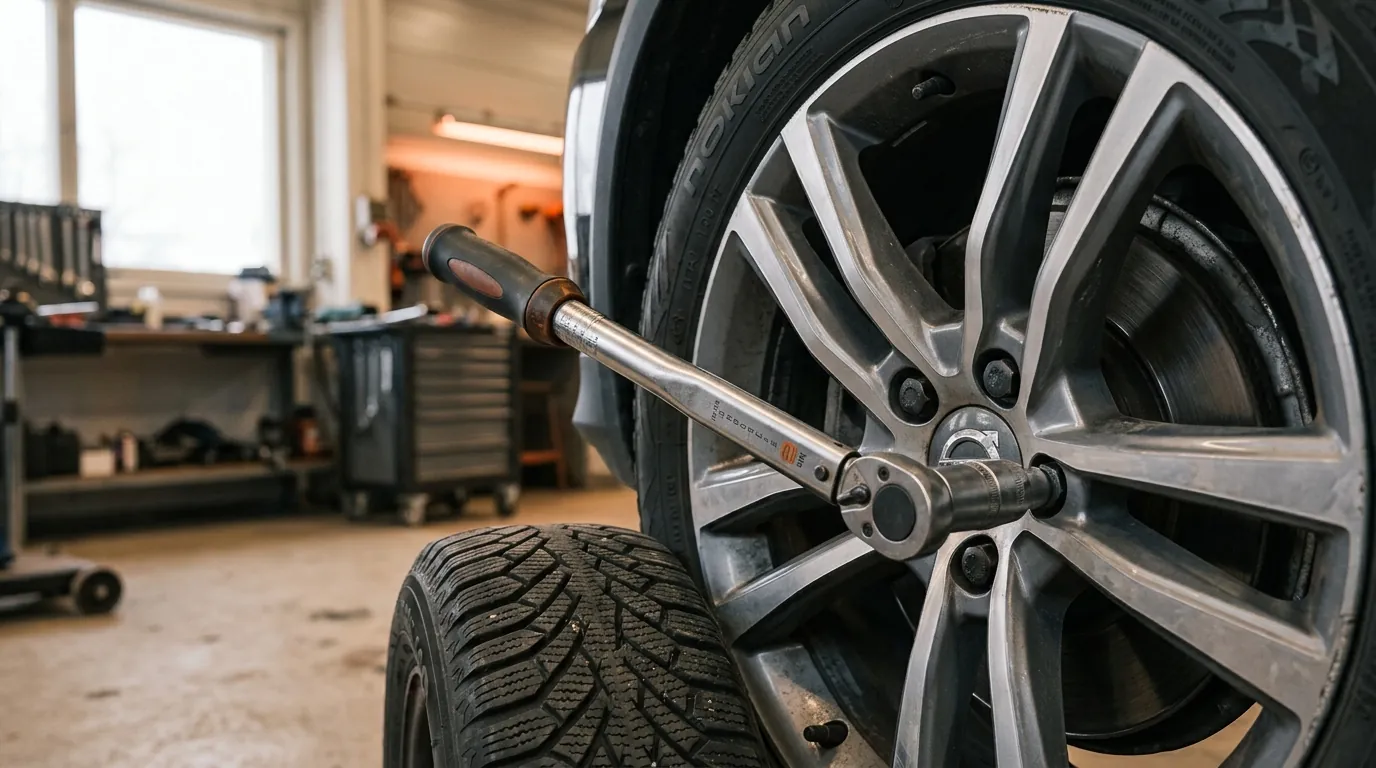
Changing tyres at home takes firm, level ground, a proper jack and a torque wrench. According to Nokian Tyres, damage to the car's underbody caused by lifting mistakes is unfortunately common. The bolts are tightened crosswise, and finally with a torque wrench to the torque allowed for the rim.
We change tyres that are already on rims at Lampputie 12 in Suutarila, Helsinki. A tyre change has a fixed price (kiinteä hinta), and you book it online: you pick a free time, and the booking is confirmed at once. At the change, we measure the tread depth of every tyre and tell you the readings. We also check the sidewalls and the week of manufacture, set the pressures and tighten the wheel nuts with a torque wrench.
You can add a wash of the removed tyres to the same booking. The tyres are washed and dried before they leave with you. You can choose balancing at the same time, too. Choose any extras when you book, because each one reserves its own time.
We do not store tyres, and we do not fit loose tyres to rims. Autonrengasliitto advises always having tyres fitted to rims at a professional tyre shop, so bring loose tyres to the change only once they have been fitted to rims. Book your spring change in good time, because April is the busiest tyre month of the year.