Published Updated
Failing the inspection (katsastus) is nothing unusual: in 2025 there were 2 184 538 periodic inspections of passenger cars, and 663 060 of them, or 30.4 %, ended in a rejection. Under the Vehicles Act (ajoneuvolaki 82/2021), the re-inspection is part of the same inspection, not a new one (section 2, paragraph 18), and its rules are set out in sections 159 and 162 of the Act.
The table gives the time limits for a failed car, each with its section of the Vehicles Act.
| Situation | Time limit | What you may do | Vehicles Act |
|---|---|---|---|
| Inspected on time and failed, no driving ban (ajokielto) | 2 months from the rejection | Use the car on the road | section 159(1) |
| Re-inspection | 1 month from the rejection | Choose any station entitled to inspect the car | section 162(1) |
| Driving ban, or failed at an overdue inspection | Certificate valid until the end of the following day at most | With the station's certificate, take the car to the nearest place of repair | section 159(2) |
| Inspection interrupted for a reason beyond your control | Use for 2 weeks after the inspection period ends, finish within 1 month | Use the car, unless it has been banned from driving | section 156(4) and (5) |
Traficom, the Finnish Transport and Communications Agency, says in its guidance that the two-month right of use applies to a car once the faults that failed it have been repaired.
Did your car fail? Send us the inspection report, and we will tell you the price of the repair before the work starts.
What is checked at the re-inspection?
The inspector checks the items in which the inspection found faults or deficiencies (section 162(2)). The whole car is not checked again. If the car fails the re-inspection too, the next one covers the items that were faulty at the previous re-inspection.
The law makes one exception. If the inspector suspects a fault in some other item that would lead to a driving ban, they must check that item as well (section 162(3)). A driving ban is imposed for a dangerous fault, one that directly and immediately endangers safety. For example, under Traficom's inspection criteria a fluid leak in the brake lines is a fault that leads to a driving ban. The inspector cannot overlook a fault like that on the grounds that the item was not on the fault list.
Many small faults can also lead to a rejection. Under the inspection criteria, minor faults in four or more inspection items are classed together as one serious fault, and the car fails. The fault list then need not show a single serious fault in its own right, but a re-inspection is still needed.
How soon must the re-inspection be done?
A failed car can be approved at a re-inspection within a month of the rejection (section 162(1)). The month runs from the day of the rejection, not from the day the repair is finished. If the car fails on Monday 16 November 2026, the re-inspection must be done no later than Wednesday 16 December 2026.
The month has to cover booking the repair, any wait for parts, the repair itself and then the appointment at the inspection station. Some parts have to be ordered in, and the inspection station does not always have a slot for the very next day. In any case, the law requires the faults behind a rejection to be repaired as soon as possible (section 158(1)). So it pays to book the repair on the day of the rejection.
Can the re-inspection be done at a different station?
Yes, if the car failed a periodic inspection. The re-inspection, often called uusintakatsastus in everyday Finnish, can be done at any inspection station whose inspection licence entitles it to inspect that car (section 162(1)). Traficom's guidance says the same in fewer words: you can choose whichever inspection station you like. That choice helps if the station that failed the car has no slots left before the month is up. Under the Act on Vehicle Inspection Activities (laki ajoneuvojen katsastustoiminnasta 957/2013), a station must accept any customer's car on request, within the scope of its inspection licence (section 23).
Only the other types of inspection require the same station. After a registration, modification or coupling inspection, the re-inspection must be done at the same station that failed the car. If one of these inspections is interrupted, it is also completed at the same place.
You can still find advice online saying that the re-inspection after a periodic inspection must also be done at the same station. That advice is based on old provisions. The current Vehicles Act has been in force since 1 March 2021, and it has never required the same station for the re-inspection after a periodic inspection.
Can you drive a failed car before the re-inspection?
Yes, if the car was taken to the inspection by its due date and was not banned from driving. It may then be used on the road for up to two months from the rejection (section 159(1)). Traficom's guidance states the condition plainly: the faults that failed the car must be repaired before it may be used.
The two-month period of use does not extend the month you have for the re-inspection. The second month gives time for a new inspection if the window for the re-inspection has closed. For the car in the example above, the re-inspection deadline is 16 December 2026, but the period of use only ends on 16 January 2027. Once the two months have passed, the car may be driven only when repaired, and only to an inspection booked for it.
If the car fails the re-inspection too, Traficom says it may not be driven until the faults have been repaired. Once repaired, the car may be used for up to two months from the first rejection.
A car under a driving ban may not be driven until the faults have been repaired and the car has passed an inspection (section 157(2)). The inspection station can issue a certificate that lets you take the car to the nearest place where it can be repaired. The certificate is valid until the end of the following day at most (section 159(2)). The same applies to a car that failed an inspection carried out only after its due date. We explain the ban on use (käyttökielto), the driving ban and the transfer permit (siirtolupa) in more detail in the article on overdue inspections.
What if the month runs out?
Then the re-inspection can no longer be done. According to Traficom's guidance, the inspection is done all over again: the car goes through a new periodic inspection that checks every item, not just the lines on the fault list. The new inspection can also turn up faults that were not recorded the first time.
The two-month period of use is still running at that point, so it is worth booking the new inspection within it.
How much does a re-inspection cost?
The law sets no price for a re-inspection. Inspection stations set their own prices, and they must report the fees they generally charge, by type of inspection, to Traficom's register of inspection services (Act on Vehicle Inspection Activities 957/2013, section 26). Prices vary from station to station, so we give no figure here.
Ask the station for the price when you book the re-inspection. Ask at the same time whether the price includes measuring the brakes or the exhaust emissions, if those were the reason for the rejection. And weigh the price against the alternative: once the month is up, you face a whole new periodic inspection.
We tell you the price of the repair before the work starts, separately for each item on the fault list.
Do you need to show a receipt for the repair?
The law does not require one. At the re-inspection the inspector checks the failed items for themselves (section 162(2)), and whether the car passes depends on what they see and measure on it. Traficom's guidance for the owner of a failed car does not mention a receipt.
A receipt is still useful for your own records. We give you a written breakdown of parts and labour, so you can see what was done on each item on the fault list. The paperwork also helps later, because it tells whoever repairs the car next, and the car's next owner, what has been replaced.
From rejection to pass, step by step
- Rejection day. Read the inspection certificate. It records the faults found and how each was classed. Mark the day the month runs out in your calendar.
- The same day. Book the repair so that the work and the re-inspection fit into the month without rushing.
- At the workshop. We go through the fault list item by item with the car on the lift and tell you the price before the work starts. We also check the neighbouring parts, so the same fault does not fail the car again.
- The repair. The repaired item is road-tested or measured before the car leaves for the re-inspection.
- A slot at the station. Book the re-inspection at any station entitled to inspect your car. Leave a few days' leeway before the month is up.
- The re-inspection. The inspector checks the failed items. When they are in order, the car passes. You can find the due date of the next inspection in Traficom's Oma asiointi service.
We explain the intervals between inspections, and how the due date is worked out, in the article on inspection intervals.
A repair notice is a different matter
A repair notice (korjauskehotus) means that the inspector found a minor fault but the car passed. No re-inspection is needed. The fault must still be repaired within a reasonable time (section 158(2)), and the inspection certificate shows the date by which it must be repaired. According to Traficom, notices are stored in the register, appear on the inspection certificate and are removed from it at the next periodic inspection if the faults have been repaired.
A great many notices are recorded. In 2025, passenger cars first registered in 2005–2021 were given 1 002 794 repair notices, and 590 509 of them concerned lights and electrical equipment. We explain what you should do about a notice in the article on repair notices.
When should you take the car to a workshop?
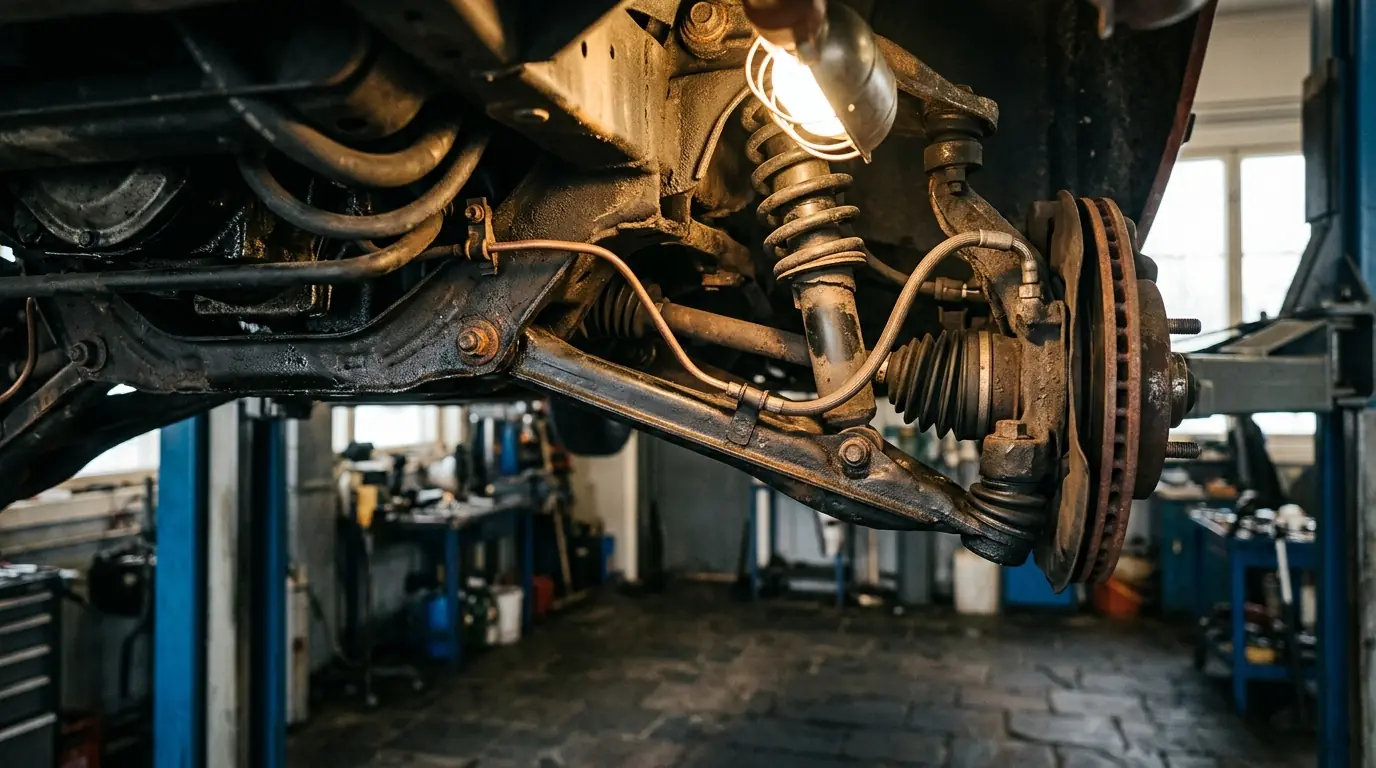
As soon as you have the fault list in your hand. The sooner the car is at the workshop, the more easily the repair, the parts order and the re-inspection fit into the month. The most common rejection causes are the axles, the suspension and the brakes. In 2025 they accounted for 525 970 rejection faults, two thirds of the total. The figure covers passenger cars first registered in 2005–2021. These are jobs for a lift, and we repair them as an inspection repair or a suspension repair.
If the inspection is still ahead of you, it makes sense to have the faults repaired before it. You will find what you can check yourself in the article on preparing for the inspection, and the most common rejection causes in the article on why cars fail the inspection.
We are a general workshop in Suutarila, serving customers in Helsinki and Vantaa. We repair all makes. We hold no inspection licence, so we carry out neither inspections nor re-inspections. We repair the items on the fault list, and the inspection station checks them.