
Coolant change and frost protection check
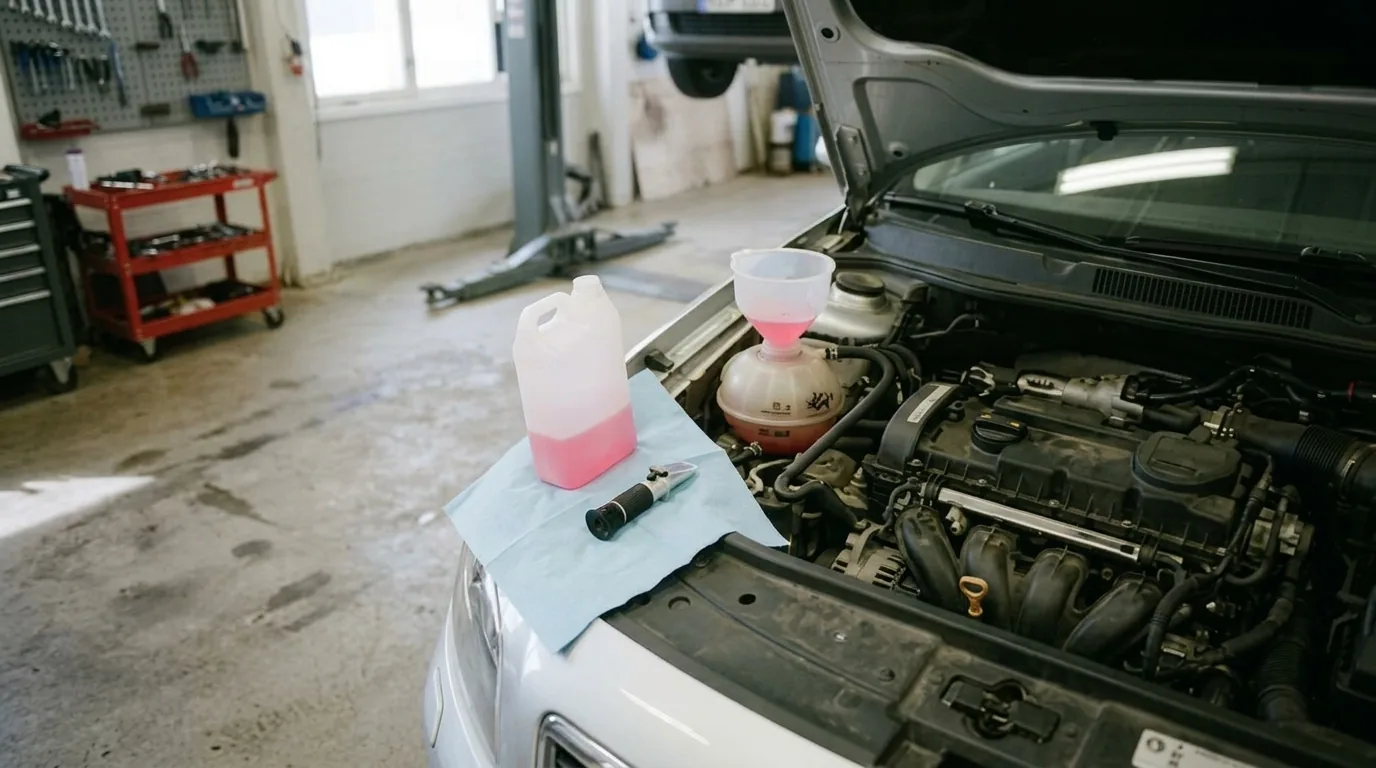
Coolant carries heat away from the engine, withstands frost and protects the cooling system from corrosion, but its additives wear out over time. We change the coolant on cars of every make, measure the frost protection and tell you the price before the work starts.
estimate
approx. 110 €
- Takes about
- 45 min
- Prices include VAT
- 25,5 %
- The old coolant's condition checked and its frost protection measured before the work
- Old coolant drained from the radiator and, where needed, from the engine block
- New coolant of the type the manufacturer requires, diluted to the right concentration
How it works
Call us or drop in
Give us the registration. We confirm the price and agree a time in the same call.
We do the work
You get the car back at the time we agreed.
Takes about 45 min
You pay the agreed price
No surprises on the invoice. If we find anything else, we call before we touch it.
Have the coolant's frost protection measured in the autumn, before the hard frosts, especially if water was added to the tank in the summer.
Call 045 262 5950What the price includes
What the price includes
- The old coolant's condition checked and its frost protection measured before the work
- Old coolant drained from the radiator and, where needed, from the engine block
- New coolant of the type the manufacturer requires, diluted to the right concentration
- The system filled and bled to the manufacturer's instructions
- The engine run up to operating temperature, and the fan and heater checked
- Hoses, connections, the radiator and the expansion tank checked visually for leaks
- Frost protection measured after filling, the old coolant recycled and the change recorded in the service book
What the price does not include
- Flushing the cooling system. If the old coolant is brown or full of sediment, the system is worth flushing before it is refilled. We tell you before the work whether a flush is needed.
- Changing the coolant in an electric car's cooling circuits and a hybrid's other circuits, such as the battery and inverter circuits. We give you their price separately.
- Replacing a leaking hose, the water pump, the thermostat, the radiator or the expansion tank.
- Finding the fault if there is oil in the coolant or coolant disappears with no visible leak. The cause can be the cylinder head gasket, the oil cooler or, on a diesel, the EGR cooler.
About this work in detail
What coolant does
The water pump circulates coolant through passages in the engine, and in the radiator the coolant gives off its heat to the air. The thermostat keeps the circuit to the radiator closed until the engine has warmed up. The same coolant also heats the cabin as it flows through the heater core.
Coolant is a mixture of water and antifreeze. Antifreeze is glycol with corrosion inhibitors added. The glycol stops the mixture freezing and raises its boiling point. The inhibitors protect the metals and seals of the engine, the radiator and the water pump.
The inhibitors are used up gradually, but that does not change the frost protection. So old coolant can corrode the system from the inside while the tester still shows enough frost protection. Rust and sediment block the narrow channels of the radiator and the heater core, and the water pump seal can start to leak.
In an electric car the coolant cools the battery, the inverter and the electric motor, and in a hybrid the combustion engine as well. There are often two or more circuits, and they can take different coolants and have different change intervals.
Read the full guide
Symptoms worth having checked
Book a time if you notice any of these:
- the coolant is brown, rusty or cloudy, or there is oil on its surface in the expansion tank
- the level drops and the tank has to be topped up again and again
- there are coloured drops under the car or a sweet smell from under the bonnet
- the heater blows cool air although the engine is warm, or there is a sweet smell in the cabin
- the engine warms up slowly or the temperature gauge stays lower than usual
- the temperature gauge climbs higher than usual or the coolant warning light comes on
Many of these are not fixed by changing the coolant alone. If coolant disappears, there is a leak somewhere. An engine that warms up slowly often has a thermostat stuck open, and oil in the coolant points to the cylinder head gasket or the oil cooler. So we first find out what causes the symptom.
When the change is due
The interval is set by the car's manufacturer and written in the service book or the service schedule. It varies a great deal with the make and the coolant. On older cars and with conventional coolants it is often two to five years.
With long-life coolants the interval is much longer. For many manufacturers the first change comes only at 5–15 years or 150 000–250 000 km, whichever comes first. Some manufacturers set no change at all, and the coolant's condition and frost protection are checked at services instead.
The change is also worth doing when the service history is unknown, for example on a used car you have just bought, or when plain water has been added to the coolant. It can be combined with a scheduled service.
Frost protection before the winter
The mixture's frost protection depends on the share of antifreeze. When antifreeze and water are mixed half and half, the mixture typically withstands about −36 °C, which is usually enough for a winter in the Helsinki region. Volkswagen's instructions, for example, put the antifreeze share at no less than 40 % and no more than 60 %. A stronger mixture does not improve the frost protection but weakens it, and the coolant also cools less well.
If water was added to the tank in the summer, the frost protection may have dropped a lot. Freezing coolant expands and can crack the radiator, the heater core or, at worst, the engine block. Measuring the frost protection takes only a moment. The coolant does not need changing if it is clean, the frost protection is enough and the manufacturer's interval has not yet been reached.
Fitting a block or hose heater usually means draining coolant anyway. If the car has no engine heater, block heater installation and the coolant change are therefore worth doing on the same visit.
How the change is done
- We check which coolant the manufacturer requires and how much the system takes. The type cannot be told from the colour, because coolants of the same colour can be of different types and the same type is sold in different colours.
- We measure the old coolant's frost protection and look at its colour and cleanliness. If there is rust, sediment or oil in it, we tell you before we go on.
- Once the engine has cooled, we drain the old coolant from the radiator drain plug or the lower hose. On some cars coolant is also drained from the engine block.
- We fill the system with new coolant. We dilute the antifreeze to the concentration in the manufacturer's instructions, or use a ready-diluted coolant.
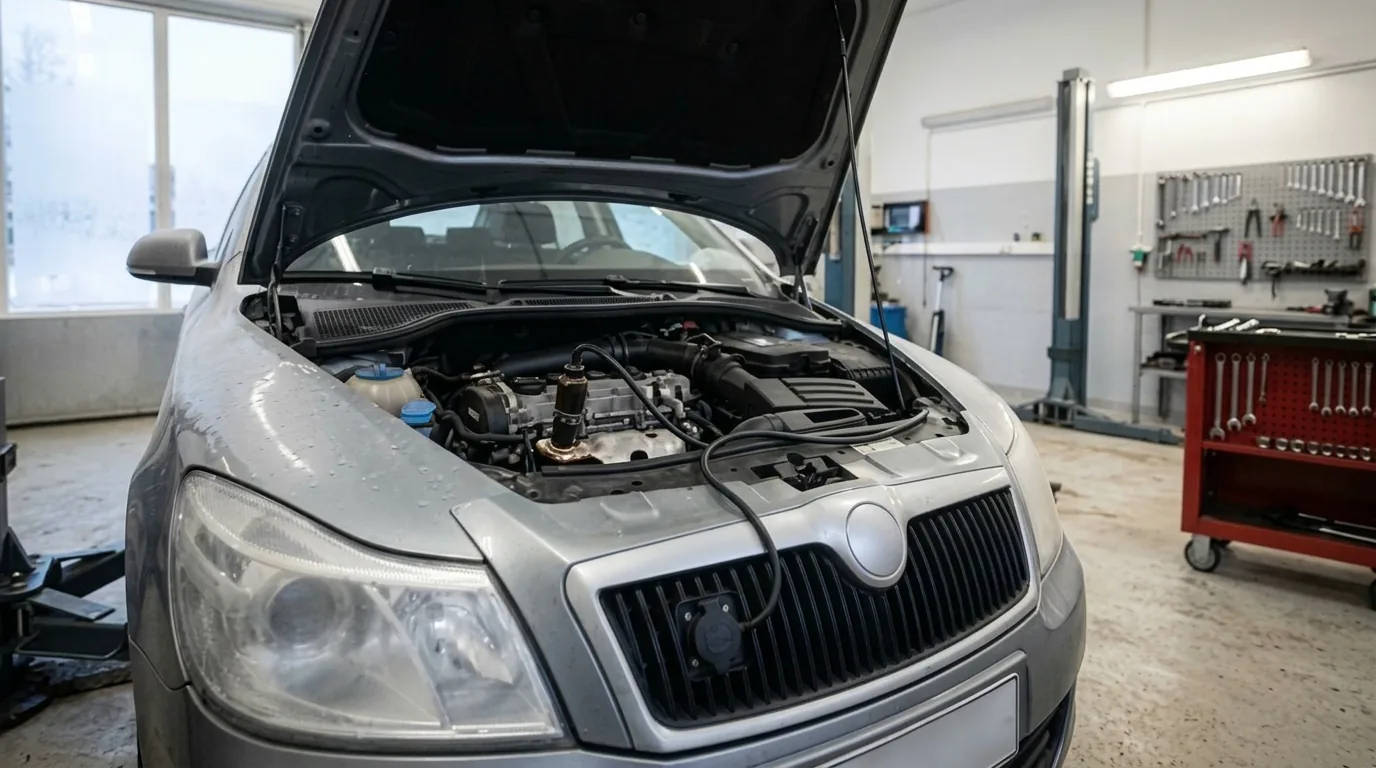
- We bleed the system to the manufacturer's instructions. Air left in the system is a common reason an engine overheats or the heater blows cold after a change. On some cars the bleeding is done with a diagnostic tool that runs the car's electric water pump.
- We run the engine until it is warm and check that the fan cuts in, the heater blows warm and no connection leaks. Finally we set the coolant level and measure the frost protection.
How long it takes
The work itself usually takes from half an hour to a little over an hour. A flush, more than one cooling circuit and a system that is hard to bleed make it longer. We tell you the expected time when we agree the booking.
What affects the price
The price of the change varies from car to car. What affects it most:
- The amount of coolant. A small car's system takes about five litres, a large engine's over ten.
- The type of coolant. Prices per litre differ a lot, and some cars take only the manufacturer's own coolant.
- The bleeding. Some systems are slow to bleed, and on some the bleeding is done with a diagnostic tool.
- Draining. If the radiator has no drain plug, or an undertray has to come off, draining the coolant takes longer.
A flush and changing the coolant in other circuits are priced separately. We check the car and tell you the price before the work starts. If something turns up during the work that changes the price, we call you before we go on.
Coolant and the inspection
Coolant is not an inspection item of its own, but the inspector looks under the car for leaking oil and other fluids. Under Traficom's inspection criteria, a fluid leak that forms drops gets a repair notice. If drops form continuously, the car fails. A leak that causes a fire risk leads to a driving ban.
In Traficom's inspection statistics for 2025, 200 rejecting faults and 3 045 repair notices were recorded for fluid leaks. Oil leaks and fuel leaks are counted separately.
On a diesel car taken into use from the start of 1980 to the end of August 2016, the exhaust is measured with a smoke opacity test. Before the test the inspector checks that the engine has the right amount of oil and coolant.
A repair notice does not stop the car passing, but a dripping leak is worth fixing before the winter. Every time water is added to a leaking system, the frost protection weakens. Read more about inspection repairs.
Checking and topping up the coolant yourself
- The level. Look at the level in the expansion tank when the engine is cold. It should be between the MIN and MAX marks.
- The cap. Do not open the expansion tank cap while the engine is warm. The system is then under pressure, and hot coolant can spray out.
- Topping up. Add only the coolant the manufacturer requires, at the right concentration. The owner's manual tells you the right type. Different types should not be mixed, because some coolants form sediment when mixed. If you add water in an emergency, mention it at the next service so the frost protection gets measured.
- Leaks. Look at your parking spot for drops under the car. Coolant is dyed, usually green, blue, red, pink, orange or violet, and it smells sweet. Clear, odourless water under the car is usually condensation from the air conditioning.
Coolant is poisonous, and its sweet taste attracts pets. Wipe up any spill and take old coolant to a hazardous waste collection point.
When not to drive the car
Stop somewhere safe and switch off the engine if you notice any of these:
- the temperature gauge climbs into the red, or the red coolant warning light comes on
- steam rises from under the bonnet
- the expansion tank is empty, or coolant is running out under the car
- white, sweet-smelling smoke still comes from the exhaust after the engine has warmed up
An overheated engine can be damaged within a few minutes: the cylinder head gasket can fail or the head can warp. Let the engine cool before you open the cap, and do not pour cold coolant into a hot engine.
If the coolant has leaked away or white smoke comes from the exhaust, the car has to come to the workshop on a tow truck. Call us and we will agree a time.
If something else needs fixing
We do not start work you do not know about. If the car needs something else fixed, we call and tell you what the extra work costs and what happens if it is left undone. You decide.
The final price may exceed the estimate by at most 15 per cent, additional work included.
We work to the motor vehicle service and repair terms approved by the consumer advisory board of the Finnish motor trade.

Shall we agree a time?
Leave a booking request online or call. We confirm the time and tell you the price before any work starts.
estimate
approx. 110 €
- Address
- Lampputie 12 C 67
00750 HelsinkiShow on the map - Opening hours
- Mon–Fri8.00–18.00Sat9.00–15.00Sunclosed
- Phone
- 045 262 5950
- huolto@caron.fi