
Headlight alignment
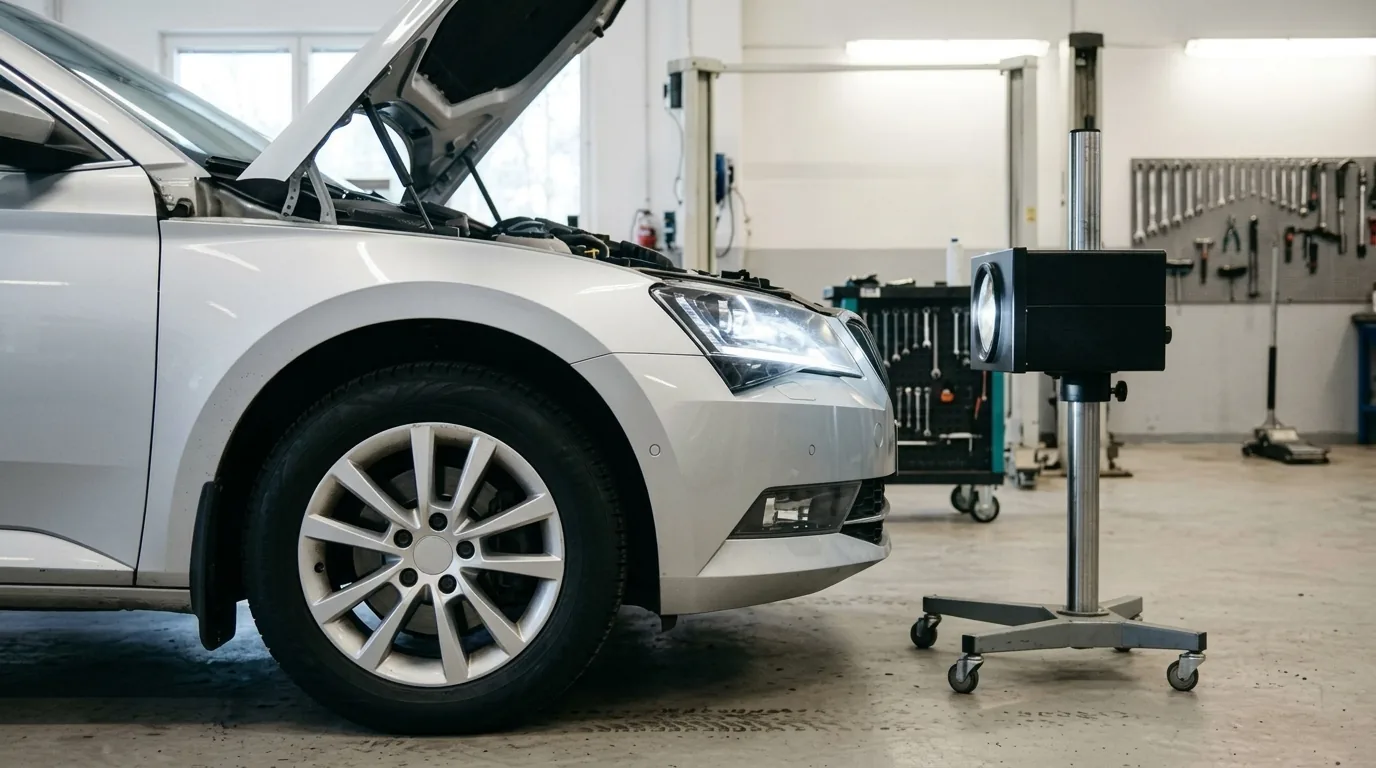
We align headlights on every make with a beam setter, including when the vehicle inspection has given a repair notice about the low beams. Alignment usually takes under an hour, and we tell you the price before the work starts.
typical price range
25–
We tell you the exact price for your car before the work starts.
- Prices include VAT
- 25,5 %
- Headlights checked before alignment: bulbs, beam pattern, and the condition and mounting of the headlamp units
- Car prepared to the manufacturer's instructions: tyre pressures set, load removed and headlight levelling at zero
- Both low beams aimed vertically and horizontally with a beam setter
How it works
Call us or drop in
Give us the registration. We confirm the price and agree a time in the same call.
We do the work
You get the car back at the time we agreed.
You pay the agreed price
No surprises on the invoice. If we find anything else, we call before we touch it.
If the inspection gave you a repair notice about the low beam, bring the inspection certificate. It shows us what the inspector recorded.
Call 045 262 5950What the price includes
What the price includes
- Headlights checked before alignment: bulbs, beam pattern, and the condition and mounting of the headlamp units
- Car prepared to the manufacturer's instructions: tyre pressures set, load removed and headlight levelling at zero
- Both low beams aimed vertically and horizontally with a beam setter
- High beams aimed on cars where they adjust separately
- Levelling checked, and the basic setting of automatic levelling made with a diagnostic tool where the car needs it
- Final check, comparing the two lights with each other
What the price does not include
- Bulb replacement. If a bulb has failed or is the wrong type, we tell you and give you the price of replacing it before we carry on.
- Repair or replacement of a headlamp unit whose adjusting screw is seized or broken or whose mounting tab is cracked. Polishing yellowed headlights is a separate job.
- Diagnosis and repair of the headlight levelling motor, height sensor or control.
- Aiming fog lights and auxiliary lights. They can be aimed at the same visit, and we tell you the price first.
- Calibration of cornering and adaptive headlights where it needs the manufacturer's own equipment.
About this work in detail
What alignment adjusts
A low beam's job is to light the road ahead and its right-hand edge without dazzling oncoming drivers. The top of the beam has a sharp cut-off. On the left, the side of oncoming traffic, the cut-off is lower. On the right it rises at an angle, so that the driver sees the roadside, cyclists and pedestrians from further away.
Alignment sets the cut-off to the right height and the right sideways direction. If the cut-off is too high, the light dazzles oncoming drivers. If it is too low, the beam reaches the road too close to the car, and the road further ahead stays dark.
On many cars there is a marking on or next to the headlamp unit, such as 1.0 %. It is the manufacturer's basic aim: over 10 metres the cut-off should drop by 10 cm.
Read the full guide
How to tell the lights are misaligned
- Oncoming drivers flash their high beams at you although you are on low beam. The light is probably too high.
- The beam ends close to the car and the road further ahead is dark. The light is too low.
- On a garage door or a wall, the two beams sit at different heights, or one points to the side.
- The light changed after a bulb or a headlamp unit was replaced.
- A message about a headlight levelling fault appears on the dashboard. On many xenon cars the beam moves when the lights come on. If it no longer moves, the automatic levelling may be broken.
- The inspection certificate has a note about the low beam's aim or beam pattern.
Why the aim changes
Headlights do not usually turn out of position on their own. A frequent cause is a bulb or headlamp unit replacement. A bulb can sit crooked in its holder, and a new headlamp unit always has to be aimed. Front-end accident repairs, new springs, lowering or raising springs, sagging springs, a failed levelling motor or height sensor and a cracked headlamp mounting tab also affect the aim.
When alignment is due
Headlight alignment has no set interval in kilometres or years. Lights are aimed when the aim is wrong or when a part that affects it has been replaced. It is worth having the aim checked
- every time a headlamp unit has been replaced
- after a bulb change, if the light looks different from before
- after a front-end accident repair or a suspension repair
- when the inspection has given a repair notice about the low beam
- in autumn before the dark evenings, if the lights have seemed weak or dazzle.
How the work is done
- We check that both lights work and that the bulbs are the right type and sit straight in their holders. We also look at the condition and mounting of the headlamp units.
- We prepare the car to the manufacturer's instructions. We set the tyre pressures to the specified values, take out any heavy load and turn the levelling control to zero.
- We place the beam setter in front of the headlight on a level floor and measure the height and the sideways direction of the cut-off for each light separately.
- We adjust the lights at the headlamp's adjusting screws. Where the car needs it, we make the basic setting of the automatic levelling with a diagnostic tool.
- We check the high beams and the levelling, and compare the two lights once more.
If the lights cannot be aimed because an adjusting screw is seized or a mounting tab is broken, we tell you why and what the repair costs before we carry on.
How long it takes
Alignment usually takes 15 to 40 minutes. It takes longer if the adjusting screws can only be reached with the bumper or the wheel arch liner off, or if the levelling of xenon or LED lights has to be set with a diagnostic tool. The lights can also be aimed during a service or another repair.
What the price depends on
The price of headlight alignment varies from car to car. It depends on:
- The type of light. Halogen lights are usually adjusted at the adjusting screws alone. Xenon and LED lights often have automatic levelling, whose basic setting is made with a diagnostic tool.
- Where the adjusting screws are. On most cars they are reached from under the bonnet. On some, the bumper or the wheel arch liner has to come off first.
- The condition of the adjusters. A seized or broken adjusting screw or a cracked mounting tab can mean repairing or replacing the headlamp unit.
- Levelling faults. A broken levelling motor, height sensor or control has to be repaired before the lights can be aimed correctly for good.
- Cornering and adaptive lights. On some newer cars the lights have to be calibrated with the manufacturer's own equipment.
So we check the lights and tell you the price before the work starts.
Headlights and the vehicle inspection
At the inspection the aim of the low beams is measured with a beam setter, and the two lights are compared with each other. Under Traficom's inspection regulation, a misaimed low beam is a minor fault that earns a repair notice. A repair notice is also given for a blurred or faulty beam pattern and for one low beam not working. The car is rejected if the low beams do not work, their light output is insufficient, or the lamp holds an unapproved or unsuitable bulb.
Low-beam levelling is mandatory on cars first registered on or after 1 July 1995, unless the suspension design exempts the car. If a mandatory levelling system does not work and the basic aim is wrong, the car is rejected. If the levelling does not work but the basic aim is right, the result is a repair notice. On xenon lights and powerful LED lights, however, a fault in the automatic levelling is grounds for rejection.
According to Traficom's statistics, the periodic inspections of passenger cars in 2025 recorded 7 310 low-beam faults that led to a rejection and 132 256 low-beam repair notices. The low beam was the second most common reason for a repair notice, just after the number plate light. The statistics do not say how many of the entries concerned the aim and how many, for example, a failed bulb.
A repair notice does not require a re-inspection. Under the Vehicles Act a minor fault must still be repaired within a reasonable time, and several minor faults can together lead to a rejection. If the police find that a notice has not been acted on, they can order the car to a check inspection. If the inspection found other faults too, bring the whole certificate and we will look at them at the same time. The inspection repairs page explains how we go through the fault list.
What you can check yourself
- In the dark, drive onto level ground a few metres from a garage door or a wall. Compare the top edges of the two beams. They should be at the same height, and a clear difference means one light is misaimed. The test does not replace a measurement.
- Check that the levelling wheel is at zero when the car is unloaded. A higher number lowers the light.
- Clean the headlights. Dirt weakens the light, and yellowed plastic also blurs the cut-off.
- If you change a bulb yourself, check that it sits straight in its holder and that both sides have the same kind of bulb.
When not to drive the car
Lights that are slightly misaimed can be driven to the workshop. If they dazzle oncoming drivers, lower them with the levelling control and drive as little as possible in the dark before the alignment. Do not set off in the dark if
- neither low beam works
- the light points so low that you cannot see the road more than a few metres ahead
- there is water in a headlight and the light keeps going out.
In that case, bring the car to the workshop in daylight. Water in the unit can break the bulb and, over time, corrode the electrical connections. If a headlamp unit is loose or hanging, do not drive until it has been secured. A unit that comes off can fall onto the road.
If something else needs fixing
We do not start work you do not know about. If the car needs something else fixed, we call and tell you what the extra work costs and what happens if it is left undone. You decide.
Once we have seen the car, we tell you the price and whether it is a fixed price, a maximum price or an estimate. The work starts only once you have accepted the price.
We work to the motor vehicle service and repair terms approved by the consumer advisory board of the Finnish motor trade.


Shall we agree a time?
Leave a booking request online or call. We confirm the time and tell you the price before any work starts.
typical price range
25–
We tell you the exact price for your car before the work starts.
- Address
- Lampputie 12 C 67
00750 HelsinkiShow on the map - Opening hours
- Mon–Fri8.00–18.00Sat9.00–15.00Sunclosed
- Phone
- 045 262 5950
- huolto@caron.fi