
Fuel filter replacement
The fuel filter is part of the service schedule on most diesel cars, but on many newer petrol cars it sits inside the tank and is not replaced at a service. We replace a filter outside the tank on cars of every make, usually in under an hour, and tell you the price before the work starts.
typical price range
80–
We tell you the exact price for your car before the work starts.
- Prices include VAT
- 25,5 %
- Filter location and type checked from the car's data and service schedule
- A new fuel filter or filter element, with its seals
- Water and sediment drained from the filter housing on diesel cars
How it works
Call us or drop in
Give us the registration. We confirm the price and agree a time in the same call.
We do the work
You get the car back at the time we agreed.
You pay the agreed price
No surprises on the invoice. If we find anything else, we call before we touch it.
If your diesel car's fuel filter interval is close, have the filter replaced in the autumn before the frosts. An old filter or one holding water clogs more easily in frost than a new one.
Call 045 262 5950What the price includes
What the price includes
- Filter location and type checked from the car's data and service schedule
- A new fuel filter or filter element, with its seals
- Water and sediment drained from the filter housing on diesel cars
- Fuel system bled after the change, with a diagnostic tool where needed
- Connections checked for leaks with the engine running, and the fault memory read
- Road test, disposal of the old filter and an entry in the service book
What the price does not include
- Replacing a filter inside the fuel tank. The pump unit has to be removed from the tank, so it is a different job. We tell you its price separately.
- Repair or replacement of the fuel pump, the high-pressure pump and the injectors.
- Replacing rusted fuel lines, connectors or the filter bracket. If they are damaged, we call you and tell you the price before we carry on.
- Draining and cleaning the fuel tank, if there is water, dirt or the wrong fuel in it.
- Diagnostics, if the symptom continues after the filter change. That is a job of its own.
About this work in detail
What the fuel filter does
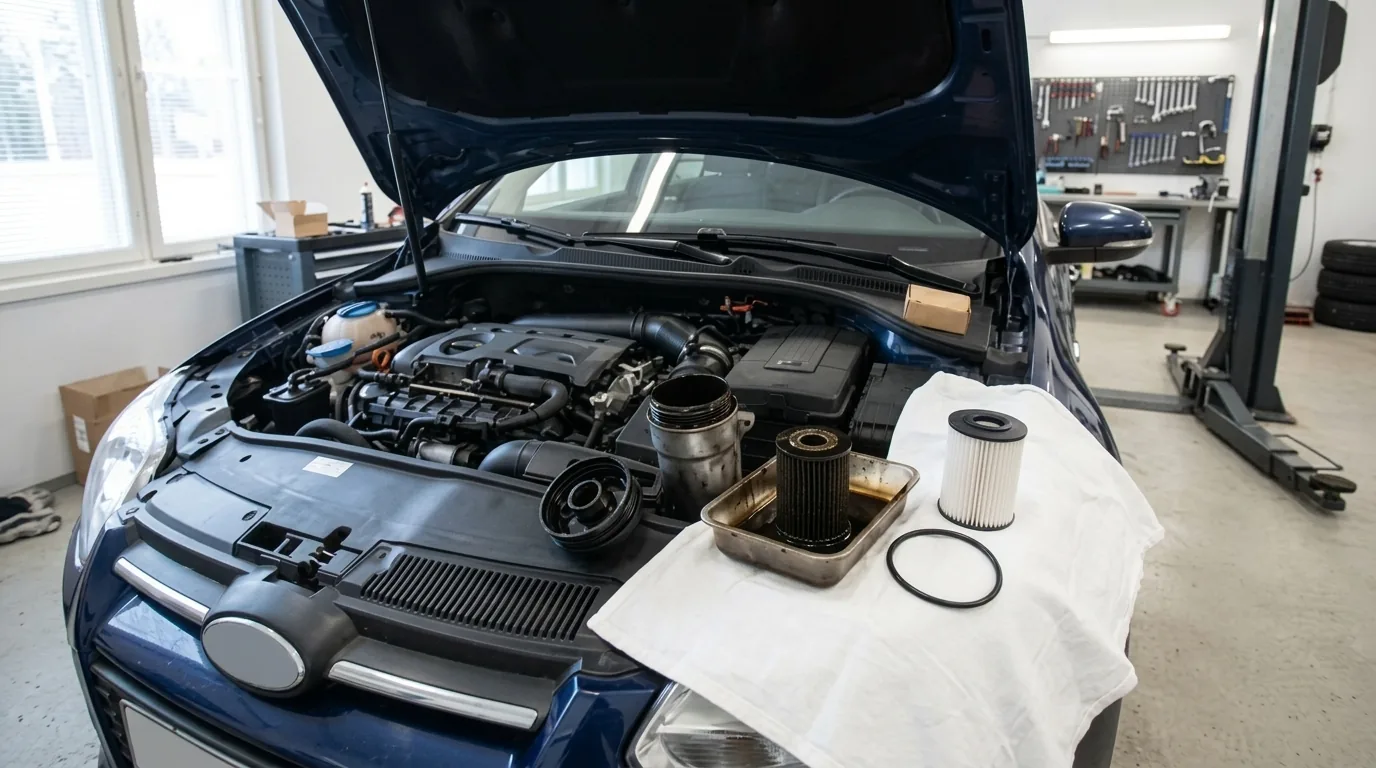
The fuel filter sits between the tank and the engine. It traps the dirt, rust and sediment carried in the fuel before they reach the injection system. On a diesel car the filter also separates water from the fuel, and the water collects at the bottom of the filter housing.
On a diesel engine the filter is especially important. A modern diesel's injection system works at very high pressure, and the parts of the high-pressure pump and the injectors are made to tight tolerances. Even a small amount of dirt wears them. The fuel also lubricates the high-pressure pump, so water weakens the lubrication and rusts the parts from the inside. Replacing the filter is a small job compared with replacing a high-pressure pump or injectors.
On a petrol car the filter is either outside the tank or inside it. On older cars the filter is in the fuel line under the car or in the engine bay, and it is replaced according to the service schedule. On many newer petrol cars the filter is inside the tank, as part of the pump unit. It is not usually replaced at a service at all. If it clogs, the pump unit has to be removed from the tank.
Read the full guide
How to recognise a clogging filter
A filter clogs gradually. The symptoms show first when the engine needs the most fuel. Book a time if you notice any of these:
- The engine jerks or loses power when accelerating, uphill or when towing a trailer.
- The dashboard shows a reduced engine power message, or the car goes into limp mode.
- The engine starts poorly, especially in frost, or stalls soon after starting.
- The idle is uneven, or the engine stalls by itself.
- The engine warning light comes on, and the fault memory holds a code about fuel pressure.
- A diesel car's dashboard warns of water in the fuel.
The fuel pump, the injectors and sensors can cause the same symptoms. On a diesel, poor cold starting can also come from the glow plugs. If the filter's interval is up or the last change is not known, it is worth replacing the filter first. If the symptom continues after the change, we find the cause with diagnostics.
When the filter is replaced
The interval is set by the car's manufacturer and written in the service schedule. On diesel cars it is usually 30 000 to 90 000 km, depending on the manufacturer. Some service schedules also set a time limit, typically 2 to 4 years, and the change is made at whichever comes first. On a petrol car with the filter outside the tank, the interval varies by manufacturer, and we check it from the car's data. For a filter inside the tank, many manufacturers give no interval at all.
It is worth replacing the filter before the interval is up if
- the tank has been run almost empty and the engine has started to jerk, because sediment may have been drawn up from the bottom of the tank
- water or poor-quality fuel has got into the tank
- the car's service history is not known, for example on a used diesel you have just bought.
On a diesel car the change is worth making in the autumn if the interval is close. When the first frosts come, the tank may still hold diesel filled in the summer. In frost, wax crystals form in summer-grade diesel and can clog the filter, and an old filter or one holding water clogs more easily than a new one. The change can be made together with a scheduled service.
How the work is done
- We check from the car's data and service schedule where the filter is and which filter the car needs. We tell you the price before we start.
- On a petrol car we first release the pressure from the fuel system. Any fuel that runs out is collected in a container.
- We remove the old filter or filter element. On a diesel we drain the water and sediment from the filter housing at the same time and look at what kind of fuel comes out. If there is a lot of water or dirt, the tank needs checking too.
- We fit the new filter and new seals as the manufacturer instructs.
- We bleed the fuel system. On many diesels the electric lift pump bleeds the system when the ignition is switched on a few times. Older cars use the filter's hand primer, and on some cars the bleed is done with a diagnostic tool.
- We start the engine, check the connections for leaks and read the fault memory. Finally we road test the car and make an entry in the service book.
How long it takes
On most cars the change itself takes 15 to 45 minutes. A filter in the engine bay is the quickest. Changing a filter under the car and bleeding a diesel take more time, and connectors seized by rust make the job longer. Replacing a filter inside the tank is a different job. How long it takes depends on whether the pump can be reached from under the rear seat or the tank has to be lowered.
What the price depends on
The price of a fuel filter replacement varies from car to car. It depends on:
- The engine. A diesel filter usually costs more than a petrol car's, because it also separates water. If a heater or a water sensor is part of the filter, the price rises further.
- The type of filter. On some cars only the filter element is replaced in its housing, on others the whole filter with its housing.
- The location. Replacing a filter under the car takes longer than one in the engine bay.
- The bleed. Bleeding a diesel adds time, especially if the tank has been run empty and air has got into the system.
- Other faults. Rusted connectors, brittle fuel hoses or a tank with water in it add work.
- The parts. Original and aftermarket parts differ in price. We tell you which filter we use.
So we check the car and tell you the price before the work starts.
The fuel filter and the inspection
The fuel filter is not an inspection item of its own, but it can affect the inspection in two ways. The first is leaks. The inspector checks for leaks visually. In Traficom's inspection regulation, a fluid leak that forms drops gets a repair notice, one that drips continuously is grounds for rejection, and one that is a fire hazard leads to a driving ban. The fuel tank and lines also have an inspection item of their own, where a leak leads to a rejection or a repair notice. In the 2025 statistics, fuel leaks accounted for 1 543 rejecting faults and 459 repair notices, so a fuel leak most often led to a rejection.
The second is the engine warning light. A clogged filter lowers the fuel pressure, and the engine control unit can store a fault code for it and light the warning light. On a diesel car first registered in 2007 or later, a fault reported by the warning light is grounds for rejection. On a diesel first registered in September 2016 or later, a code stored in the fault memory is enough for a rejection. On a petrol car first registered in 2001 or later, the grounds for rejection are a fault reported by the warning light and certain engine fault codes.
In the 2025 statistics, the on-board diagnostics system, OBD, accounted for 30 779 rejecting faults. The statistics do not say how many of them were caused by the fuel supply.
What you can check yourself
- The service book. Look in the service book or the service history to see when the filter was last replaced and whether it is part of the car's service schedule.
- Smell and damp. A smell of fuel around the car or damp at the filter and line connections can mean a leak.
- When the symptom appears. Write down any dashboard messages and when the symptom comes: at a cold start, with the engine warm, when accelerating or at idle. That helps us tell faults in the filter apart from faults in the pump and the injectors.
- Refuelling. Do not run the tank empty. If a diesel car stands a lot, make sure before the frosts that the tank holds winter-grade diesel.
Do not remove a diesel's filter or open its connections yourself if you do not know the car's bleeding procedure. If air gets into the system, the engine may not start, and long cranking strains the starter motor and the battery.
When not to drive the car
A car that jerks only slightly can usually be driven to the workshop. Do not keep driving if
- fuel is dripping under the car or the smell of fuel is strong
- the engine stalls repeatedly while driving or loses power in the middle of an overtake
- a diesel car shows the water warning and the engine starts to run unevenly.
A fuel leak is a fire hazard, and the car should not be started. Have it towed to the workshop. If the water warning comes on and the engine still runs normally, drive the shortest way to the workshop and avoid heavy load, because water can damage the high-pressure pump and the injectors. Call us and we will agree a time.
If something else needs fixing
We do not start work you do not know about. If the car needs something else fixed, we call and tell you what the extra work costs and what happens if it is left undone. You decide.
Once we have seen the car, we tell you the price and whether it is a fixed price, a maximum price or an estimate. The work starts only once you have accepted the price.
We work to the motor vehicle service and repair terms approved by the consumer advisory board of the Finnish motor trade.


Shall we agree a time?
Leave a booking request online or call. We confirm the time and tell you the price before any work starts.
typical price range
80–
We tell you the exact price for your car before the work starts.
- Address
- Lampputie 12 C 67
00750 HelsinkiShow on the map - Opening hours
- Mon–Fri8.00–18.00Sat9.00–15.00Sunclosed
- Phone
- 045 262 5950
- huolto@caron.fi