
Automatic gearbox oil change
We change automatic and manual gearbox oil to the manufacturer's instructions, whatever the make. An automatic gearbox oil change usually takes 1 to 2 hours. We tell you the price before the work starts.
typical price range
230–
We tell you the exact price for your car before the work starts.
- Prices include VAT
- 25,5 %
- Gearbox oil that meets the manufacturer's requirements
- The old oil drained and the new oil filled
- Oil level checked at the right temperature, with a diagnostic tool where needed
How it works
Call us or drop in
Give us the registration. We confirm the price and agree a time in the same call.
We do the work
You get the car back at the time we agreed.
You pay the agreed price
No surprises on the invoice. If we find anything else, we call before we touch it.
What the price includes
What the price includes
- Gearbox oil that meets the manufacturer's requirements
- The old oil drained and the new oil filled
- Oil level checked at the right temperature, with a diagnostic tool where needed
- New seals on the drain and fill plugs
- The gearbox fault memory read before and after the work
- Leak check on the lift and a road test
- Disposal of the old oil and an entry in the service book
What the price does not include
- The filter or strainer, the sump gasket and the labour to replace them, where the gearbox has a replaceable filter. We tell you the price before the work.
- Flushing the gearbox with a machine, or a second oil change after a short drive. Those are priced separately.
- Repairing a leak, if the check finds a seal that leaks.
- Oil for a separate differential or transfer case, for example on four-wheel-drive and rear-wheel-drive cars. Those are changed and priced separately.
- Gearbox repair and software updates, if the fault memory points to a mechanical or electrical fault.
About this work in detail
In a conventional automatic gearbox the oil does far more than lubricate. It carries the engine's power through the torque converter, works as the hydraulic fluid of the valve body, presses the clutches together as the gear changes and carries heat away from the gearbox. As the oil ages, its friction properties change and its lubricating ability weakens. It also collects wear particles from the clutches. Gear changes become slower and harsher, and the clutches wear faster.
In a manual gearbox the oil's job is simpler: it lubricates the gears, the bearings and the synchromesh. In many front-wheel-drive cars the same oil also lubricates the differential, which sits in the same casing as the gearbox.
Read the full guide
Automatic gearboxes come in many kinds
A conventional torque-converter automatic, a continuously variable CVT and a dual-clutch gearbox need different oils, and even within one type the requirements vary between manufacturers. Dual-clutch gearboxes come in two kinds: in a wet-clutch gearbox the clutches run in an oil bath, in a dry-clutch one they do not. On Volkswagen, Škoda and Seat the dual-clutch gearbox is known as DSG, on Audi as S tronic. The multitronic used on older Audi models, by contrast, is a CVT. The wrong oil can make a gearbox jerk and wear quickly, so we always choose the oil by the manufacturer's requirement, not by viscosity alone.
Symptoms that make a gearbox worth having checked
- The gear changes with a jolt or later than usual, especially when the car is cold.
- When you move the selector from P or N to D or R, the gear engages after a delay or with a thump.
- The engine revs rise but the car does not accelerate to match. The gearbox is then slipping.
- The car shudders under light acceleration at a particular speed.
- A gearbox warning light comes on or the gearbox stays in one gear. The latter usually means the gearbox has gone into its emergency mode.
- There is a reddish or brown oil stain under the car where it has been parked.
The symptoms can come from old oil or a low oil level, but also from worn clutches, a faulty valve body or the control unit's software. An oil change does not repair a mechanical fault. If there are symptoms already, we first read the fault memory, road test the car and tell you whether an oil change is likely to help or the fault lies elsewhere.
When the oil is changed
The manufacturer sets the interval, and the differences are far greater than for engine oil. In many automatic gearboxes the service schedule never changes the oil, because the manufacturer treats the fill as a lifetime fill meant to last the gearbox's whole life. In others a change is part of the schedule, and the interval depends on the make and the gearbox. On many Volkswagen and Škoda wet-clutch DSG gearboxes, for example, the oil and filter are changed every 60 000 km. If the service book gives a time limit as well as the distance, the change is made by whichever comes first.
A lifetime fill does not mean the oil never ages. Towing a trailer or a caravan and constant stop-and-go traffic raise the oil temperature and age it faster than steady main-road driving. Some manufacturers set a shorter interval for heavy use. So a change is worth considering on a lifetime-fill gearbox too, if the car has a high mileage or regularly tows a trailer.
Manual gearbox oil
Manual gearbox oil is under less strain, and in many cars the manufacturer treats it as a lifetime fill too. A change is due when the service book's interval comes up, or when the gearbox has leaked and the leak has been repaired. Sometimes new oil also helps when the gears are stiff to select on a frosty morning. Requirements vary a lot between manual gearboxes as well, so we look up the right oil grade in the manufacturer's data.
Does an oil change break an old gearbox
You often hear that an oil change breaks an old automatic gearbox that has gone a long time without service. Often what lies behind it is that the oil was changed only once the gearbox was already showing symptoms. A badly worn gearbox can fail soon after the change, but the wear had happened before it. If the gearbox already has symptoms, we tell you plainly before the work whether they point to a mechanical fault. An oil change is then not worth doing in the hope of a repair.
How the work is done
- We ask what symptoms the car has had, and read the gearbox fault memory.
- We drive the car onto the lift and check whether the gearbox or drive shaft seals are leaking.
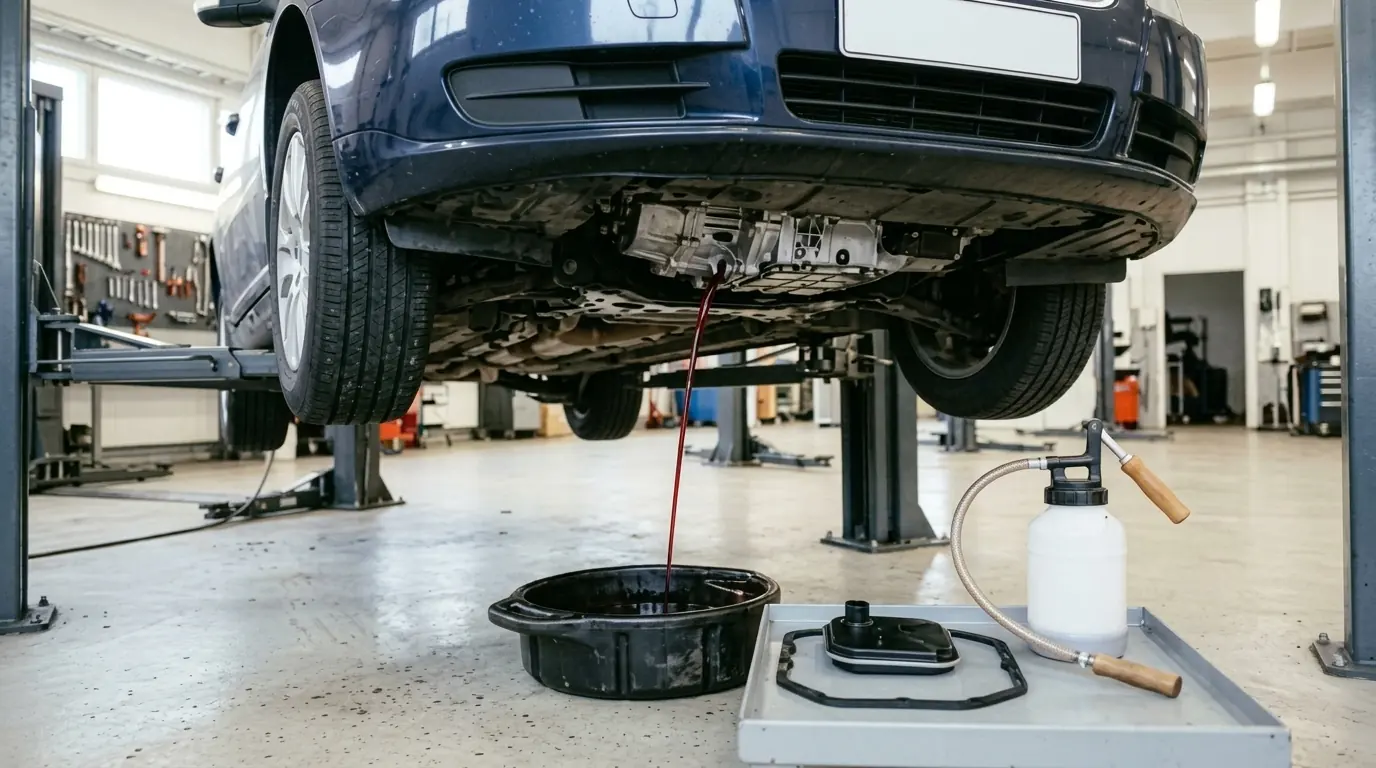
- We drain the old oil from the drain plug or through the sump. If the gearbox has a replaceable filter or strainer, we remove the sump and replace the filter.
- We fill the new oil. Many current gearboxes have no dipstick: the level is checked at the check plug with the engine running, once the oil is at the temperature the manufacturer sets. We read the temperature with a diagnostic tool.
- We road test the car, read the fault memory again, check the plugs and the level once more, and record the work in the service book.
Draining the oil from the plug does not replace all of it. Some stays in the torque converter, the oil cooler and the lines, and depending on the gearbox usually half or less is replaced at once. With very old oil the change can be done twice with a short drive in between, or the gearbox can be flushed with a machine. Those are separate jobs and not part of this price.
How long it takes
An automatic gearbox oil change usually takes 1 to 2 hours. Much of that goes on replacing the filter, where the gearbox has one, and on checking the level at the right temperature. If the car arrives hot after a long drive, on some gearboxes the oil first has to cool, because the level check starts from cool oil. A manual gearbox oil change is quicker, about an hour's work. The car is usually ready the same day.
What the price depends on
The price varies from car to car more than for an engine oil change. It depends on:
- The oil grade and amount. Gearbox oil is often specific to the manufacturer, and the fill quantity varies by gearbox.
- The filter. Some gearboxes have a replaceable filter or strainer, some do not. On some the filter is part of a plastic sump, and the whole sump is replaced.
- The check method. A level check with a diagnostic tool at the right temperature takes longer than a check with a dipstick.
- Access and plugs. Underbody covers, four-wheel drive and where the plugs sit affect the time. A rusted-in or rounded plug can add time.
We check the car and tell you the price before the work starts. If we find a leak or another fault in the gearbox, we tell you about it and the price of the repair separately before we go on.
Gearbox oil and the inspection
The inspection does not check when the gearbox oil was changed, but it does check for oil leaks. According to Traficom's statistics, oil leaks led to 43 086 repair notices and 2 632 rejections in the 2025 inspections. The statistics do not say whether the oil came from the engine or the gearbox. With a repair notice the car still passes, but a leak is worth repairing before so much oil has gone that the gearbox suffers.
What you can check yourself
- Look in the service book or the electronic service history to see whether the gearbox oil has been changed and what interval the manufacturer gives.
- Look for oil stains where the car has been parked. Automatic gearbox oil is usually reddish or brown, manual gearbox oil thicker and strong-smelling.
- If the car has a gearbox dipstick, the handbook shows how to read the level and at what temperature. Opening an automatic gearbox's check plug yourself is not worth it, because the level can only be read correctly at the correct temperature.
- Write the symptoms down: whether the jolt comes cold or warm, in which gear and at what speed. It speeds up the diagnosis.
When not to drive the car
An occasional jolt as the gear changes is no reason to leave the car standing, but it is a reason to book a time. Do not drive any distance, however, if
- the gearbox slips so that the revs rise but the car does not accelerate
- oil is clearly dripping under the car or there is a burning smell from the gearbox
- there is rumbling or knocking from the gearbox, or a gear does not engage at all
- the warning light is on and the gearbox is in emergency mode.
Emergency mode gets you carefully to a safe place, but it is not meant for carrying on as normal. Driving on a slipping gearbox or one low on oil can turn an oil change into a gearbox rebuild. In that case the car is best towed to the workshop.
If something else needs fixing
We do not start work you do not know about. If the car needs something else fixed, we call and tell you what the extra work costs and what happens if it is left undone. You decide.
Once we have seen the car, we tell you the price and whether it is a fixed price, a maximum price or an estimate. The work starts only once you have accepted the price.
We work to the motor vehicle service and repair terms approved by the consumer advisory board of the Finnish motor trade.
Related work

Oil change
Up to 5 litres of oil to the manufacturer's specification, and the filter. Each further litre 15 €. We check the fluid levels and tyre pressures at the same time.
139 €
Scheduled service
The scope varies from car to car, so we tell you the price before the work starts.
approx. 189 €
Diagnostics
The first hour. We credit it against the repair if you have the work done here.
69 €
Shall we agree a time?
Leave a booking request online or call. We confirm the time and tell you the price before any work starts.
typical price range
230–
We tell you the exact price for your car before the work starts.
- Address
- Lampputie 12 C 67
00750 HelsinkiShow on the map - Opening hours
- Mon–Fri8.00–18.00Sat9.00–15.00Sunclosed
- Phone
- 045 262 5950
- huolto@caron.fi